
Constitution, governance, social justice and institutional analysis
Community Forest Resource Rights give eligible forest-dwelling communities a legal right to protect, regenerate, conserve and manage forests traditionally used by them. A 2025 controversy in Chhattisgarh showed why this right is not merely access to forest produce: it also changes who makes decisions about local forest governance.
On 15 May 2025, the Chhattisgarh Forest Department issued an advisory restricting other departments, NGOs and private organisations from working on Community Forest Resource Rights (CFRR) management until a model framework became available. After protests and administrative disagreement, the advisory and a 23 June corrigendum were withdrawn on 3 July 2025.
Chhattisgarh controversy: timeline
| Date | Development | Core issue |
|---|---|---|
| 15 May 2025 | Forest Department issued an interim advisory | Restricted outside involvement and described a central role for the department |
| 23 June 2025 | Corrigendum corrected the description of the department as “nodal agency” | Department said the phrase was a typographical error |
| 1–2 July 2025 | Protests were held in multiple tribal regions | Gram Sabhas and activists alleged dilution of statutory rights |
| 3 July 2025 | Both communications were withdrawn | State sought model plans and training guidance from Union ministries |
What exactly is a Community Forest Resource?
Under the Forest Rights Act (FRA), a community forest resource is customary common forest land within the traditional or customary boundaries of a village, including seasonal use by pastoral communities. Depending on actual customary use, it can include reserved forests, protected forests and protected areas.
Section 3(1)(i) recognises the community right to protect, regenerate, conserve or manage such a resource for sustainable use. The right is therefore different from individual title over a farm plot.
Do not confuse these three categories
| Category | What it covers | Primary beneficiary |
|---|---|---|
| Individual Forest Right | Land under eligible occupation for habitation or self-cultivation, subject to the Act | Individual or household |
| Community Rights | Rights such as grazing, fishing, access to water bodies and ownership or disposal of minor forest produce | Village community or eligible group |
| CFR management right | Authority and responsibility to protect, regenerate, conserve and manage customary common forest | Gram Sabha/community |
Why the Gram Sabha is central
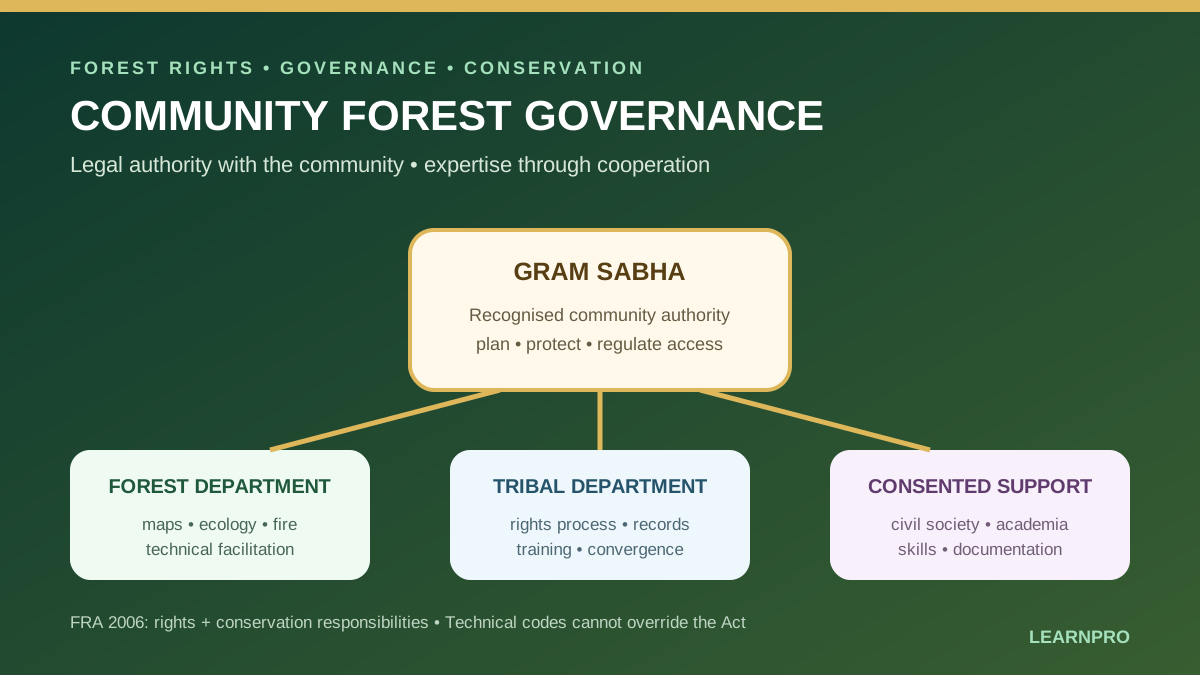
Section 6 makes the Gram Sabha the authority that begins the rights-recognition process by receiving and verifying claims and preparing a resolution. Sub-divisional and district-level committees examine the resolution through the statutory procedure; a Forest Department cannot replace that structure by an executive circular.
The amended FRA Rules also require the Gram Sabha to constitute a committee from among its members for protecting wildlife, forest and biodiversity. The committee may prepare a conservation and management plan for the community forest resource. That plan is to be integrated with the Forest Department’s working plan, with changes considered through the prescribed committee process.
Thus, community authority and scientific forestry are not legally opposite ideas. The challenge is to integrate technical evidence without turning consultation into departmental veto.
Rights come with conservation duties
Section 5 empowers forest-right holders and Gram Sabhas to:
- protect wildlife, forest and biodiversity;
- ensure that adjoining catchments, water sources and other ecologically sensitive areas are adequately protected;
- preserve habitat from destructive practices affecting cultural and natural heritage; and
- ensure that community decisions regulating access and stopping harmful activity are followed.
The FRA therefore does not grant an unrestricted right to commercially extract everything. It joins tenure security with a legally enforceable conservation role.
Why did the Forest Department issue the advisory?
The department said field implementation had become inconsistent because no common model showed how community-prepared plans should align with the National Working Plan Code, 2023. It argued that uncoordinated plans could create ecological and inter-departmental conflict.
Critics saw a different problem: the advisory barred government bodies, NGOs and private organisations from CFRR-related activity and appeared to place community forests under departmental control. Tribal groups argued that this inverted the FRA, under which the department provides maps, records and technical assistance while the Gram Sabha retains the statutory role.
What did withdrawal of the order mean?
Withdrawal removed the disputed May advisory and its corrigendum; it did not cancel recognised CFR titles. The state said it would seek model management plans, implementation guidelines and training modules from the Ministry of Tribal Affairs and the Ministry of Environment, Forest and Climate Change.
At the time, the state reported 4,349 CFRR titles covering 2,006,224 hectares and 478,641 individual titles. Because figures reported in some accounts varied, these should be read as the state’s announced administrative totals rather than as an independently audited measure of effective control on the ground.
FRA and the National Working Plan Code
| Instrument | Purpose | Legal relationship |
|---|---|---|
| Forest Rights Act, 2006 | Recognises rights and remedies historical injustice | Parliamentary law |
| FRA Rules | Set claim, committee and management procedures | Subordinate legislation under the Act |
| National Working Plan Code, 2023 | Provides a framework for scientific forest working plans | Administrative/technical framework; cannot override the Act |
| CFR management plan | Records community priorities, protection and sustainable use | Prepared through the Gram Sabha-linked process and coordinated with working plans |
The principle of hierarchy is important: a technical code can help implement a statute but cannot extinguish a right granted by Parliament.
Why CFRR matters for conservation and livelihoods
- Tenure security: communities have an incentive to protect resources when their authority is recognised.
- Local knowledge: residents understand seasonal water, fire, grazing and species patterns.
- Livelihoods: minor forest produce, grazing and other customary uses support household income and food security.
- Accountability: Gram Sabha decisions are visible to the people directly affected.
- Conflict reduction: mapped and recognised rights can reduce uncertainty between communities and agencies.
- Climate resilience: diverse forests and protected catchments strengthen adaptation.
Implementation problems
- CFR boundaries may overlap with working-plan compartments or neighbouring village claims.
- Gram Sabhas may lack maps, translated records and technical support.
- Recognition on paper may not transfer control over minor forest produce, transit permits or revenue.
- Women, pastoralists and particularly vulnerable tribal groups may be under-represented.
- Mining, plantations, wildlife management and compensatory afforestation can create competing claims.
- NGO support can be valuable, but it should be transparent and based on community consent.
A workable governance model
- Gram Sabha leadership: decisions begin with the recognised community institution.
- Joint evidence: satellite maps, cadastral records and local knowledge are reconciled openly.
- Technical facilitation: forest and tribal departments provide ecology, fire and inventory expertise.
- Consent-based assistance: civil-society or academic support follows Gram Sabha approval.
- Conflict resolution: neighbouring claims use a documented, appealable process.
- Public monitoring: plans, harvest rules, revenues and ecological indicators are disclosed locally.
For connected environmental governance themes, read LearnPro’s guides to agroforestry rules and tree felling and CITES and wildlife trade.
UPSC and State PSC relevance
Community Forest Resource Rights connect GS Paper II topics—tribal welfare, decentralisation and statutory rights—with GS Paper III topics such as forest conservation and sustainable livelihoods. An answer should distinguish recognition of rights from management planning and explain why a departmental guideline cannot override the FRA.
Mains practice question: Community forest governance can reconcile livelihood justice with biodiversity conservation only when legal authority and technical responsibility are clearly allocated. Discuss.
Conclusion
The Chhattisgarh episode was a dispute about institutional power, not simply a drafting error. Scientific management is necessary, but it must operate through the law’s community-centred architecture. The durable solution is a capable Gram Sabha supported by expert departments—not a choice between community rights and conservation.
Frequently asked questions
What are Community Forest Resource Rights?
They are rights under Section 3(1)(i) of the Forest Rights Act to protect, regenerate, conserve or manage customary community forest resources for sustainable use.
Who prepares a CFR management plan?
A committee constituted by the Gram Sabha under the FRA Rules can prepare the plan, which is coordinated with the Forest Department’s working plan through the prescribed process.
Did Chhattisgarh cancel CFR titles in July 2025?
No. The state withdrew the disputed advisory and corrigendum; recognised rights and titles were not cancelled by that withdrawal.
Can a working plan override the Forest Rights Act?
No. A technical or administrative code must be implemented consistently with the parliamentary statute and its rules.
Does CFRR permit unlimited forest extraction?
No. Rights are linked with duties to protect wildlife, biodiversity, catchments and cultural and natural heritage and to stop destructive practices.
Primary and authoritative references
Get course, notes, test-series and answer-writing guidance for UPSC and State PSC preparation.