
CITES at 50 years marks five decades since the Convention on International Trade in Endangered Species of Wild Fauna and Flora entered into force on 1 July 1975. Signed in Washington in 1973, CITES created a common permit system so international wildlife trade would be legal, sustainable and traceable rather than drive species toward extinction.
By 2025, the Convention had 185 Parties—184 countries and the European Union—and regulated international trade in more than 40,900 animal and plant species. India ratified CITES on 20 July 1976, and it entered into force for India on 18 October 1976. The fiftieth anniversary is useful for assessing both an important global institution and the enforcement gaps that illegal wildlife markets continue to exploit.
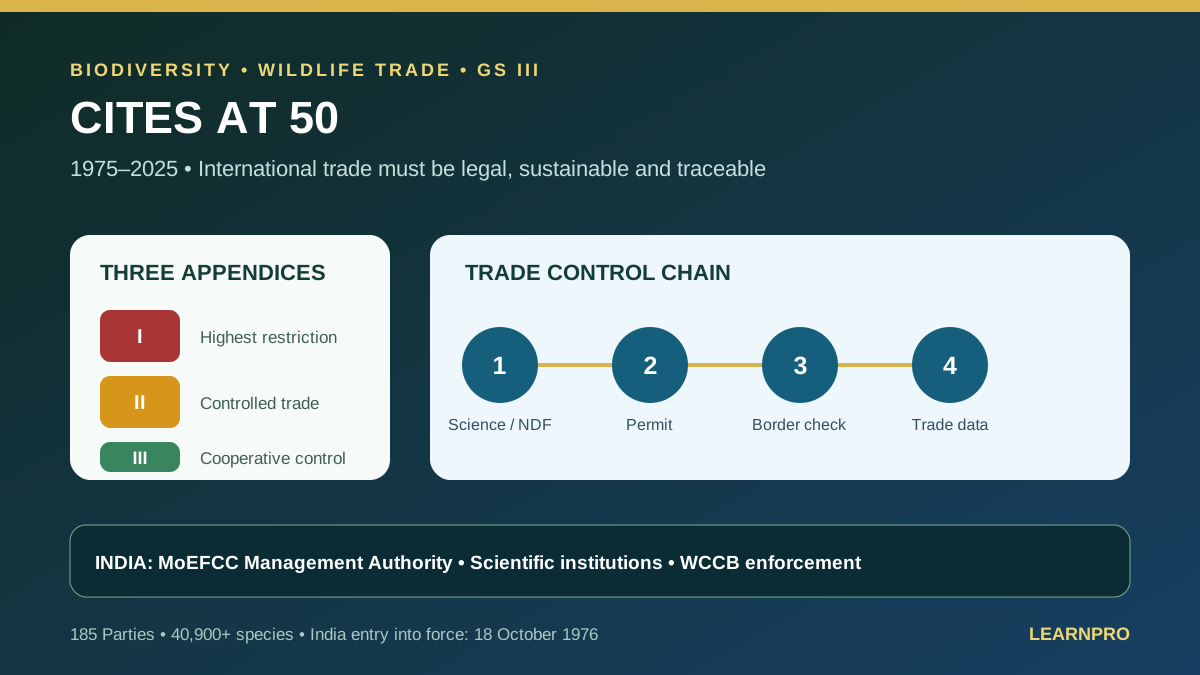
What does CITES regulate?
CITES regulates international trade in listed specimens. A specimen may be a live animal or plant, a dead specimen, a recognisable part, or a derivative such as skin, timber, medicine or a manufactured product. The Convention does not replace domestic wildlife law and does not directly protect habitats. Each Party must adopt national law, designate authorities and enforce permits at its borders.
CITES also does not ban all wildlife trade. It applies different levels of control depending on the conservation risk and the Appendix in which a species is listed.
The three CITES Appendices
| Appendix | Conservation position | Trade rule |
|---|---|---|
| Appendix I | Species threatened with extinction and affected or potentially affected by trade | International commercial trade is generally prohibited; exceptional non-commercial trade needs strict permits |
| Appendix II | Species not necessarily threatened now but that may become so without controlled trade; also look-alike species | Trade allowed under permits, including a scientific finding that export will not harm survival |
| Appendix III | Species protected in at least one country that asks other Parties for trade-control assistance | Certificates or permits help verify origin and legality |
Appendix II contains most listed species. Its core tool is the non-detriment finding (NDF): a Scientific Authority must be satisfied that export will not be detrimental to the species’ survival. A Management Authority then checks legality and issues the relevant document.
How the CITES permit chain works
- Identify the specimen: determine the species, Appendix, source and product type.
- Scientific assessment: where required, the Scientific Authority assesses whether the proposed export is sustainable.
- Legal-acquisition check: the Management Authority verifies that the specimen was obtained in accordance with national law.
- Issue permit or certificate: the document records species, quantity, purpose, source, exporter and destination.
- Border verification: customs and wildlife authorities inspect documents and, where necessary, the consignment.
- Report trade: Parties submit annual data that help identify trends and irregularities.
For Appendix I, an export permit and import permit are normally required, and commercial purposes face severe restriction. For Appendix II, an export permit is normally central, although domestic rules may be stricter. Re-export certificates cover specimens that were previously imported.
What has CITES achieved in 50 years?
- Common legal language: Parties use shared species listings, source codes and permit concepts.
- Trade transparency: a global trade database provides evidence on legal trade flows.
- Science in decisions: NDFs connect export volumes with species status and management.
- Compliance tools: Parties can face recommendations to suspend trade when implementation remains inadequate.
- Adaptive listings: the Conference of the Parties can add, remove or transfer species as evidence changes.
- Cooperation against crime: CITES works with INTERPOL, UNODC, the World Customs Organization and the World Bank through ICCWC.
The Convention’s importance lies not in stopping all use but in establishing that international demand must remain within ecological limits and a verified legal chain.
Why serious gaps remain
- Illegal laundering: wild-caught specimens may be falsely declared captive-bred or artificially propagated.
- Weak NDF capacity: many countries lack current population, harvest and trade data.
- Identification difficulty: processed timber, powders, medicines and online photographs can be hard to identify to species.
- Online markets: social media and parcel delivery let sellers reach buyers across borders quickly.
- Enforcement mismatch: criminal networks operate internationally while many agencies remain fragmented.
- Community exclusion: restrictions can fail if local people bear costs without livelihood benefits.
- Non-trade threats: habitat loss, pollution, invasive species and climate change fall beyond CITES’ main trade mandate.
CITES and India
India’s Ministry of Environment, Forest and Climate Change is the principal CITES Management Authority. Scientific Authorities include specialised institutions such as the Zoological Survey of India, Botanical Survey of India, Wildlife Institute of India and others. The Wildlife Crime Control Bureau is a central enforcement focal point.
The Wild Life (Protection) Amendment Act, 2022 strengthened domestic implementation by adding provisions for CITES-listed specimens, designating Management and Scientific Authorities and regulating possession, transfer and reporting for scheduled specimens. Customs law, foreign-trade controls and state wildlife enforcement also contribute.
India is both a range country for threatened species and a market/transit jurisdiction. Enforcement priorities include big-cat parts, pangolins, reptiles, birds, marine species, orchids, medicinal plants and valuable timber. Ports, airports, land borders and postal parcels all require risk-based checks.
India’s implementation priorities
- Digitise end-to-end permits with secure identifiers that customs can verify in real time.
- Strengthen scientific data for NDFs through population monitoring, harvest records and transparent methodologies.
- Improve forensic capacity using morphology, DNA, wood anatomy and chemical analysis.
- Target online trade through platform cooperation, financial intelligence and parcel-risk systems.
- Coordinate agencies across WCCB, customs, police, forest departments and prosecutors.
- Support communities with legal livelihoods and benefit-sharing where sustainable use is allowed.
- Track case outcomes, not only seizures, because conviction and network disruption matter.
What happened in the anniversary year?
The 78th meeting of the CITES Standing Committee took place in Geneva in February 2025 and reviewed issues including trade sustainability, compliance and wildlife crime. CITES CoP20 was held in Samarkand, Uzbekistan, from 24 November to 5 December 2025—the first CITES Conference of the Parties hosted in Central Asia. A CoP considers species-listing proposals, implementation rules, compliance, budgets and future work.
Anniversary rhetoric should not be confused with performance. The useful questions are whether listed populations are stable, legal trade remains within biological limits, seizures lead to prosecutions, and local communities receive fair benefits.
CITES, CBD and domestic conservation
CITES and the Convention on Biological Diversity are complementary. CITES focuses on international wildlife trade; the CBD addresses biodiversity conservation, sustainable use and benefit-sharing more broadly. India’s domestic laws protect species and habitats, while CITES controls cross-border movement of listed specimens.
For the wider biodiversity context, see LearnPro’s explainer on the global biodiversity framework and the related analysis of agroforestry and legal timber traceability.
Policy framework for the next decade
| Problem | Priority solution |
|---|---|
| Paper fraud | Interoperable electronic permits and border validation |
| Data-poor NDFs | Published methods, precautionary quotas and independent review |
| Online trafficking | Platform duties, financial tracing and cross-border investigation |
| Weak prosecutions | Specialist investigators, prosecutors and forensic chains of custody |
| Livelihood conflict | Community participation, legal value chains and benefit-sharing |
| Multiple threats | Connect trade controls with habitat, climate and pollution policy |
UPSC and State PSC relevance
CITES at 50 years is relevant to GS Paper II international agreements and GS Paper III biodiversity, wildlife crime and environmental governance. In an answer, explain the three Appendices, the NDF-permit chain, India’s 2022 legal amendment and the limits of a trade-focused convention.
Mains practice question: CITES has built a global system for regulating wildlife trade, but permits alone cannot conserve species. Evaluate its achievements, limitations and India’s implementation priorities after 50 years.
Conclusion
CITES has endured because it combines science, permits, trade records and international cooperation. Its next phase must respond to e-commerce, sophisticated laundering and ecological change while protecting legitimate livelihoods. The test is not how many species are listed, but whether trade remains legal, sustainable and traceable in practice.
Frequently asked questions
When did CITES enter into force?
CITES entered into force on 1 July 1975, making 2025 its fiftieth year of implementation.
Does CITES ban all wildlife trade?
No. It prohibits or strictly restricts some trade and regulates other trade through permits according to the species’ Appendix.
What is a non-detriment finding?
It is a scientific determination that a proposed export will not harm the survival of the species in the wild.
When did CITES enter into force for India?
India ratified it on 20 July 1976, and it entered into force for India on 18 October 1976.
What is the difference between CITES and the CBD?
CITES focuses on international trade in listed wildlife, while the CBD covers biodiversity conservation, sustainable use and benefit-sharing more broadly.
Primary references and official databases
- CITES Secretariat: what is CITES?
- CITES Secretariat: the three Appendices
- CITES country profile: India
- CITES CoP20: Samarkand, 2025
- CITES Trade Database





Sources and further reading
- CITES Secretariat: what is CITES?cites.org
- CITES Secretariat: the three Appendicescites.org
- CITES country profile: Indiacites.org
- CITES CoP20: Samarkand, 2025cites.org
- CITES Trade Databasetrade.cites.org