TREM V emission norms are India’s proposed stricter standards for pollutant emissions from agricultural tractors and related non-road machinery. They regulate carbon monoxide (CO), hydrocarbons (HC), nitrogen oxides (NOx), particulate matter (PM) and, for specified engine classes, particle number (PN). A February 2026 draft notification proposes a phased timetable rather than applying Stage V to every tractor at once.
UPSC relevance: GS Paper III—environmental pollution, farm mechanisation, technology and regulatory governance; Prelims—CMVR, TREM stages and non-road engines. Focus keyword: TREM V emission norms.
What is the current status of TREM V emission norms?
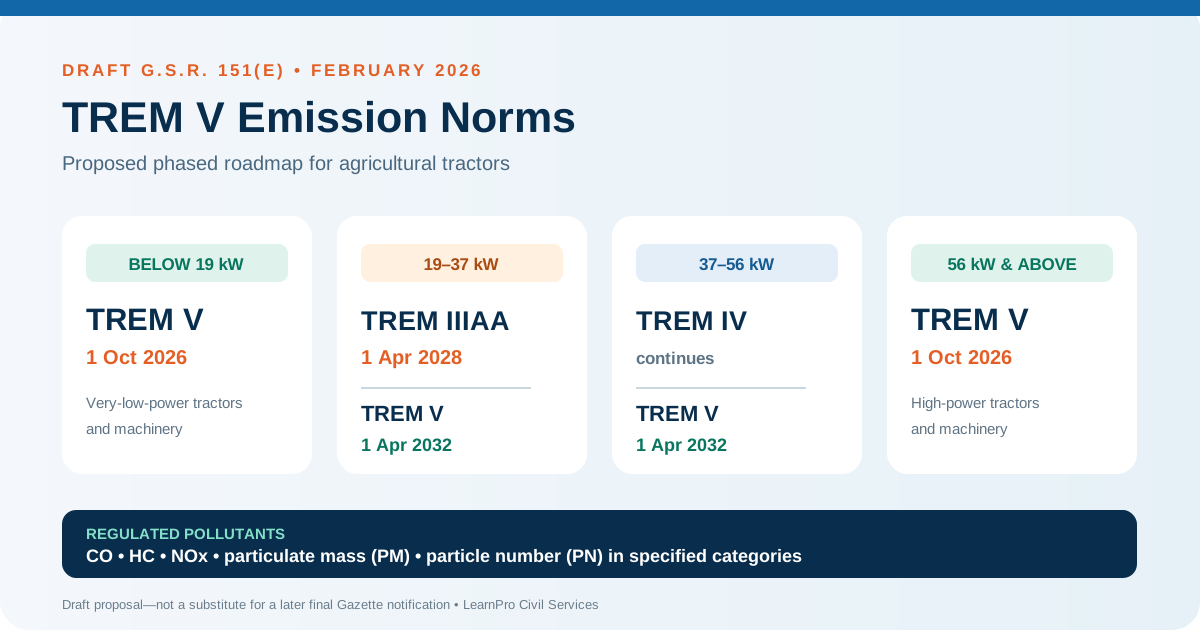
The legal position needs careful wording. Earlier rules scheduled TREM V from 1 April 2026. However, the Ministry of Road Transport and Highways published draft G.S.R. 151(E) on 27 February 2026 proposing a new phased path. The draft invited objections and stated that the rules would operate after final publication. Therefore, candidates should call the timetable below a 2026 draft proposal unless citing a later final Gazette notification.
What does TREM mean?
TREM refers to emission standards for agricultural tractors. These machines operate off-road and have different duty cycles from cars and trucks: slow high-load work, dust exposure, seasonal use, puddling and long periods at relatively steady engine speed. India separated tractor standards from construction-equipment vehicle standards through amendments to the Central Motor Vehicles Rules, 1989 (CMVR).
TREM standards apply at manufacture and type approval. They are not a ban on all older tractors already in use. Applicable dates, power classes, registration windows and conformity-of-production rules determine compliance.
Proposed 2026 implementation timeline
| Engine power | Approximate tractor band | 2026 draft proposal |
|---|---|---|
| Below 19 kW | Below roughly 25 HP | TREM V from 1 October 2026 |
| 19 to below 37 kW | Roughly 25–50 HP | TREM IIIAA from 1 April 2028; TREM V from 1 April 2032 |
| 37 to below 56 kW | Roughly 50–75 HP | TREM IV continues; TREM V from 1 April 2032 |
| 56 kW and above | Above roughly 75 HP | TREM V from 1 October 2026 |
Power conversion is approximate because one metric horsepower is about 0.7355 kW. The notification’s legal categories are expressed in kilowatts, so an answer should preferably use kW boundaries.
Which pollutants are controlled?
- Carbon monoxide: produced by incomplete combustion; high exposure impairs oxygen delivery in the body.
- Hydrocarbons: unburnt or partly burnt fuel compounds that contribute to ozone and secondary pollution.
- Nitrogen oxides: formed at high combustion temperatures; they contribute to ozone, secondary particulate matter and respiratory harm.
- Particulate matter: soot and other fine particles from diesel exhaust; small particles can penetrate deep into the lungs.
- Particle number: counts particles rather than measuring only their mass. A PN limit addresses very small particles that may contribute little mass but remain numerous.
The draft’s TREM V table introduces a PN limit of 1 × 10¹² particles per kWh for several engine classes and tightens PM limits to 0.015 g/kWh in the 19–560 kW bands. These limits often require advanced after-treatment and better engine control.
What technology is needed?
| Technology | Main function | Operational issue |
|---|---|---|
| Diesel oxidation catalyst (DOC) | Oxidises CO and hydrocarbons | Performance depends on exhaust temperature |
| Diesel particulate filter (DPF) | Captures soot and reduces particle emissions | Needs regeneration; low-temperature or dusty duty cycles can complicate use |
| Selective catalytic reduction (SCR) | Uses urea solution to reduce NOx | Requires correct fluid quality, dosing and maintenance |
| Electronic engine control and sensors | Manage combustion and after-treatment | Adds diagnostic, repair and technician requirements |
The official explanatory note says field conditions such as puddling may create reliability and maintenance concerns for more complex systems. It estimated an upgrade cost of roughly ₹2–2.5 lakh for a move from TREM IIIA to TREM V and ₹60,000–₹1 lakh for a move from TREM IV to TREM V. These are policy estimates in the draft explanation, not a guaranteed retail-price increase.
Why has a phased approach been proposed?
- Affordability: small and medium tractors are central to Indian farming and custom-hiring services.
- Duty-cycle suitability: low exhaust temperatures can make filter regeneration and after-treatment more difficult.
- Repair ecosystem: electronics and sensors need trained technicians, diagnostics and reliable parts in rural areas.
- Industrial transition: manufacturers need time to redesign engines, validate durability and create compliant product families.
- Export alignment: stricter standards can help high- and low-power tractor exports meet advanced-market requirements.
The policy problem is a genuine trade-off: delay preserves near-term affordability but also delays cleaner rural engines. A good answer should not reduce it to “environment versus farmers”. Poor air quality also harms farmers, labourers and rural children.
Why do tractor emissions matter for rural air quality?
Air-pollution policy often focuses on large cities, but diesel engines operate close to drivers, farm workers and settlements. Tractors may also be used for haulage and stationary operations. Their emissions interact with road dust, biomass burning, crop-residue burning, household fuels and other sources.
TREM standards are therefore one part of a wider rural clean-air strategy. LearnPro’s primer on air pollution in India explains sources, health effects and control instruments.
How is compliance enforced?
The CMVR framework uses type approval before a model enters production and conformity of production to test whether production vehicles continue to meet the approved standard. AIS-137 provides testing procedures. The draft also deals with test cycles, reference fuels, onboard diagnostic requirements for specified categories, reagent-based NOx controls and conformity labels.
Effective regulation needs more than laboratory certification:
- independent and adequately equipped testing agencies;
- random in-use surveillance where legally provided;
- tamper-resistant software and after-treatment systems;
- availability of low-sulphur fuel and standard-compliant urea solution;
- repair information and technician training; and
- public disclosure of failures, recalls and corrective action.
A balanced policy design
- Finalise a predictable roadmap: publish the final rule, testing standard and transition provisions early.
- Target support, not dilution: use credit guarantees, scrappage incentives or custom-hiring support for vulnerable users rather than weakening emission measurement.
- Build rural service capacity: train technicians and ensure filters, sensors and reagents are available beyond major cities.
- Measure real-world performance: study field duty cycles, regeneration failures and tampering, then update standards transparently.
- Integrate mechanisation policy: promote efficient equipment use, shared machinery and lower-emission alternatives where technically suitable.
UPSC answer framework
Define TREM as non-road tractor emission standards under CMVR. State that G.S.R. 151(E) is a draft February 2026 proposal, then reproduce the phased power-band timeline. Explain PM, PN and NOx control, followed by the affordability, repair and implementation trade-offs. Conclude with predictable standards, targeted farmer support and strong compliance.
Probable question: “Phased tractor-emission standards illustrate the difficulty of reconciling environmental regulation with farm mechanisation.” Examine.
Conclusion
TREM V emission norms can substantially reduce pollution from new tractor engines, especially fine particles. The 2026 draft recognises that India’s dominant farm-machinery segments face cost and reliability constraints and therefore proposes staged compliance. The best policy is neither indefinite delay nor abrupt implementation: it is a final, credible timetable supported by testing, rural maintenance capacity and targeted affordability measures.
Frequently asked questions
What is TREM V?
TREM V is a stricter stage of Indian emission standards for agricultural tractor engines and specified related machinery, controlling CO, hydrocarbons, NOx, particulate mass and, in relevant categories, particle number.
Are TREM V norms final for every tractor from October 2026?
The February 2026 document is a draft proposal. It proposes October 2026 for below-19 kW and above-56 kW categories, while the 19–56 kW bands move to full TREM V in 2032.
What is TREM IIIAA?
TREM IIIAA is a proposed interim stage for the 19–37 kW category from April 2028, with stricter limits than TREM IIIA but without the full Stage V PM and particle-number requirements.
What is the difference between PM and PN?
PM measures the mass of particulate matter emitted; PN counts the number of particles. A low mass can still include many very small particles.
Do the norms ban old tractors?
Emission stages primarily govern manufacture, type approval and registration of vehicles covered by the applicable dates. They do not automatically amount to a nationwide ban on all older tractors already registered.
Official sources
- MoRTH draft G.S.R. 151(E), 27 February 2026
- MoRTH/PIB note on separation and earlier TREM implementation dates
- Ministry of Road Transport and Highways: Central Motor Vehicles Rules