
Agroforestry rules in India seek to solve a practical contradiction: farmers are encouraged to grow trees, but uncertain felling and transit permissions can make those trees difficult to harvest and sell. In June 2025, the Ministry of Environment, Forest and Climate Change circulated Model Rules for Felling of Trees in Agricultural Lands to States and Union Territories.
The model framework uses the National Timber Management System (NTMS) for plantation registration, traceability, felling applications and transit documentation. Its broader purpose is to increase trees outside forests, strengthen farm income, reduce pressure on natural forests and develop a legal domestic timber market. Because land and many operational forestry rules involve states, implementation depends on state adoption and alignment.
What is agroforestry?
Agroforestry deliberately combines trees with crops, pasture or livestock on the same land-management unit. It is not the same as converting a natural forest into a plantation. A well-designed system retains agricultural production while adding tree products and ecological functions.
| System | Combination | Example benefit |
|---|---|---|
| Agrisilviculture | Trees + field crops | Timber, fruit, fodder, shade and diversified income |
| Silvopasture | Trees + pasture/livestock | Fodder, shelter and improved land productivity |
| Agrosilvopastoral | Trees + crops + livestock | Multiple outputs and risk spreading |
| Boundary plantation | Trees along field borders | Wind protection and timber with limited crop displacement |
Why did farmers need simpler rules?
Tree-growing decisions are long term. A farmer will plant commercial trees only if rules at harvest time are predictable. Different species lists, paper permits, repeated inspections and separate transit requirements across states create delay and price uncertainty. Traders may discount farm timber when its legal origin is hard to establish.
Over-regulation can therefore create a perverse incentive: farmers may avoid planting trees because they fear they will not be allowed to cut them later. Complete deregulation is also risky because timber from natural forests could be falsely shown as farm-grown. The policy goal is easy compliance with credible traceability.
Institutional structure under the model rules
The State Level Committee already constituted under the Wood-Based Industries (Establishment and Regulation) Guidelines, 2016 is proposed as the oversight body. Representatives of agriculture and revenue departments are added because plantation verification involves land records and farm systems, not the forest department alone.
The committee is expected to:
- advise the state on agroforestry promotion and timber production;
- recommend simpler felling and transit procedures;
- empanel agencies to verify applications and timber movement;
- monitor implementation and address misuse; and
- connect tree production with wood-based industries and markets.
How the NTMS process works
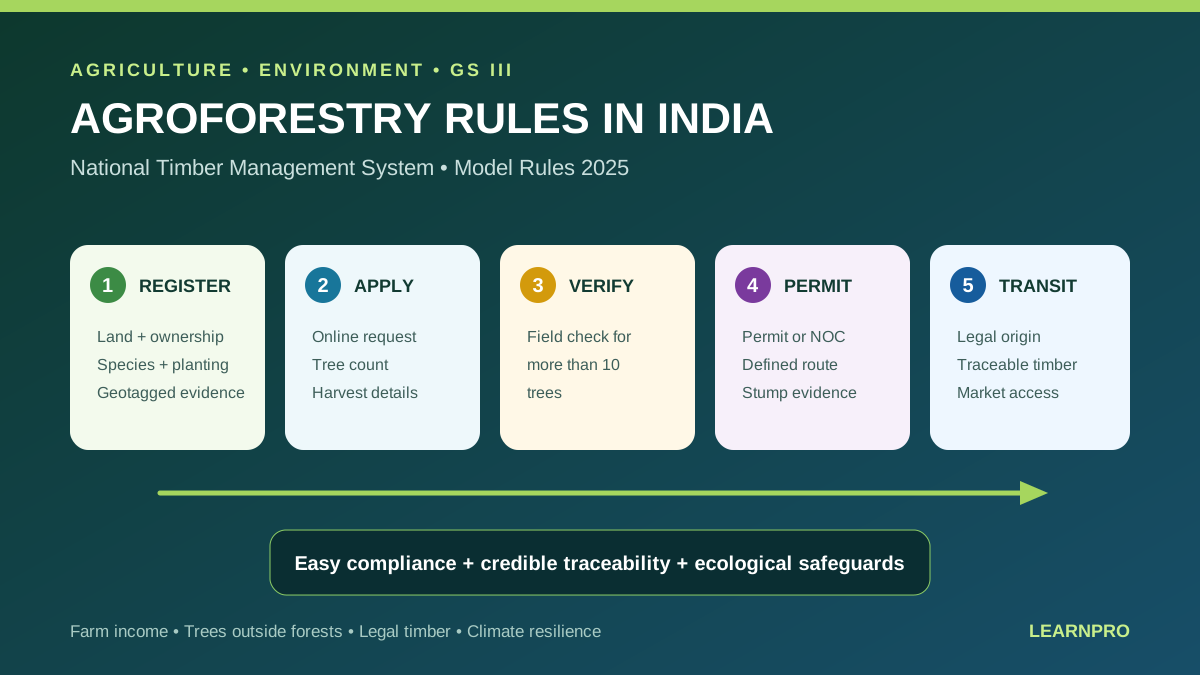
- Register the land: the applicant records ownership and location details on the National Timber Management System.
- Record the plantation: species, planting date, number of saplings and geospatial information are uploaded with geotagged photographs.
- Update growth: periodic evidence helps distinguish a registered farm plantation from timber of uncertain origin.
- Apply before felling: the applicant uses the portal when the trees are ready for harvest.
- Verification where required: an empanelled agency checks the land, trees and estimated timber.
- Issue document: the competent authority provides a permit or system-generated NOC under the applicable route.
- Track transit: legal documentation follows the timber from farm to buyer or processing unit.
Difference between up to 10 and more than 10 trees
| Proposed route | Procedure | Control |
|---|---|---|
| 10 trees or fewer | Upload photographs; a NOC may be generated through the portal | Post-felling stump photographs and possible official verification |
| More than 10 trees | Online application followed by field verification | Empanelled agency report and permit based on verified details |
The Divisional Forest Officer supervises verifying agencies and reports performance to the State Level Committee. This separation can reduce routine workload, but only if agencies are trained, audited and protected from conflicts of interest.
How the framework can benefit farmers
- income diversification: timber, bamboo, fruit, fodder and other tree products can supplement seasonal crop income;
- risk management: trees may provide an asset during crop failure, although market and weather risks remain;
- lower transaction costs: online registration and defined timelines can reduce repeated visits to offices;
- better market access: traceability can help buyers and exporters verify legal origin;
- soil and water benefits: suitable species can improve organic matter, reduce erosion and support moisture management; and
- climate resilience: trees store carbon, reduce heat and protect fields from wind.
Environmental benefits—and important cautions
Agroforestry can expand tree cover outside recorded forests and reduce harvesting pressure on natural forests. It can create habitat links and improve soil structure. These gains are not automatic. Dense monocultures of fast-growing exotic species may deplete water, simplify biodiversity or compete with crops. Poorly timed harvesting can leave soil exposed.
Policy should reward right tree, right place, right purpose. Native and multipurpose species, mixed systems, local water balance and farmer knowledge should guide design. Tree cover on farms cannot replace the ecological complexity or legal protection of natural forests.
Legal and federal issues
The Centre’s document is a model for states, not a single self-executing nationwide permit code. States have different tree-preservation laws, exempt-species lists, land records and transit rules. A farmer must follow the rules actually adopted in the relevant state.
The Indian Forest Act, state laws, forest-conservation rules and protections for scheduled species may apply in different situations. The 2017 amendment excluding bamboo grown outside forests from the Indian Forest Act definition of “tree” simplified one important farm product, but state transit or other requirements can still matter.
Implementation risks
- digital exclusion: small farmers may lack smartphones, geospatial files or reliable connectivity;
- land-record mismatch: tenancy, joint titles and outdated records can block registration;
- false declaration: natural-forest timber could be laundered through farm documents;
- verification capture: private agencies may create a new layer of rent-seeking if fees and audits are unclear;
- market risk: a permit does not guarantee a fair price or buyer;
- species mismatch: commercial promotion without ecological advice may harm water or soil; and
- state fragmentation: inconsistent adoption can continue to obstruct interstate timber movement.
A farmer-centred implementation roadmap
- provide assisted registration at panchayats, common service centres and agriculture offices;
- publish state-wise species, permit, fee and transit rules in simple language;
- integrate NTMS with consent-based land records without excluding tenants and joint holders;
- set service timelines and an appeal mechanism;
- audit verification agencies using random physical checks and remote sensing;
- link farmers with nurseries, extension advice, producer groups, insurance and transparent price information; and
- measure survival, soil, water and income outcomes rather than registrations alone.
Agroforestry also links with crop-residue and rural-energy policy. See LearnPro’s guide to the MNRE biomass programme and the review of agriculture and allied-sector output.
UPSC and State PSC relevance
Agroforestry rules in India fit GS Paper III topics: agriculture, farmers’ income, environmental conservation, climate action and digital governance. A strong answer should explain the regulatory contradiction, the NTMS workflow, federal implementation and safeguards against timber laundering.
Mains practice question: Simplifying tree-felling rules can promote agroforestry, but weak traceability may harm natural forests. Discuss the design and implementation of India’s 2025 model rules.
Conclusion
The model rules address a real barrier by making the legal harvest of farm trees more predictable. Their success will depend on state adoption, assisted access, trustworthy verification and viable markets. Regulation should make planting attractive while keeping illegal forest timber out of the supply chain.
Frequently asked questions
What are the 2025 model agroforestry rules?
They are a central model for states to simplify registration, felling and transit of trees grown on agricultural land.
What is NTMS?
The National Timber Management System is the proposed digital platform for registering farm plantations, applying for felling permission and tracing timber.
What happens when a farmer wants to cut more than 10 trees?
The model process requires an online application, field verification by an empanelled agency and a permit based on the report.
Do the model rules automatically apply in every state?
No. State adoption and alignment with existing state laws and transit rules are necessary.
Can agroforestry replace natural forests?
No. Farm-tree systems can supply timber and ecological services, but they do not reproduce the biodiversity and functions of natural forests.
Primary references and further reading
- Akashvani: Government model rules and NTMS
- Government of India: National Agroforestry Policy 2014
- Ministry of Environment, Forest and Climate Change
- NITI Aayog: Greening and Restoration of Wasteland with Agroforestry
- Forest Survey of India: India State of Forest Report





Sources and further reading
- Akashvani: Government model rules and NTMSnewsonair.gov.in
- Government of India: National Agroforestry Policy 2014agriwelfare.gov.in
- Ministry of Environment, Forest and Climate Changemoef.gov.in
- NITI Aayog: Greening and Restoration of Wasteland with Agroforestryniti.gov.in
- Forest Survey of India: India State of Forest Reportfsi.nic.in