Decarbonisation in India is the process of reducing greenhouse-gas emissions while expanding electricity, industry, transport, housing and jobs. India’s goal is net-zero emissions by 2070, supported by 2030 targets for lower emissions intensity and a larger non-fossil power system. The challenge is not simply to add solar panels; it is to redesign grids, industrial processes, finance and institutions without slowing development.
UPSC relevance: GS Paper III—environment, energy, infrastructure, industry and inclusive growth; Essay—climate justice and development. Focus keyword: decarbonisation in India.
Why is decarbonisation in India in the news?
India crossed the halfway mark in the share of non-fossil sources in installed electricity capacity during 2025. By 31 March 2026, the government reported 283.46 GW of non-fossil capacity: 274.68 GW of renewables, including large hydro, and 8.78 GW of nuclear power. Solar alone accounted for 150.26 GW.
This is an important capacity milestone, but installed capacity is not the same as electricity generated. Solar and wind output varies with weather and time of day. Coal plants can therefore remain important for balancing even when their share of capacity falls. The next phase of decarbonisation in India depends on storage, flexible generation, transmission and demand management.
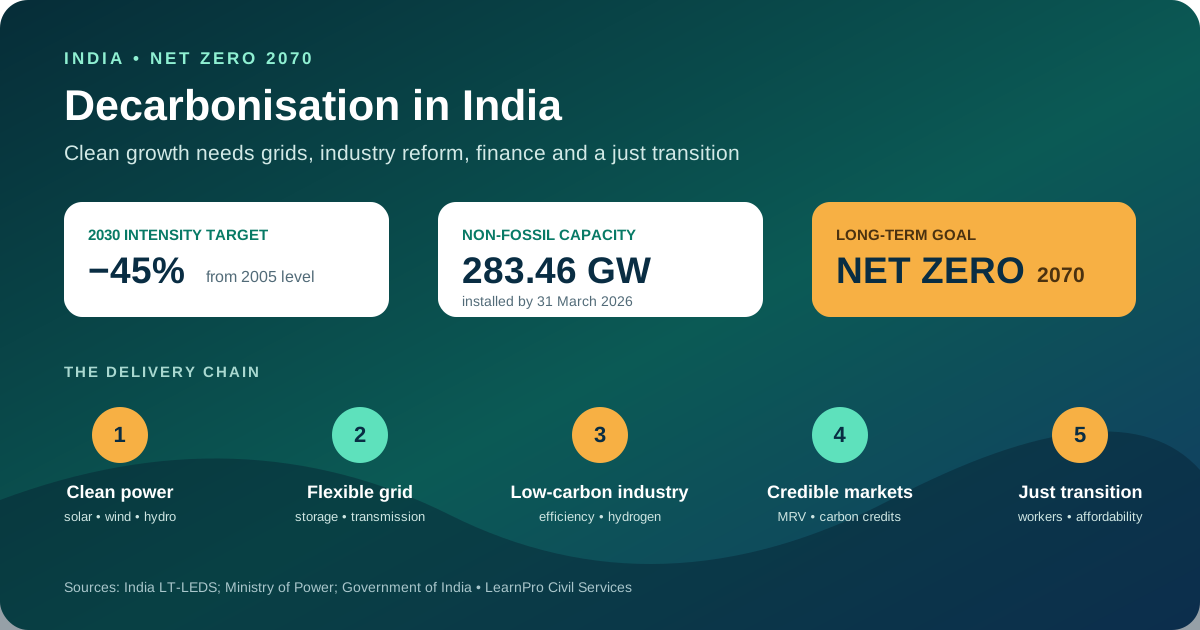
India’s climate targets at a glance
| Commitment | Target year | What it means |
|---|---|---|
| Reduce emissions intensity of GDP by 45% from the 2005 level | 2030 | Produce each unit of GDP with fewer emissions; it is not an absolute emissions cap. |
| About 50% of cumulative installed electricity capacity from non-fossil sources | 2030 | A capacity-share target covering renewables, hydro and nuclear. |
| Create an additional carbon sink of 2.5–3 billion tonnes of CO₂ equivalent through forest and tree cover | 2030 | Increase removals, subject to land, ecology and measurement safeguards. |
| Net-zero greenhouse-gas emissions | 2070 | Balance remaining human-caused emissions with durable removals. |
Net zero is not zero emissions. Some residual emissions may remain in hard-to-abate activities, but they must be balanced by removals. Emissions intensity is also different from absolute emissions: intensity can fall while total emissions rise if the economy grows faster.
What does India’s long-term strategy propose?
India’s Long-Term Low-Emission Development Strategy (LT-LEDS), submitted in 2022, identifies seven broad transitions:
- low-carbon development of electricity systems consistent with development;
- an integrated, efficient and inclusive transport system;
- adaptation in urban design, buildings and sustainable urbanisation;
- economy-wide decoupling of growth from emissions;
- development of a low-emission industrial system;
- carbon-dioxide removal and related engineering solutions; and
- enhancement of forest and vegetation cover.
The strategy is deliberately developmental. India has low historical responsibility and still needs energy for productive employment and basic services. Climate justice therefore requires domestic reform as well as predictable international finance and technology.
The power system: capacity is only the first step
Renewable power can reduce fuel imports and operating emissions, but high shares of variable solar and wind create a system-integration problem. Four reforms are central:
- Transmission: new interstate and intrastate lines must connect resource-rich regions with demand centres.
- Storage: batteries and pumped storage shift electricity across hours and support grid stability.
- Flexible demand and generation: time-of-day tariffs, smart metering, hydro and flexible thermal operation help match supply and demand.
- Distribution reform: financially weak DISCOMs struggle to sign bankable contracts, invest in networks and pay generators on time.
LearnPro’s analysis of DISCOM reform and renewable integration explains why grid economics matters as much as generation capacity.
How can hard-to-abate industry decarbonise?
Steel, cement, fertiliser, refineries and chemicals require high-temperature heat or process reactions that cannot always be electrified directly. Their transition uses several levers:
- energy and material efficiency, including efficient kilns, motors, waste-heat recovery and better product design;
- circularity, such as more scrap-based steel and reduced clinker content in cement;
- renewable electricity for processes that can be electrified;
- green hydrogen and green ammonia where direct electrification is difficult;
- carbon capture, utilisation and storage for selected residual process emissions, after lower-cost reductions; and
- standards and public procurement that create demand for low-carbon steel, cement and fertiliser.
For the role and limits of hydrogen, see green hydrogen in India’s energy transition.
How will India’s carbon market work?
The Ministry of Power notified the Carbon Credit Trading Scheme (CCTS), 2023 under the Energy Conservation Act. The framework has two parts:
| Mechanism | Who participates? | Basic logic |
|---|---|---|
| Compliance mechanism | Obligated entities in energy-intensive sectors | Facilities receive greenhouse-gas emissions-intensity targets. Outperformance can generate certificates; underperformance requires certificates to be purchased or surrendered as prescribed. |
| Offset mechanism | Non-obligated entities with eligible projects | Verified emission reductions, avoidance or removals may earn carbon-credit certificates under approved methodologies. |
Official statements indicate compliance trading is expected to begin in 2026–27. Covered sectors include aluminium, cement, chlor-alkali, fertiliser, iron and steel, petrochemicals, petroleum refining, pulp and paper and textiles.
A credible market needs accurate baselines, additional reductions, independent verification, a registry that prevents double counting and penalties strong enough to support the price signal. Weak credits can create the appearance of action without real decarbonisation. LearnPro’s note on safeguards for India’s carbon market examines these integrity risks.
Transport, buildings and cities
Electric vehicles reduce oil use and urban tailpipe pollution, but their climate benefit improves as the grid becomes cleaner. Policy should prioritise buses, rail, walking and cycling alongside private EVs. Freight efficiency, logistics planning and cleaner fuels are important where batteries are less suitable.
Buildings lock in energy demand for decades. Efficient envelopes, daylighting, cool roofs, appliance standards and compact public-transport-oriented cities can avoid electricity demand before it arises. This is often cheaper than producing additional clean power later.
Finance and a just transition
Renewable projects may be competitive per unit of electricity, yet the transition requires large upfront investment in grids, storage, industrial equipment and resilient infrastructure. High cost of capital can make an otherwise sound project expensive. A clear climate-finance taxonomy, stable contracts, blended finance and transparent risk allocation can reduce financing costs. Read the related explainer on India’s climate-finance taxonomy.
A just transition must also support coal-dependent workers, districts and small businesses. It includes:
- advance notice and participatory mine-closure plans;
- pensions, social protection and portable benefits;
- skills linked to real local jobs, not training without placement;
- land restoration and treatment of environmental liabilities; and
- new public and private investment in coal-dependent regions.
Key policy risks
- Capacity–generation confusion: a non-fossil capacity milestone does not show the same share in actual generation.
- Technology lock-in: long-lived high-emission assets can become expensive or stranded.
- Import concentration: dependence on imported cells, modules, batteries or critical minerals creates supply risk.
- Land and ecological conflict: poorly sited renewable projects can damage habitats and livelihoods.
- Regressive costs: tariff or fuel reforms can hurt low-income households without targeted protection.
- Weak measurement: unreliable emissions data undermines both regulation and carbon markets.
A practical roadmap
- Clean electricity: accelerate renewables, transmission, storage and distribution reform together.
- Electrify efficient end uses: move suitable transport, cooking, heating and industrial loads to electricity.
- Target hard sectors: use green hydrogen, circular materials and selective carbon capture where direct electrification is insufficient.
- Price verified emissions: build the CCTS around conservative baselines and transparent monitoring.
- Protect people and ecosystems: integrate labour, land, biodiversity and affordability safeguards.
- Mobilise finance: lower capital costs while avoiding hidden public liabilities.
UPSC answer framework
Start by defining decarbonisation as reducing the carbon intensity and, over time, absolute emissions of development. Distinguish capacity from generation and emissions intensity from absolute emissions. Organise the body around power, industry, transport, buildings, carbon markets and finance. Conclude that decarbonisation in India succeeds only when clean energy, reliable growth and distributive justice move together.
Probable question: “India’s net-zero transition is primarily an institutional and infrastructure challenge, not only a technology challenge.” Discuss.
Conclusion
Decarbonisation in India has moved from target-setting to system reform. Non-fossil capacity has grown quickly, but reliable low-carbon electricity requires grids, storage and financially viable distribution. Industry needs efficiency, new processes and credible carbon accounting. A durable pathway must also protect workers, consumers and ecosystems. Net zero by 2070 will be the cumulative result of near-term investment decisions—not a single future policy.
Frequently asked questions
What is decarbonisation?
Decarbonisation means reducing greenhouse-gas emissions from energy, industry, transport, buildings and land use through efficiency, clean energy, process change and, for limited residual emissions, durable removals.
What is India’s net-zero target year?
India has announced a goal of net-zero greenhouse-gas emissions by 2070.
Has India already achieved 50% non-fossil electricity?
India has crossed 50% non-fossil share in installed electricity capacity. This should not be confused with the share of electricity actually generated, which depends on plant utilisation and weather.
What is the Carbon Credit Trading Scheme?
CCTS 2023 is India’s framework for carbon-credit certificates. It includes a mandatory compliance mechanism for obligated industrial entities and an offset mechanism for eligible projects by non-obligated entities.
Why is storage important for renewable energy?
Storage shifts electricity from periods of high solar or wind output to periods of higher demand and helps maintain reliability as variable renewable generation increases.
What is a just transition?
A just transition manages the social and regional effects of decarbonisation through worker protection, skills, economic diversification, environmental restoration and affordable access to energy.
Official sources
- MoEFCC: India’s Long-Term Low-Emission Development Strategy
- Government of India: non-fossil installed capacity as on 31 March 2026
- Ministry of Power Annual Report 2025–26
- Ministry of Power: CCTS sectors and expected compliance trading
- National Action Plan on Climate Change