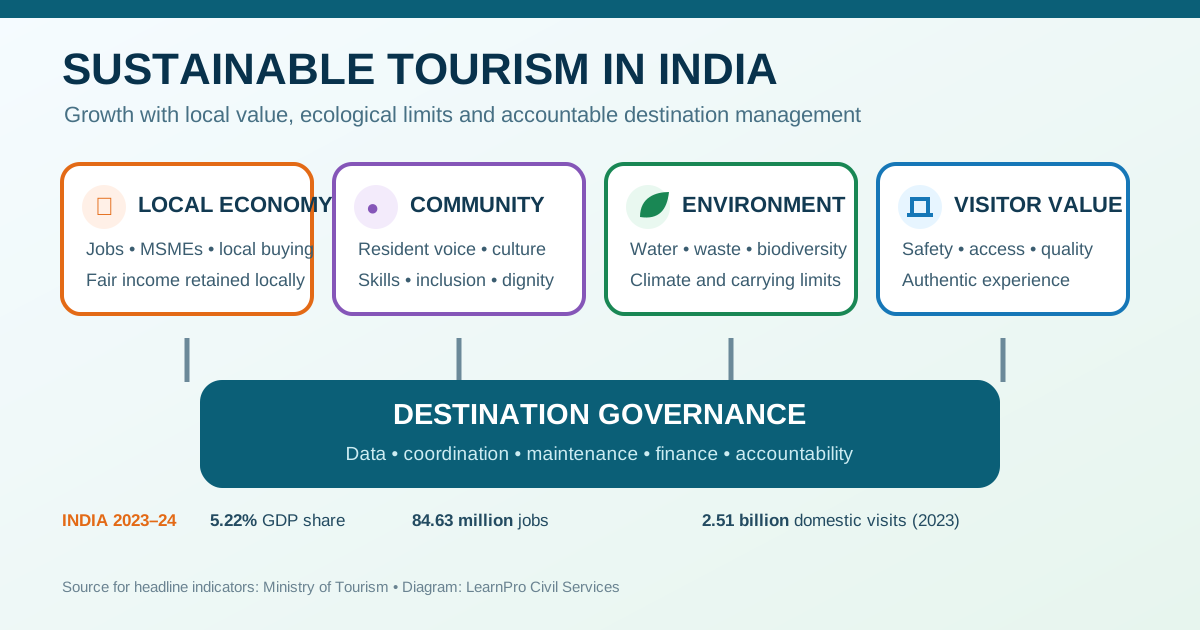
Sustainable tourism in India means increasing visitor value and local livelihoods without damaging the natural, cultural and civic systems on which a destination depends. Tourism is economically important because spending on hotels, food, transport, guides, crafts and entertainment creates a wide employment chain. It is also a form of services export when a foreign visitor purchases these services in India.
UPSC relevance: GS Paper III—economy, employment, infrastructure and environment; GS Paper II—federal and local governance; GS Paper I—culture and geography. Focus keyword: sustainable tourism in India.
What do the latest official data show?
Tourism statistics use different measures. A Foreign Tourist Arrival (FTA) counts a foreign passport holder arriving in India, while an International Tourist Arrival (ITA) also includes non-resident Indian arrivals under the Ministry’s series. Domestic tourist visits count trips, not unique persons. These figures should not be mixed.
| Indicator | Latest official figure used | Interpretation |
|---|---|---|
| Tourism share in GDP | 5.22% in 2023–24 (provisional) | The sector has recovered close to its pre-pandemic GDP share. |
| Direct and indirect jobs | 84.63 million in 2023–24 | Tourism has a large employment multiplier across formal and informal work. |
| Domestic tourist visits | 2.51 billion in 2023 | Domestic demand is the main volume base; visits are not unique travellers. |
| Foreign tourist arrivals | 9.95 million in 2024; 9.15 million in 2025 | Recovery is not automatically linear; competitiveness and external shocks matter. |
| Foreign-exchange earnings | about US$28 billion in 2023 | Inbound tourism earns foreign exchange like an export of services. |
These indicators measure scale, not sustainability. A destination can receive more visitors while local wages stagnate, water stress rises and heritage deteriorates. Policy should therefore track value per visitor, length of stay, local procurement, resident satisfaction, waste, water and ecosystem condition alongside arrival numbers.
Why is tourism an economic frontier?
- Employment intensity: accommodation, food, mobility, guiding and retail absorb varied skill levels, including women and young workers.
- Regional development: visitors purchase services at the destination, allowing remote cultural, coastal, forest and mountain areas to participate in growth.
- MSME linkages: homestays, restaurants, transport providers, artisans and local producers can enter the value chain.
- Foreign exchange: inbound visitor spending is recorded as a travel-services receipt in the balance of payments.
- Infrastructure spillovers: better sanitation, public spaces, connectivity and digital information can also improve residents’ quality of life.
The multiplier is not guaranteed. If food, labour, ownership and booking commissions come from outside the destination, income “leaks” out. Local skills, finance, producer networks and fair platform access are therefore part of tourism policy.
What makes tourism sustainable?
| Dimension | Destination-level test |
|---|---|
| Environmental | Are water use, waste, emissions, construction and visitor flows within ecological limits? |
| Economic | Do local households and enterprises retain a fair share of visitor spending throughout the year? |
| Social and cultural | Are residents involved, cultural practices respected and displacement or commodification avoided? |
| Visitor experience | Are sites safe, accessible, authentic, clean and well interpreted? |
| Governance | Is one destination body accountable for data, maintenance, coordination and grievance redress? |
Carrying capacity is not simply a fixed daily headcount. It depends on season, water, road width, waste systems, habitat sensitivity, crowd behaviour and emergency access. Timed entry, dynamic pricing, shuttle systems, dispersed itineraries and seasonal caps may be more effective than one permanent number.
What is India’s policy framework?
The Ministry of Tourism’s National Strategy for Sustainable Tourism identifies seven pillars: environmental sustainability; biodiversity protection; economic sustainability; socio-cultural sustainability; certification; information, education and capacity building; and governance.
- Swadesh Darshan 2.0: shifts from building thematic circuits towards a tourist- and destination-centric model with benchmarking, hard and soft interventions, operation and maintenance, marketing and impact assessment.
- PRASHAD: supports pilgrimage and spiritual-heritage destinations, where crowd, sanitation and carrying-capacity management are essential.
- Travel for LiFE: encourages visitors and tourism businesses to adopt resource-efficient and responsible behaviour.
- Hotel classification rules: include requirements relating to sewage treatment, rainwater harvesting, waste management and pollution control.
- Paryatan Mitra and Paryatan Didi: focus on destination-level skills, hospitality and participation.
For an applied example of religious tourism and local infrastructure, read the LearnPro profile of Deoghar and Baidyanath Dham.
Why is federal governance central?
Tourism is not managed by one ministry. The Union handles national promotion, standards, visas and financial-assistance schemes. States regulate tourism services and lead destination development. Urban local bodies and panchayats manage streets, waste, water, sanitation and local permissions. Forest departments, the Archaeological Survey of India, transport authorities, police and disaster-management agencies control other critical functions.
This fragmentation creates a common failure: a capital project is completed, but no institution owns daily operations. Every major destination needs a professional destination management organisation or equivalent coordination body with:
- a published destination plan and measurable service standards;
- representation of residents, small businesses, workers and conservation bodies;
- ring-fenced revenue for maintenance rather than construction alone;
- real-time data on crowd, mobility, water, waste and complaints; and
- annual disclosure of environmental and local-economic outcomes.
What are the main risks?
- Overtourism and ecological stress: crowding, unregulated construction, traffic, solid waste and groundwater extraction can exceed local capacity.
- Climate and disaster exposure: heat, coastal erosion, wildfire, landslide and extreme rainfall threaten visitors and assets. Mountain planning should use evidence from topics such as Gangotri Glacier retreat and Himalayan hazard governance.
- Heritage degradation: vibration, encroachment, visual pollution and poor visitor circulation can damage monuments and living traditions.
- Informal and seasonal work: many workers lack stable income, training, social security or safe working conditions.
- Unequal benefit: land-value gains and platform commissions may accrue to outside investors while residents bear congestion and waste.
- Safety and accessibility gaps: tourist police, verified operators, emergency information, universal access and grievance systems remain uneven.
A practical reform agenda
- Measure destination health: create a public dashboard covering water per visitor-night, waste recovery, local employment, resident sentiment and ecosystem indicators.
- Price external costs: use conservation fees, congestion charges or parking prices transparently and spend the proceeds locally.
- Disperse demand: promote secondary sites and off-season products only after essential services and community consent are in place.
- Strengthen local enterprise: connect hotels with farmers, artisans, guides and women’s collectives through procurement standards and digital discovery.
- Make biodiversity a design constraint: apply buffers, low-impact mobility and visitor zoning in sensitive landscapes; see the wider global biodiversity pattern and India’s 2030 targets.
- Plan for climate risk: publish evacuation maps, heat protocols and multilingual alerts, and audit infrastructure for future hazards.
UPSC-ready analysis
Core argument: tourism becomes a durable economic frontier only when destinations are managed as living systems rather than construction sites. Success is not the maximum number of arrivals; it is higher local value with lower ecological and civic stress.
Mains conclusion: India should combine the market reach of national promotion with empowered local management, transparent carrying-capacity tools and community participation. This can convert tourism growth into jobs, services exports, heritage conservation and balanced regional development.
Official sources
- Ministry of Tourism—tourist arrivals, jobs and GDP share, March 2026
- Ministry of Tourism—2025 foreign tourist arrivals and medical tourism
- Economic Survey summary—tourism employment, receipts and international ranking
- National Strategy for Sustainable Tourism—seven pillars
- Ministry of Tourism—Swadesh Darshan 2.0 approach
Frequently asked questions
What is sustainable tourism in India?
It is tourism that produces viable local livelihoods and good visitor experiences while protecting ecological systems, heritage, culture and residents’ quality of life over the long term.
How does tourism count as a services export?
When a foreign visitor buys accommodation, food, transport or other services in India, the spending is an export receipt because the service is supplied by India to a non-resident.
What is Swadesh Darshan 2.0?
It is the revamped central scheme built around sustainable, responsible and tourist- and destination-centric development, including planning, infrastructure, skills, management, marketing and impact assessment.
Is carrying capacity only a cap on visitor numbers?
No. It is a management concept linked to season, water, waste, mobility, ecosystem sensitivity, safety and resident tolerance. The appropriate limit can change with conditions and infrastructure.
Which level of government manages tourism in India?
Management is shared. The Union supports promotion, standards and schemes; States lead sector regulation and projects; local bodies deliver many daily services; specialised agencies manage forests, monuments, transport, safety and disasters.