
India export strategy is no longer simply about shipping a larger quantity of goods. The harder task is to earn more value from every shipment, become indispensable within global production networks, and meet the environmental, technical, labour, traceability and rules-of-origin requirements that increasingly determine access to major markets. This shift—from volume-led exports to value-led, compliant participation in global value chains (GVCs)—is central to India’s manufacturing ambitions and to the General Studies Paper III themes of industrial policy, external trade, infrastructure and inclusive growth.
Why in News?
The Economic Survey 2025–26 has placed deeper integration with global value chains at the centre of India’s structural transformation. It notes that India accounted for about 2.9 per cent of global manufacturing gross value added and only about 1.8 per cent of world merchandise exports in 2024. This gap shows that a large domestic manufacturing base does not automatically translate into an equally strong export presence.
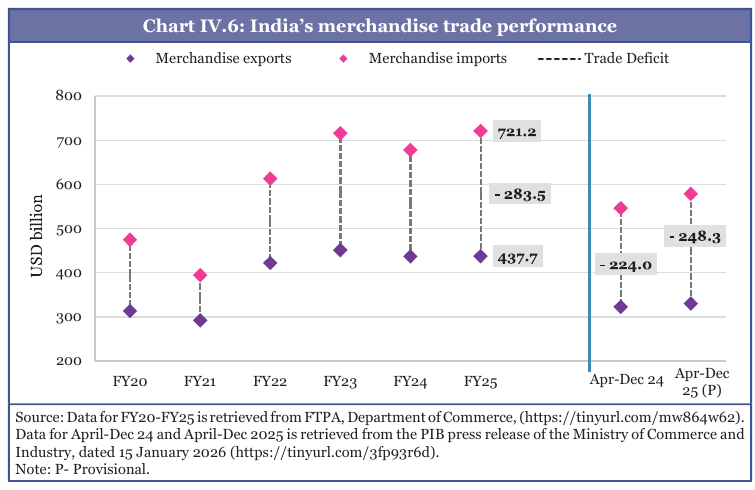
At the same time, the composition of exports is changing. According to the Survey’s external-sector chapter, merchandise exports remained around US$437.7 billion in FY2024–25, but non-petroleum, non-gems-and-jewellery exports grew more strongly and accounted for 78.7 per cent of merchandise exports. Services exports continued to provide resilience. The policy question, therefore, is not whether India can export, but whether Indian firms can move from low-margin, price-sensitive segments to higher-value functions such as design, precision manufacturing, certification, digital services, branding and after-sales support.
The Government’s Export Promotion Mission, with an announced outlay of ₹25,060 crore for FY2025–26 to FY2030–31, also reflects this change. It seeks to combine trade finance, market readiness, logistics support and compliance assistance instead of treating export promotion merely as an incentive paid after shipment.
Understanding Global Value Chains and GVC Upgrading
A global value chain divides the production of a good or service across different countries. A smartphone may be designed in one country, use semiconductors fabricated in another, contain components made in several Asian economies, be assembled elsewhere and be marketed through a global brand. Trade statistics record the final shipment value, but the income retained by each country depends on the function performed within the chain.
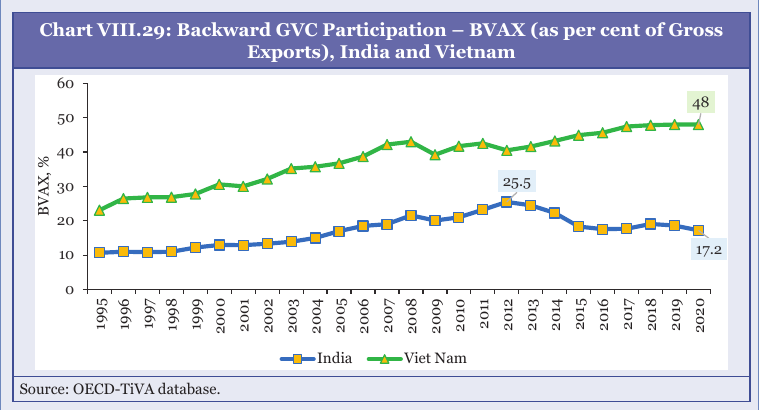
GVC participation has two broad sides. In backward participation, a country imports intermediate goods, components, technology or specialised services and uses them to produce exports. In forward participation, a country’s domestic inputs are used in another country’s exports. A competitive economy requires an intelligent balance: access to high-quality imported inputs where necessary, along with progressively stronger domestic supplier capability.
GVC upgrading means moving towards activities that generate greater productivity, technological learning and domestic value addition:
- Process upgrading: producing the same product more efficiently through automation, quality control, better logistics and reduced defects.
- Product upgrading: moving from basic or standardised goods to more sophisticated, reliable or specialised products.
- Functional upgrading: acquiring higher-value functions such as research, design, testing, branding, distribution and maintenance.
- Chain upgrading: using existing capabilities to enter a more technologically demanding industry—for example, moving from conventional auto components to electronics, batteries or precision systems.
For India, the objective is not crude import substitution and not unrestricted import dependence. It is strategic integration: use globally competitive inputs where they raise export capability, build domestic depth in critical components, and ensure that more knowledge, wages, profits and intellectual property remain within the economy over time.
India Export Strategy: Strengths and Structural Gaps
India’s total exports of merchandise and services reached an all-time high of about US$825.25 billion in FY2024–25, according to the Department of Commerce’s 2025 year-end review. Services exports were a major source of strength, while non-petroleum merchandise exports also reached a record level. Electronics, pharmaceuticals, automobiles, engineering goods, chemicals, defence production and digitally delivered services offer important opportunities.
However, aggregate export value can conceal weaknesses. India’s share in global merchandise trade remains modest relative to the size of its economy. Many firms operate at a small scale, depend on imported technology without developing domestic design capability, or remain outside the supplier networks of large multinational enterprises. Export success is also concentrated in a limited number of states, districts and firms.
| Area | Existing strength | Required upgrading |
|---|---|---|
| Services | IT and business services provide a large trade surplus | Expand engineering R&D, AI-enabled services, legal, accounting, health and professional services |
| Pharmaceuticals | Scale in generic medicines and vaccines | Greater innovation, complex generics, biosimilars and regulatory capability |
| Electronics | Rapid assembly growth and policy support | Domestic component ecosystems, design, tooling and semiconductor-linked capabilities |
| Automobiles | Established supplier base and engineering talent | EV systems, power electronics, software and global safety compliance |
| Textiles and food | Large labour base and raw-material availability | Traceability, sustainability, technical textiles, processing, branding and cold chains |
Why Volume-Led Export Growth Is No Longer Sufficient
Low margins and price competition
Standardised products are easily replaced by suppliers from another country. Firms competing only on low wages or currency movements have little bargaining power. A fall in global demand or a small tariff preference elsewhere can quickly divert orders.
Imported content without domestic learning
Importing components is not inherently a weakness; competitive imported inputs can enable exports. The problem arises when assembly expands without local supplier development, technology absorption or functional upgrading. Gross export value then rises faster than domestic value addition.
Concentration risk
Dependence on a small set of products or markets exposes exporters to recession, sanctions, shipping disruption, tariff action and geopolitical rivalry. Diversification must occur across products, destinations and supply-chain functions.
Standards now operate as market-access conditions
Modern trade barriers are often embedded in product standards, sanitary and phytosanitary rules, carbon reporting, data requirements, responsible-sourcing expectations and supply-chain due diligence. A tariff concession is of little use if an exporter cannot prove origin, safety, emissions performance or conformity with the buyer’s technical specifications.
Compliance Is the New Infrastructure of Trade
Compliance should not be seen only as paperwork. It is a productive capability that allows a firm to enter demanding markets and remain a trusted supplier. Five areas are especially important.
- Technical and quality standards: Exporters need accredited laboratories, reliable metrology, certification and sector-specific testing. Delayed or costly testing is a serious disadvantage for MSMEs.
- Rules of origin: Preferential tariffs under a free trade agreement require proof that a product has sufficient originating value. Digital records of components and production processes reduce fraud and help firms claim legitimate preferences.
- Environmental compliance: Carbon accounting, energy efficiency, waste management and product-life-cycle information are becoming relevant to market access and buyer selection. The WTO’s Global Value Chain Development Report 2025 highlights the growing interaction between resilient value chains, digital verification and sustainability requirements.
- Traceability: Food, textiles, minerals, pharmaceuticals and engineering supply chains increasingly require information about origin, processing, safety and custody. Traceability protects consumers and helps isolate defects without rejecting an entire product category.
- Social and governance standards: Large buyers examine labour conditions, data integrity, anti-corruption systems and supplier due diligence. Indian firms need practical support to meet these requirements without turning compliance into an exclusionary fixed cost.
Policy Architecture for Value-Led Export Growth
Export Promotion Mission
The Export Promotion Mission can become the coordinating platform for affordable trade finance, e-commerce export support, market intelligence, overseas warehousing, standards compliance and assistance to first-time exporters. Its success should be measured not only by disbursal, but by the number of firms that enter and remain in global markets, the value added retained domestically and the diversification achieved.
Trade agreements linked with domestic preparedness
Free trade agreements can provide tariff preferences, services access, investment linkages and clearer rules. But utilisation depends on firms understanding product-specific rules of origin, standards and documentation. Negotiation and domestic capacity-building must therefore proceed together. Otherwise, market access exists legally but remains unused commercially. This issue also connects with LearnPro’s analysis of the WTO crisis and the challenges facing trade multilateralism.
Production capability and supplier ecosystems
Production-linked incentives and sectoral industrial policies can attract anchor firms, but durable gains require local supplier development, tooling, testing, skill formation and competition. Incentives should reward additionality—new investment, exports, technology, domestic sourcing and productivity—rather than protect inefficient production indefinitely. The investment dimension can be studied further through the article on FDI policy, security screening and manufacturing investment.
Logistics and customs reform
Predictable border processes matter as much as average cost. Paperless customs, port-community systems, risk-based inspection, multimodal logistics and faster refund of legitimate duties reduce working-capital pressure. District-level connectivity and reliable power are essential if export activity is to spread beyond established coastal clusters. A related policy example is the treatment of SEZ manufacturing units and concessional customs-duty relief.
Services as an input into manufacturing exports
Design, finance, software, logistics, testing and professional services are embedded in manufactured exports. Competitive services increase manufacturing value addition. Policy should therefore avoid treating merchandise and services as separate worlds. Sector-specific upgrading is visible in the case of biosimilars, regulatory approval and Indian pharmaceutical exports.
Major Challenges
- MSME compliance costs: Certification, audits and digital systems involve fixed costs that smaller firms cannot easily absorb.
- Inverted or high-cost input structures: Duties on intermediate goods can create an anti-export bias when finished products face strong international competition.
- Fragmented institutions: Exporters deal with central ministries, state departments, standards bodies, customs, banks, ports and sectoral regulators. Poor coordination raises uncertainty.
- Skill and technology gaps: Precision production, industrial design, testing and regulatory affairs require specialised human capital.
- Unequal regional participation: Landlocked and less-industrialised states face higher logistics costs and thinner supplier networks.
- Green-transition finance: Cleaner machinery and measurement systems require capital, while buyers may shift compliance burdens down the chain without sharing costs.
- Geopolitical fragmentation: Friend-shoring may create opportunities, but it can also force firms to navigate competing standards, technology controls and market blocs.
Way Forward
- Create sector-specific upgrading road maps. Electronics, pharmaceuticals, textiles, food processing, automobiles and green technologies require different combinations of components, skills, standards and market access.
- Build shared compliance infrastructure. Common testing laboratories, certification facilities, carbon-accounting tools and traceability platforms can reduce the fixed cost faced by MSME clusters.
- Adopt a trade-in-value-added approach. Policy evaluation should track domestic value addition, imported-input productivity, technology transfer, wages and supplier depth—not gross shipment value alone.
- Keep intermediate inputs competitive. Tariff policy should distinguish strategic vulnerability from routine protectionism. Access to world-class inputs can be essential for world-class exports.
- Use anchor investors to develop local suppliers. Investment agreements and incentive schemes should include vendor-development, training, R&D and quality-upgradation programmes.
- Make export finance faster and more inclusive. Credit guarantees, invoice financing, insurance and working-capital support should reach smaller exporters with viable orders.
- Integrate states and districts. State export strategies should identify realistic product clusters, close logistics gaps and connect local firms with export-promotion councils and global buyers.
- Strengthen data and early-warning systems. Exporters need timely information on new standards, trade-remedy actions, shipping disruptions and regulatory changes in destination markets.
UPSC and State PSC Examination Relevance
Syllabus linkage: GS Paper III—Indian economy; liberalisation; changes in industrial policy and their effects on industrial growth; infrastructure; investment models; and the effects of globalisation. The topic also connects with GS Paper II through international economic relations and with the Essay paper through themes of self-reliance, competitiveness and globalisation.
For connected preparation, revise the LearnPro Economy topic hub, follow the current-affairs analysis, and practise the probable question through the Mains answer-writing section.
| For Prelims | For Mains |
|---|---|
| Backward and forward GVC participation | Difference between gross exports and domestic value addition |
| Rules of origin and preferential tariffs | Tariff policy, imported inputs and anti-export bias |
| Technical barriers, SPS measures and certification | Compliance as a competitiveness and inclusion issue |
| Export Promotion Mission | Role of MSMEs, states, logistics and supplier ecosystems |
Probable Mains Question: “India’s export competitiveness will increasingly depend on domestic value addition and compliance capability rather than shipment volume alone.” Examine the statement in the context of India’s integration with global value chains.
Suggested answer structure
Begin by defining GVC upgrading and explaining the shift from gross export volume to value retained within the economy. Use India’s merchandise-export and global-share data to establish the problem. Analyse standards, input competitiveness, logistics, MSME capability, technology and FTAs under separate subheadings. Conclude with a balanced strategy of competitive integration, domestic capability-building and verifiable compliance.
Conclusion
India does not have to choose between self-reliance and global integration. Effective self-reliance is the capacity to participate in international production from a position of technological strength, reliable quality and diversified domestic capability. Export growth will be durable only when Indian firms perform more valuable functions, smaller suppliers can meet global standards, and imported inputs translate into learning and domestic supplier depth. The next phase of trade policy must therefore measure success not simply in containers shipped or dollars earned, but in productivity gained, technology absorbed, risks reduced and value retained across the Indian economy.
India Export Strategy FAQs
What is the central objective of India export strategy?
The central objective is to increase the value retained within India from exports. That requires higher productivity, domestic supplier development, technological learning, competitive services, better logistics and the ability to satisfy standards in destination markets—not merely a rise in gross shipment volume.
What does GVC upgrading mean?
GVC upgrading means moving towards more productive and valuable activities within a global value chain. It can involve better production processes, more sophisticated products, higher-value functions such as design and branding, or entry into a technologically more advanced industry.
Why are imported intermediate goods important for Indian exports?
Competitive intermediate goods can help Indian firms assemble, process and export at scale. The Economic Survey explains that backward GVC participation may initially raise foreign value added but can generate larger absolute domestic value added and employment through scale, learning and supplier development. The policy goal should be competitive integration followed by capability deepening.
Why is compliance becoming important for export competitiveness?
Tariff access alone cannot secure an order when an exporter cannot demonstrate product safety, origin, quality, emissions performance or traceability. Testing, certification, carbon accounting, rules-of-origin documentation and responsible-sourcing systems have therefore become part of modern trade infrastructure.
What is the Export Promotion Mission?
The Export Promotion Mission is a Government of India initiative announced with an outlay of ₹25,060 crore for FY2025–26 to FY2030–31. It seeks to improve trade finance, market readiness, compliance capability and export competitiveness through an integrated and digitally enabled framework.
How is India export strategy relevant for UPSC preparation?
It directly relates to GS Paper III topics including the Indian economy, industrial policy, infrastructure, liberalisation and the effects of globalisation. It can also be used in GS Paper II questions on international economic relations and in essays on self-reliance, manufacturing and globalisation.
Official Sources for Further Reading
- Economic Survey 2025–26: Structural Transformation and Global Integration
- Economic Survey 2025–26: External Sector
- Government of India: Export Promotion Mission
- WTO: Global Value Chain Development Report 2025





Sources and further reading
- Economic Survey 2025–26: Structural Transformation and Global Integrationindiabudget.gov.in
- Government of India: Export Promotion Missionpib.gov.in
- WTO: Global Value Chain Development Report 2025wto.org
- Economic Survey 2025–26: External Sectorindiabudget.gov.in