
Phone tapping and right to privacy involve a difficult constitutional balance. The State may need to intercept communications in a genuine public emergency or for public safety, but every interception intrudes into private conversation and can chill free speech. Indian law therefore does not give investigating agencies a general power to tap phones whenever they suspect an offence.
The current framework is Section 20 of the Telecommunications Act, 2023 read with the Telecommunications (Procedures and Safeguards for Lawful Interception of Messages) Rules, 2024. The rules came into force on 6 December 2024 and superseded Rules 419 and 419A of the Indian Telegraph Rules for new orders. The constitutional principles developed in PUCL v Union of India and K.S. Puttaswamy v Union of India remain central.
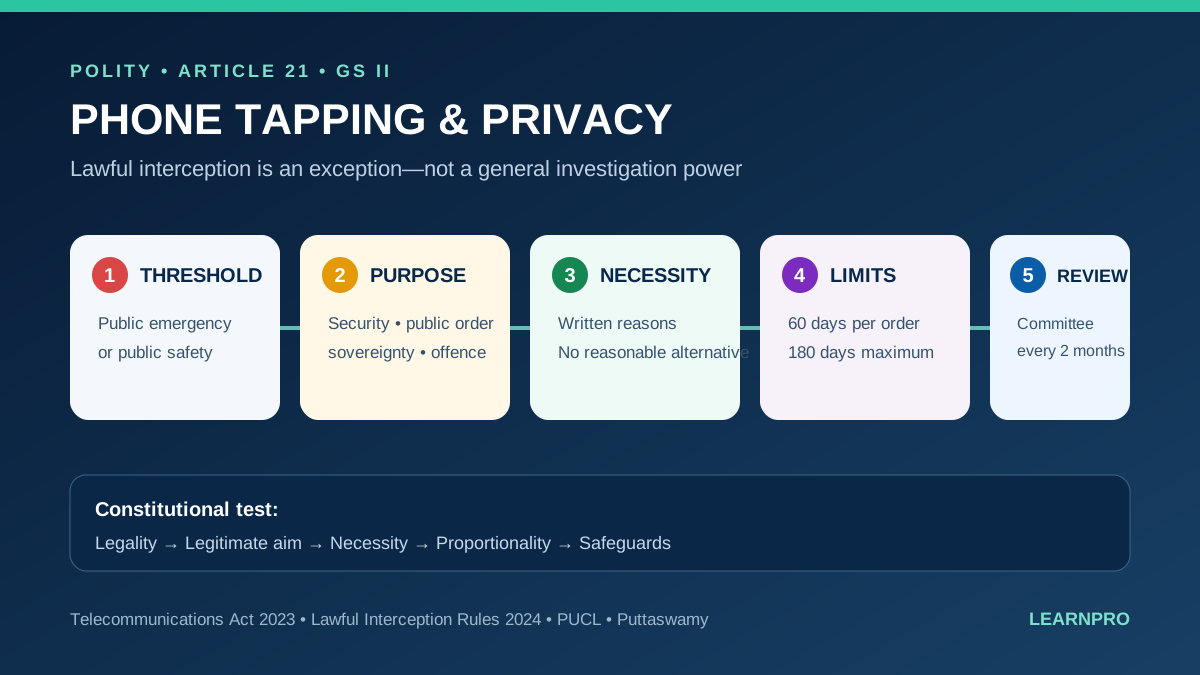
What does phone tapping mean?
Phone tapping is the interception, monitoring or acquisition of a communication while it is being transmitted. It differs from obtaining an existing call-detail record. A call-detail record may show numbers, time, duration and location-related metadata; interception can reveal the content of a call or message. Both affect privacy, but content interception is more intrusive.
Unauthorised private interception, spyware use and hacking are not made lawful by the rules discussed here. The 2024 rules govern interception by authorised agencies under a valid government order.
Constitutional basis of the right to privacy
Article 21 protects life and personal liberty, while Article 19(1)(a) protects speech and expression. In the 1996 People’s Union for Civil Liberties judgment, the Supreme Court held that a private telephone conversation falls within the right to privacy and that tapping also affects free expression.
The nine-judge bench in K.S. Puttaswamy (2017) affirmed privacy as a fundamental right. A State restriction must satisfy a structured test:
- legality: there must be a valid law authorising the intrusion;
- legitimate aim: the action must pursue a constitutionally permissible purpose;
- necessity and proportionality: the method must be suitable and no more intrusive than reasonably required; and
- procedural safeguards: the system must limit arbitrary use and provide accountability.
Section 20 of the Telecommunications Act, 2023
Section 20(2) permits an interception order only on the occurrence of a public emergency or in the interest of public safety. Even then, the government must be satisfied that interception is necessary or expedient for one of the listed grounds and must record reasons in writing.
| Legal stage | Question that must be answered |
|---|---|
| Threshold | Has a public emergency occurred, or does public safety require action? |
| Permitted ground | Does the order protect sovereignty and integrity, defence and security of the State, friendly relations, public order, or prevent incitement to an offence? |
| Written satisfaction | Has the authorised decision-maker recorded why interception is necessary or expedient? |
| Safeguards | Does the order comply with the 2024 rules on authority, duration, review, use and destruction? |
The listed grounds are not a substitute for the threshold. A government cannot rely only on “preventing incitement to an offence” without first establishing public emergency or public safety. Section 20 also protects press messages intended for publication by accredited correspondents unless their transmission has been prohibited under the provision.
Who can authorise interception?
Under the 2024 rules, the competent authority is:
- the Union Home Secretary for the Central Government; or
- the Secretary in charge of the Home Department for a State Government.
In unavoidable circumstances, a duly authorised officer not below the rank of Joint Secretary to the Central Government may issue an order. Where this is not feasible in a remote area or for operational reasons, the head or second senior-most officer of an authorised agency may act, subject to rank and confirmation requirements. At the state level that officer cannot be below Inspector General of Police.
Safeguards under the 2024 interception rules
- Last resort: an order should not be issued unless the authority has considered whether the information can be obtained by other reasonable means.
- Specificity: the order must relate to identified persons, messages, subjects, addresses, premises or telecom equipment rather than permit unlimited fishing.
- Reasons and authorised agency: it must identify the agency and officer and state the Section 20 reason.
- Time limit: an order runs for no more than 60 days at a time and cannot remain in force for more than 180 days in total.
- Emergency confirmation: an operational order must reach the competent authority within three working days and be confirmed within seven working days.
- Consequence of non-confirmation: interception must stop; the material cannot be used, including as evidence; and copies must be destroyed within two working days.
- Review: the relevant Review Committee meets at least once every two months and may cancel an unlawful order and direct destruction.
- Records and destruction: agencies and telecom entities must maintain secure records and destroy them within prescribed periods unless operational need or a court direction requires retention.
What did the 2025 Madras High Court decide?
In P. Kishore v Secretary to Government of India, decided on 2 July 2025, the Madras High Court examined a 2011 interception order in a corruption investigation. The Court quashed the order because ordinary crime detection did not by itself satisfy the statutory threshold of public emergency or public safety. It also found non-compliance with the mandatory review procedure.
The case arose under the old Telegraph Act and Rule 419A, but its constitutional reasoning remains important. The new Section 20 retains the same threshold language. The judgment does not mean that every intercepted communication is automatically excluded from every proceeding; it means the State must establish lawful authority and comply with mandatory safeguards. In that case, the illegally intercepted conversations could not be used, while independently obtained evidence was left for the trial court to assess.
Why ordinary suspicion is not enough
Surveillance is secret, so the affected person usually cannot challenge it before the privacy invasion occurs. A low threshold would allow agencies to collect intimate information about family, lawyers, journalists, political activity and professional sources. It could also encourage broad surveillance around a suspect rather than a narrow investigation.
Lawful investigation remains possible through warrants, searches, records, witness examination, financial trails and special statutes that expressly authorise interception for defined offences. The constitutional requirement is not that the State remain powerless; it is that the method used must match the law.
Gaps in the present framework
- Executive authorisation: interception and review remain largely within the executive rather than requiring prior judicial approval.
- Limited transparency: India does not publish sufficiently detailed aggregate statistics on applications, approvals, rejections and breaches.
- No routine notice: a person is generally not informed after surveillance ends, even where disclosure would no longer threaten an investigation.
- Digital overlap: calls, encrypted messaging, metadata, cloud services and device hacking may fall under different legal routes.
- Remedy problem: citizens may struggle to discover unlawful tapping and obtain deletion, compensation or accountability.
- Independent oversight: review committees consist of senior government officials, which raises institutional-independence concerns.
Reform agenda
- introduce prior judicial or genuinely independent authorisation, with a narrow emergency exception;
- require a written necessity and proportionality assessment for every target and renewal;
- publish anonymised annual statistics and audit findings;
- provide post-surveillance notice when it no longer creates a real security or investigation risk;
- create clear exclusion, deletion, compensation and disciplinary remedies for unlawful interception;
- protect lawyer-client, journalist-source and other privileged communications through enhanced safeguards; and
- coordinate telecom interception law with data-protection, cybercrime and criminal-procedure rules.
For the broader constitutional setting, read LearnPro’s guide to Digital India and rights safeguards and the explainer on technology, women and children.
UPSC and State PSC relevance
Phone tapping and right to privacy connect GS Paper II topics: fundamental rights, executive accountability, rule of law and judicial review. They also raise GS Paper III questions about cybersecurity and communications technology. In an answer, distinguish the statutory threshold from the permitted grounds and add the safeguards of the 2024 rules.
Mains practice question: Lawful interception may serve national security, but secrecy can also weaken constitutional accountability. Examine India’s phone-tapping framework in light of the right to privacy.
Conclusion
Privacy is not absolute, but neither is surveillance power. Section 20 and the 2024 rules permit targeted interception under limited conditions; the Constitution adds legality, legitimate purpose, necessity, proportionality and safeguards. The central rule is simple: serious investigation cannot be pursued through an unlawful method.
Frequently asked questions
Is phone tapping legal in India?
It can be legal only when the statutory threshold, listed purpose, competent authority, written reasons and safeguards under Section 20 and the 2024 rules are satisfied.
Who normally approves a phone-tapping order?
The Union Home Secretary for the Central Government or the State Home Secretary for a State Government is the competent authority, subject to limited exceptions.
How long can an interception order operate?
An order may operate for up to 60 days at a time and can be renewed, but cannot remain in force for more than 180 days in total.
Can phones be tapped merely to detect an ordinary crime?
The 2025 Madras High Court held that ordinary crime detection alone did not satisfy the required public-emergency or public-safety threshold under the corresponding Telegraph Act provision.
Which Supreme Court cases are most important?
PUCL v Union of India addressed telephone tapping and safeguards, while K.S. Puttaswamy v Union of India affirmed privacy as a fundamental right and developed the proportionality framework.
Primary references and official material
- India Code: Section 20, Telecommunications Act 2023
- Gazette: Lawful Interception Rules 2024
- Department of Telecommunications: Acts and rules
- Madras High Court judgments portal: P. Kishore, 2025:MHC:1510
- Supreme Court: PUCL v Union of India





Sources and further reading
- India Code: Section 20, Telecommunications Act 2023indiacode.nic.in
- Gazette: Lawful Interception Rules 2024eservices.dot.gov.in
- Department of Telecommunications: Acts and ruleseservices.dot.gov.in
- Madras High Court judgments portal: P. Kishore, 2025:MHC:1510mhc.tn.gov.in
- Supreme Court: PUCL v Union of Indiamain.sci.gov.in