
Tags: GS Paper 2 – Fundamental Rights, Judiciary, Criminal Justice Reforms
For Prelims: Article 21, Article 22(1) and 22(2), Bharatiya Nagarik Suraksha Sanhita 2023, D.K. Basu guidelines, Joginder Kumar case, preventive detention
For Mains: Custodial violence and safeguards against illegal detention, police accountability, balancing investigation with personal liberty
Why in News?
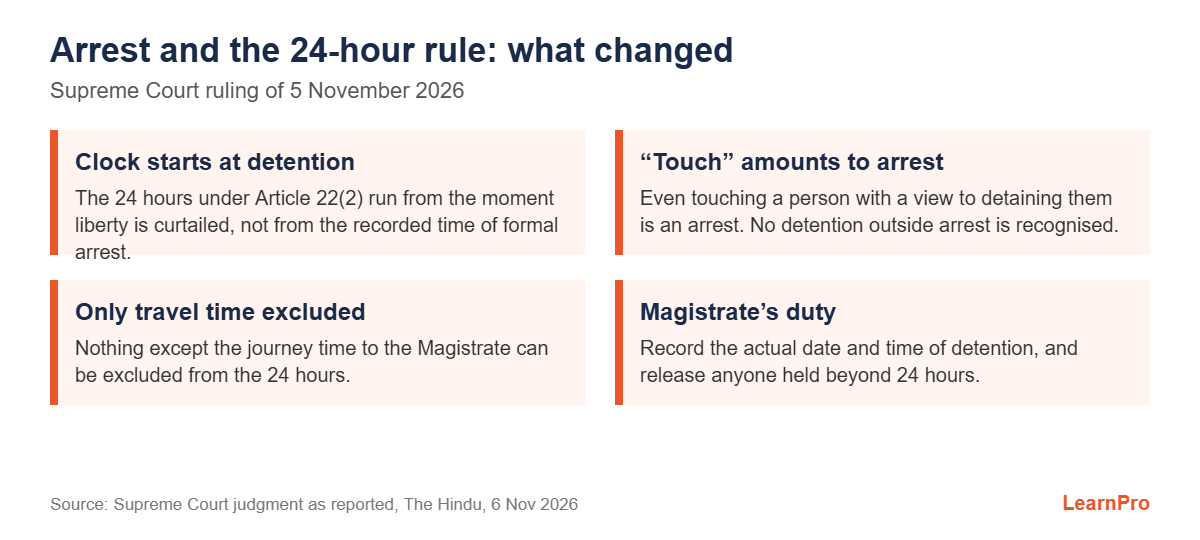
On 5 November 2026, the Supreme Court ruled that the 24-hour period under Article 22(2) for producing an arrested person before a Magistrate begins at the moment of detention, when a person’s liberty is curtailed, and not when the police formally record the arrest. The Bench was led by Justice Ujjal Bhuyan. It held that even touching a person with a view to detaining them amounts to arrest.
Summary
- The word ‘arrest’ is not defined in the IPC, the CrPC or the Bharatiya Nagarik Suraksha Sanhita (BNSS), 2023. Police have used this gap to hold people for hours or days before recording a formal arrest.
- The Court said that creating a “buffer zone” of detention outside arrest is unconstitutional, even under special laws.
- Magistrates must record the actual time of detention and release anyone held beyond 24 hours.
- The case involved four accused in a narcotics case whose formal arrest was recorded about 18 hours after they were detained.
What did the Court Hold?
- Detention is arrest: The Constitution does not recognise detention apart from arrest. Once a person suspected of an offence is restrained, they are under arrest.
- Clock starts at restraint: The 24 hours are counted from the time liberty is curtailed.
- Only travel time excluded: No period other than the journey to the Magistrate’s court can be excluded.
- Magistrate’s discretion: A Magistrate may order release even within 24 hours if the detention was longer than reasonable.
- Applies to special statutes too: The Article 21 and Article 22 safeguards cannot be diluted by special laws such as the NDPS Act.
Constitutional Safeguards Under Article 22
| Clause | Safeguard |
|---|---|
| 22(1) | Right to be told the grounds of arrest, and right to consult and be defended by a lawyer of one’s choice |
| 22(2) | Production before the nearest Magistrate within 24 hours, excluding travel time. No detention beyond that without the Magistrate’s authority. |
| 22(3) | Clauses (1) and (2) do not apply to enemy aliens or to persons held under preventive detention laws |
| 22(4)–(7) | Safeguards for preventive detention: Advisory Board review for detention beyond 3 months, communication of grounds, and the right to make a representation |
Related Legal Provisions and Judgments
- BNSS, 2023: Section 58 (no detention beyond 24 hours without a Magistrate’s order) and Section 187 (procedure when an investigation cannot be completed in 24 hours). These correspond to Sections 57 and 167 of the old CrPC.
- Joginder Kumar v. State of U.P. (1994): An arrest must be justified, and not made only because the power to arrest exists.
- D.K. Basu v. State of West Bengal (1997): Guidelines against custodial violence, including an arrest memo, informing a relative, and medical examination.
- Arnesh Kumar v. State of Bihar (2014): No automatic arrest for offences punishable with up to seven years.
- Pankaj Bansal (2023) and Prabir Purkayastha (2024): Grounds of arrest must be given in writing.
Significance of the Ruling
- Prevents custodial abuse: Most torture and forced confessions happen in the unrecorded period before formal arrest.
- Accountability: The police can no longer manipulate records to show a later time of arrest.
- Strengthens judicial oversight: Early production before a Magistrate allows a quick check on the legality of custody.
- Consistent with international standards: Article 9 of the ICCPR requires that anyone arrested be brought promptly before a judge.
Challenges in Implementation
- It is hard to prove the exact time of detention without CCTV or digital records.
- Remote areas and transit arrests may make the 24-hour deadline difficult to meet.
- Prolonged ‘questioning’ is part of police culture and will need training and institutional reform to change.
Way Forward
- Require digital time-stamped detention records and working CCTV in police stations, as directed in Paramvir Singh Saini (2020).
- Implement the Prakash Singh (2006) police reforms, including Police Complaints Authorities.
- Ratify the UN Convention against Torture and enact domestic anti-torture legislation.
Conclusion
By tying the 24-hour safeguard to the actual loss of liberty, the Court has closed a major gap that allowed illegal custody. This brings Article 22 closer to its purpose as a check on executive power during investigation.
Frequently Asked Questions (FAQs)
1. From when does the 24-hour period under Article 22(2) now begin?
From the moment of detention, when a person’s liberty is curtailed.
2. Which provision of the BNSS corresponds to Section 57 of the CrPC?
Section 58 of the BNSS, 2023.
3. To whom do Article 22(1) and 22(2) not apply?
Enemy aliens and persons arrested under preventive detention laws.
Practice Question
Mains: “The worst violations of human rights take place during investigation.” In this light, discuss the significance of the Supreme Court’s interpretation of Article 22(2). (250 words)
Sources and further reading
- Wikimedia Commonscommons.wikimedia.org