
Tags: GS Paper 3 – Indian Economy, Banking, Digital Payments
For Prelims: Unified Payments Interface (UPI), NPCI, Merchant Discount Rate (MDR), Payment and Settlement Systems Act 2007, RBI, P2P and P2M transactions, Section 10A of PSS Act
For Mains: Financial sustainability of digital public infrastructure, cost-sharing in payment systems, impact on small merchants and financial inclusion
Why in News?
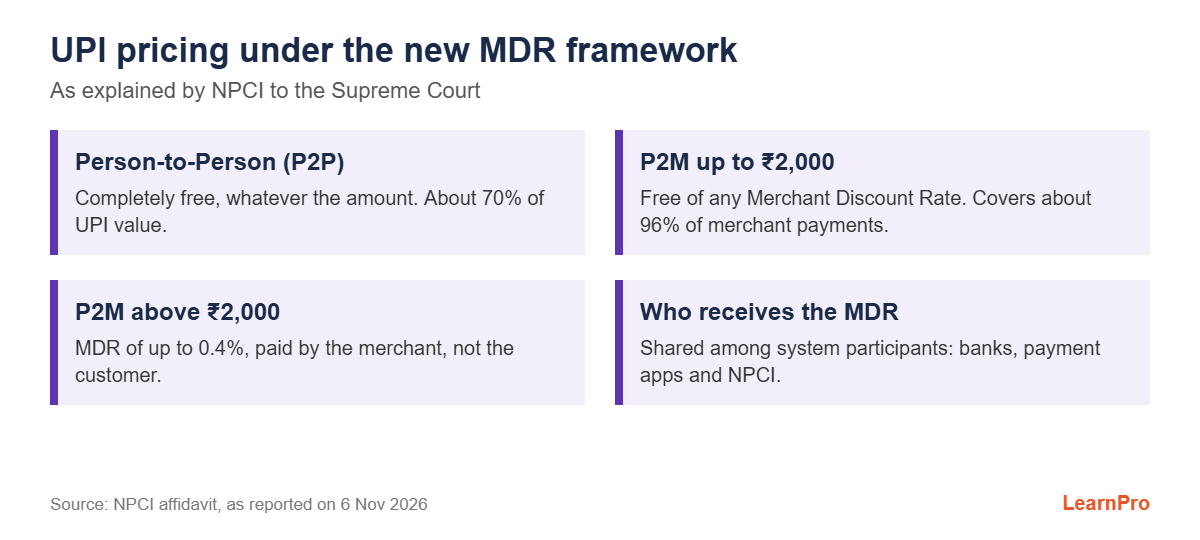
The National Payments Corporation of India (NPCI) has told the Supreme Court that a zero Merchant Discount Rate (MDR) on all UPI transactions is no longer sustainable. It was responding to a challenge against the new framework that levies an MDR of up to 0.4% on Person-to-Merchant (P2M) UPI payments above ₹2,000. NPCI said the charge would apply to only about 4% of merchant transactions.
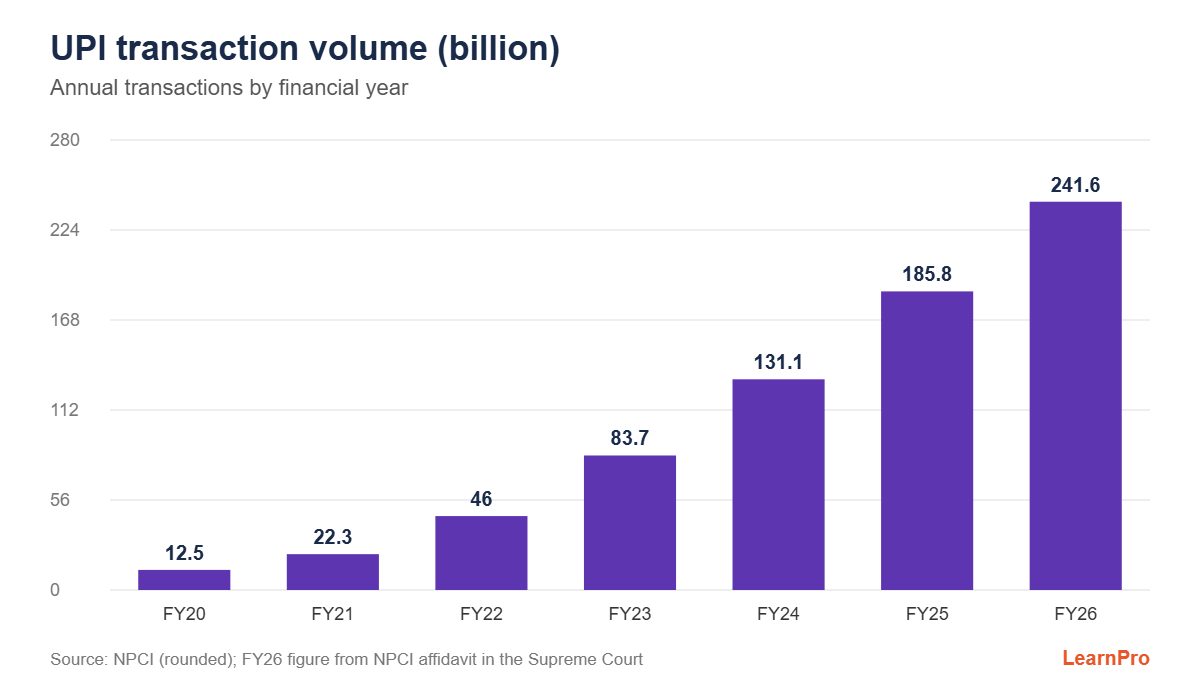
Summary
- UPI processed 24.51 billion transactions worth about ₹29.82 lakh crore in August 2026 alone, about 791 million a day. In FY 2025-26 it handled about 241.62 billion transactions worth about ₹314 lakh crore.
- P2P transfers (about 70% of UPI value) and P2M payments up to ₹2,000 stay free.
- NPCI argued that MDR is not a tax but a charge to recover the cost of running the system, so no new legislation is needed to impose it.
- Government incentive schemes that covered the cost of zero MDR since 2021-22 had placed a heavy burden on the exchequer.
What is the Merchant Discount Rate (MDR)?
- A fee that a merchant pays to the acquiring bank for accepting digital payments. It is shared among the acquiring bank, the issuing bank, the payment app or network, and NPCI.
- Background: From 1 January 2020, the government set MDR to zero for UPI and RuPay debit cards. It did this by inserting Section 10A in the Payment and Settlement Systems Act, 2007 and Section 269SU in the Income Tax Act through the Finance (No. 2) Act, 2019.
- To make up for this, the government ran a UPI incentive scheme that reimbursed banks for low-value BHIM-UPI P2M transactions.
Arguments For and Against MDR on UPI
| In favour | Against |
|---|---|
| Money is needed for security, fraud prevention and capacity as volumes reach almost 800 million a day | Merchants may pass the cost to customers, or push them back to cash |
| Reduces dependence on government subsidies | Could slow digital adoption among mid-sized merchants |
| Encourages banks and fintechs to invest and innovate | Legal question of whether the statutory zero-MDR rule can be changed without amending the law |
| Targets high-value commerce and protects small payments | Large merchants could split bills to stay under ₹2,000 |
About UPI and NPCI
- NPCI: An umbrella body for retail payments, set up in 2008 by the RBI and the Indian Banks’ Association under the PSS Act, 2007. It is a not-for-profit (Section 8) company.
- UPI: Launched in 2016. It allows real-time, interoperable bank-to-bank transfers through a mobile app, using a Virtual Payment Address or a QR code.
- Global reach: UPI or UPI-linked services work in the UAE, Singapore, France, Bhutan, Nepal, Sri Lanka, Mauritius and other countries.
- Share: UPI accounts for over 80% of India’s digital payment transactions by volume.
Way Forward
- Adopt a graded, transparent MDR that is reviewed regularly and capped for small merchants.
- Use part of the MDR revenue for fraud prevention and cyber-security.
- Monitor whether costs are passed on to consumers and whether bills are split.
- Write down the cost-recovery model for UPI as digital public infrastructure in a clear policy.
Conclusion
UPI’s scale now needs a sustainable funding model. A limited MDR that keeps everyday payments free but charges high-value commerce attempts to balance financial inclusion with the health of the payment system. The Supreme Court’s decision will shape how India funds its digital public infrastructure.
Frequently Asked Questions (FAQs)
1. Who pays the MDR?
The merchant, not the customer.
2. Which law governs payment systems in India?
The Payment and Settlement Systems Act, 2007.
3. Which UPI transactions will attract MDR under the new framework?
Person-to-Merchant payments above ₹2,000, at up to 0.4%.
Practice Question
Mains: “Digital public infrastructure cannot remain free forever.” Discuss with reference to the debate on MDR for UPI transactions. (150 words)