
Tags: GS Paper 2 – Government Policies and Interventions; GS Paper 3 – Environmental Pollution and Degradation
For Prelims: Commission for Air Quality Management (CAQM), Graded Response Action Plan (GRAP), National Air Quality Index, PM2.5 and PM10, National Clean Air Programme (NCAP), Article 21
For Mains: Limits of emergency-based pollution control, multi-sectoral sources of air pollution in the NCR, need for an airshed approach
Why in News?
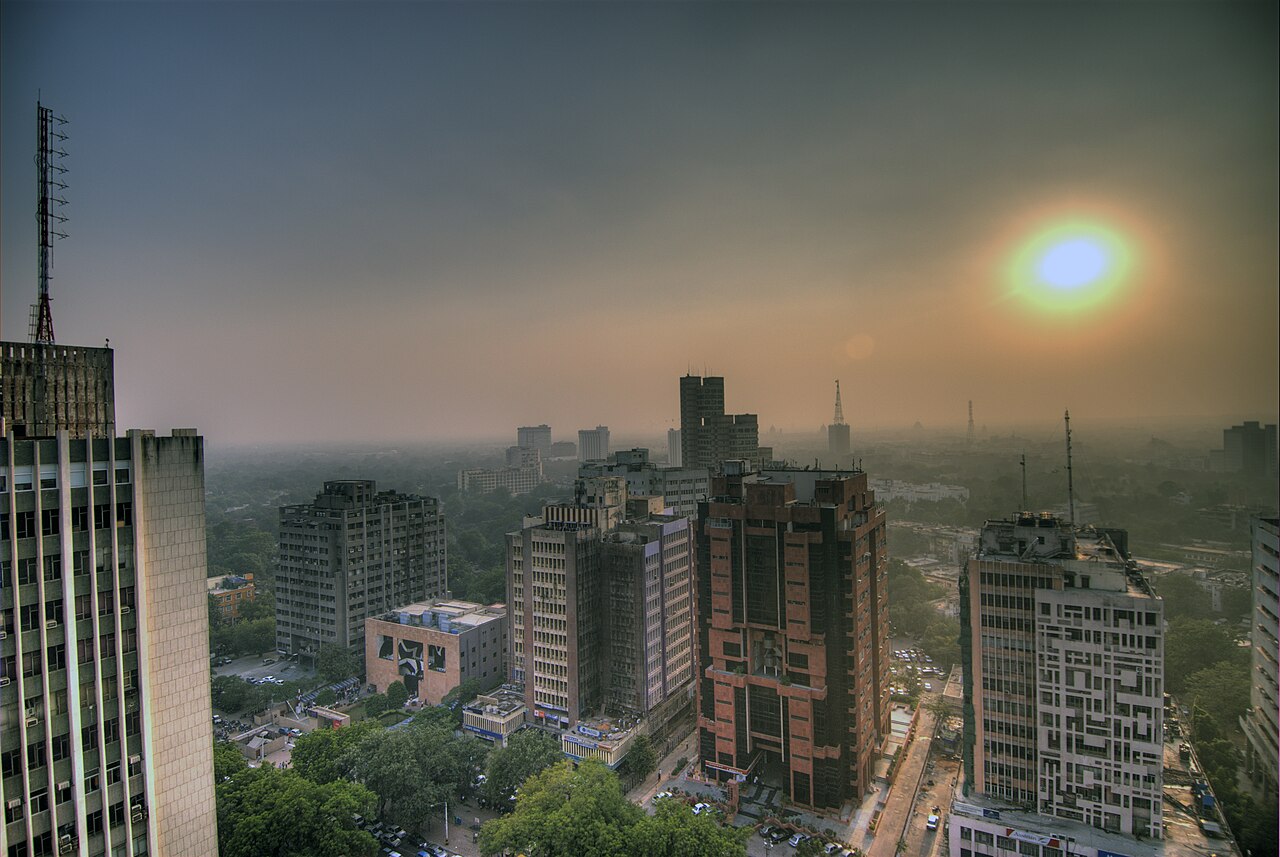
On 6 November 2026, the Supreme Court described bans on vehicles and construction in Delhi as “old, tried and failed tools”. The Bench was headed by Chief Justice of India Surya Kant. It asked the Union government and the Commission for Air Quality Management (CAQM) whether they had any scientific method other than stopping vehicles and stopping construction. On the same day, the city’s Air Quality Index (AQI) crossed 400 and GRAP Stage III curbs came into force.
Summary
- The Court said emergency bans had not stopped the yearly winter smog. It noted there is no real check on the fuel or condition of vehicles entering Delhi.
- The Centre said GRAP measures were not a complete failure. It said rapid urbanisation, festive activities and stubble burning make pollution control an uphill task.
- The Bench also said that the showy, status-driven celebration of Deepavali was making the air worse, while the poor suffer the most.
What did the Supreme Court Observe?
- Reactive approach: Bans on construction and vehicles are temporary. They start only after the AQI has already reached ‘severe’ levels, so the damage is done before they apply.
- Weak enforcement: There is no reliable way to check what fuel incoming vehicles use or how much they emit.
- Normalisation of bad air: The Bench said ‘very poor’ air has become the normal state in Delhi, and the debate now is only about ‘severe’ versus ‘very severe’.
- Role of citizens: The Court said no court order can clear the smog unless people change their behaviour. It suggested awareness campaigns and simpler festival practices.
What is the Commission for Air Quality Management (CAQM)?
- Legal basis: It was set up under the Commission for Air Quality Management in National Capital Region and Adjoining Areas Act, 2021. It replaced the Environment Pollution (Prevention and Control) Authority (EPCA), which the Supreme Court had created in 1998.
- Jurisdiction: The NCR and the adjoining areas of Punjab, Haryana, Rajasthan and Uttar Pradesh where air pollution sources affect Delhi’s air.
- Powers: It coordinates the Centre and the States, issues binding directions, and enforces GRAP. On matters of air quality in the NCR, its orders prevail over those of the State pollution boards.
What is the Graded Response Action Plan (GRAP)?
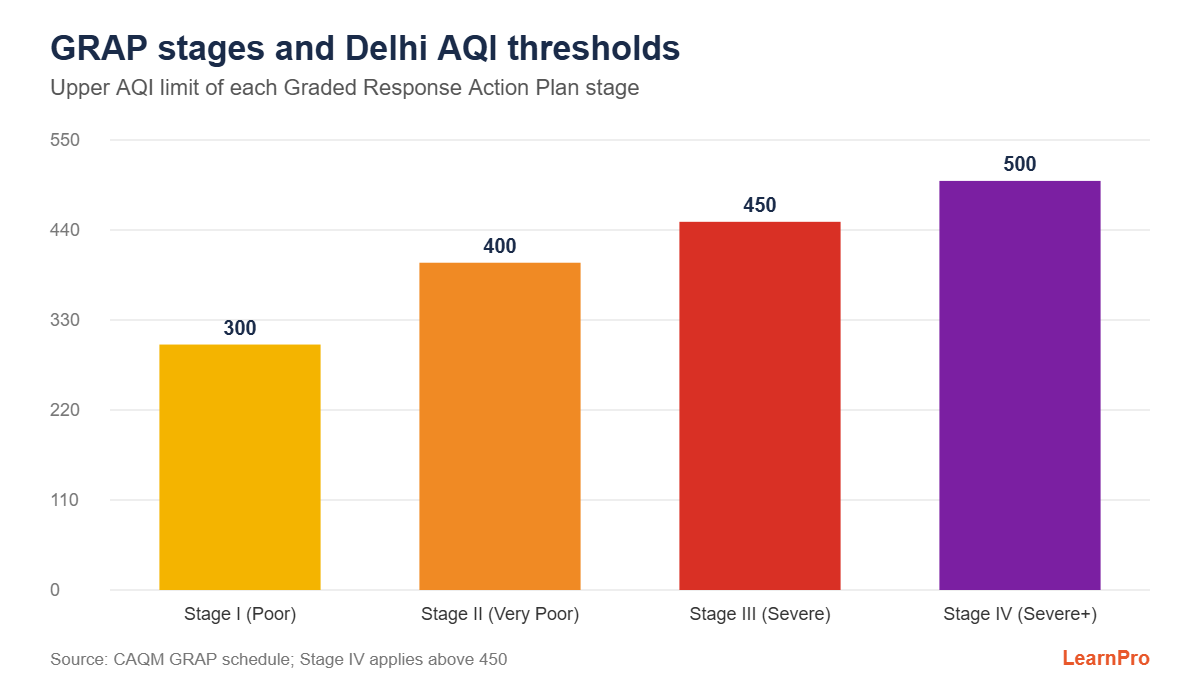
GRAP is an emergency plan that is applied in stages, linked to the AQI level in Delhi-NCR.
| Stage | AQI range | Illustrative measures |
|---|---|---|
| Stage I – Poor | 201–300 | Dust control at sites, mechanised road sweeping, enforcement of PUC norms |
| Stage II – Very Poor | 301–400 | Restrictions on diesel generator sets, higher parking fees to discourage private vehicles |
| Stage III – Severe | 401–450 | Ban on non-essential construction and demolition, curbs on BS-III petrol and BS-IV diesel four-wheelers |
| Stage IV – Severe+ | Above 450 | Entry ban on non-essential trucks, option of work-from-home and hybrid classes |
Why does Delhi’s Air Turn Toxic Every Winter?
- Meteorology: In winter, cold air near the ground gets trapped under warmer air above (temperature inversion). Calm winds and a low mixing height then hold pollutants close to the ground.
- Geography: Delhi lies in the land-locked Indo-Gangetic Plain. North-westerly winds carry smoke from crop-residue burning in Punjab and Haryana into the city.
- Local sources: Vehicle exhaust, road and construction dust, industries, waste burning and biomass used for cooking and heating.
- Regional sources: Much of Delhi’s PM2.5 comes from outside the city. Controls limited to Delhi alone therefore cannot work.
Why are Emergency Bans Called ‘Failed Tools’?
- They react after the event: They act after the peak, while the main sources such as old vehicles, open burning and industrial fuel stay active all year.
- Heavy economic cost: Construction bans hurt daily-wage workers and delay projects, with only a short-term gain in air quality.
- Enforcement gaps: PUC checks, dust rules and the ban on open burning are not strongly enforced on the ground.
- No airshed planning: Each State acts within its own borders, but polluted air crosses those borders.
Way Forward
- Airshed-based management: A single, enforceable plan for the whole Indo-Gangetic airshed, with targets for each sector.
- Clean mobility: Faster electrification of buses and last-mile transport, congestion pricing, and remote sensing to catch high-emitting vehicles.
- Crop-residue solutions: In-situ and ex-situ management, markets for paddy straw (biomass co-firing, compressed biogas), and diversification away from paddy.
- Dust and waste: Mandatory dust-control systems at construction sites, and processing of legacy waste to stop landfill fires.
- Source apportionment in real time: Publicly available data so that action targets the source that is dominant on a given day.
- Behavioural change: Green crackers, community celebrations and public awareness, as the Court suggested.
Conclusion
The Supreme Court’s remarks show that emergency bans cannot fix a problem that has many sources and lasts all year. Lasting improvement needs year-round, regional, data-driven action across transport, farming, industry and cities. GRAP should be the last line of defence, not the main policy.
Frequently Asked Questions (FAQs)
1. Under which law was the CAQM created?
The Commission for Air Quality Management in National Capital Region and Adjoining Areas Act, 2021.
2. At what AQI level does GRAP Stage III apply?
When Delhi’s AQI is in the ‘Severe’ range of 401–450.
3. Why is the air worse in winter than in the monsoon?
Temperature inversion, low wind speed and a low mixing height trap pollutants, and stubble burning adds to the load.
Practice Question
Mains: “Emergency measures such as GRAP manage the symptoms of air pollution in the NCR, not its causes.” Critically examine this statement and suggest an airshed-based approach. (250 words)
Sources and further reading
- wili hybridcommons.wikimedia.org