
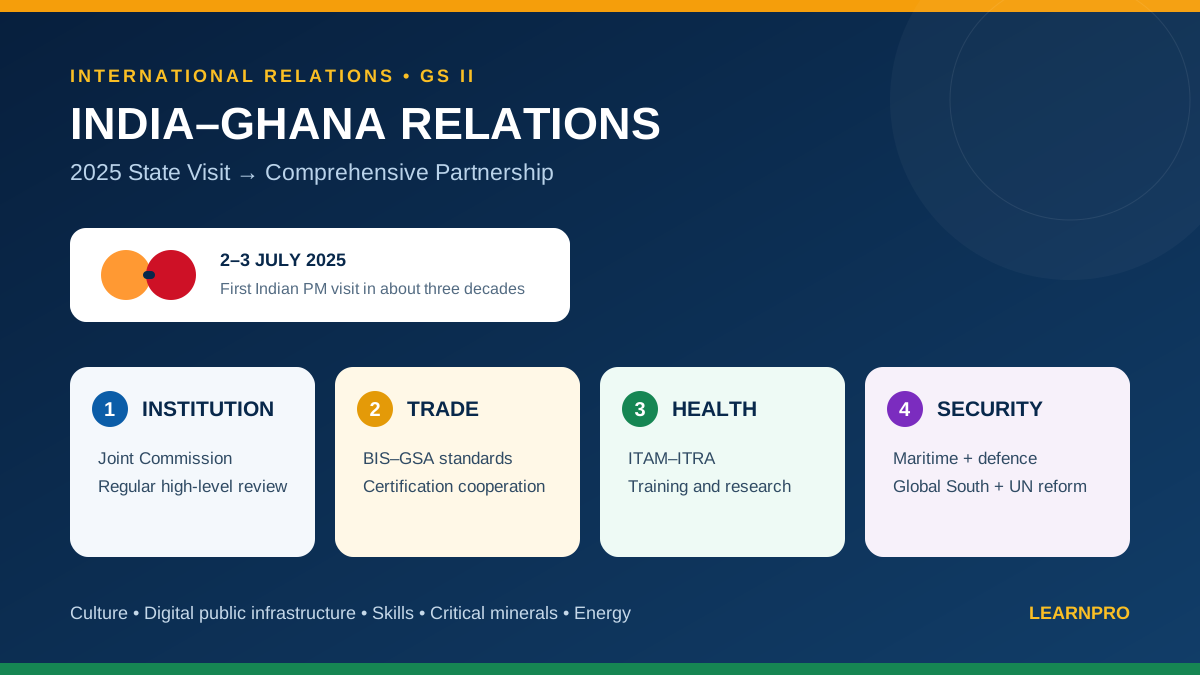
India-Ghana relations entered a new phase during Prime Minister Narendra Modi’s state visit to Ghana on 2–3 July 2025. It was the first visit by an Indian Prime Minister to Ghana in about three decades. India and Ghana elevated their ties to a Comprehensive Partnership and exchanged four memoranda of understanding covering institutional dialogue, culture, standards and traditional medicine.
The visit matters beyond ceremony. Ghana is a stable democracy, an important economy in West Africa, a member of the African Union and the headquarters country of the African Continental Free Trade Area Secretariat. For India, stronger cooperation with Ghana links trade, development partnership, energy and maritime security with its wider engagement with Africa and the Global South.
Why was the 2025 visit significant?
- High-level reset: it ended a gap of roughly three decades in visits by an Indian Prime Minister.
- Upgraded relationship: President John Dramani Mahama and Prime Minister Modi elevated bilateral ties to a Comprehensive Partnership.
- Institutional outcomes: four MoUs created practical channels for regular dialogue and sectoral cooperation.
- West Africa outreach: the visit reinforced India’s engagement with Ghana, ECOWAS and the African Union.
- Global South agenda: both countries supported South-South cooperation, sustainable development and reform of global institutions.
What were the four signed outcomes?
| Agreement | Purpose | Practical importance |
|---|---|---|
| Joint Commission Meeting | Institutionalise high-level dialogue and periodic review | Prevents cooperation from depending only on occasional leader-level visits |
| Cultural Exchange Programme | Promote exchange in art, music, dance, literature and heritage | Expands people-to-people ties and cultural diplomacy |
| BIS–GSA MoU | Cooperate on standardisation, certification and conformity assessment | Can reduce technical barriers and improve trust in traded goods |
| ITAM–ITRA MoU | Collaborate in traditional-medicine education, training and research | Connects Ghanaian institutions with India’s Ayurveda expertise |
The standards agreement deserves special attention. Tariffs are not the only obstacle to trade; incompatible testing, certification and product standards can also raise costs. Cooperation between the Bureau of Indian Standards and Ghana Standards Authority can make market access more predictable. This complements India’s broader effort to improve manufacturing quality, discussed in LearnPro’s guide to India’s manufacturing policy.
Areas identified for deeper cooperation
The official talks covered a wider agenda than the four signed MoUs:
- trade and investment, including more business links and diversified commerce;
- health and pharmaceuticals, where affordable Indian medicines and capacity building can support public health;
- digital public infrastructure, fintech and India’s Unified Payments Interface;
- skills and education, including training linked to jobs and enterprise;
- critical minerals and energy, which connect Ghana’s resources with resilient supply chains;
- defence and maritime security, including training and possible equipment cooperation; and
- agriculture and technology, where machinery, processing and knowledge exchange can raise productivity.
India offered to share experience in health, pharmaceuticals, digital public infrastructure, UPI and skill development. The distinction between a proposal and a concluded agreement is important: future cooperation was discussed in areas such as vaccine manufacturing, agricultural machinery and defence, but the official outcomes list records only the four MoUs above.
Digital cooperation and development partnership
Digital systems can give the partnership visible public value. Payments interoperability, digital identity, public-service platforms and secure data exchange may reduce transaction costs, widen access and improve delivery. However, technology transfer should include local capacity, cybersecurity, privacy safeguards and open standards rather than simply export a finished platform.
India’s own experience shows why digital infrastructure needs both scale and safeguards. Read the connected explainer on the Digital India decade.
Trade and economic significance
Ghana provides access to a growing West African market and hosts the Secretariat of the African Continental Free Trade Area. Indian firms have a long presence in sectors such as pharmaceuticals, manufacturing, agriculture, services and construction. Ghana can benefit from investment, technology and value addition; India can gain a reliable commercial partner and stronger access to regional markets.
A durable economic relationship should not be limited to exporting finished goods or extracting raw materials. It should support:
- local processing and manufacturing in Ghana;
- skills and managerial training;
- transparent financing and responsible business conduct;
- quality standards that protect consumers without becoming hidden trade barriers; and
- small-business links, not only large corporate projects.
Security and strategic dimension
The Gulf of Guinea faces piracy, illegal fishing, trafficking and other maritime risks. Cooperation in training, maritime awareness and defence can help Ghana strengthen capacity while supporting safer sea lanes. Critical-mineral cooperation also has strategic value as countries seek more resilient supply chains for clean energy and advanced manufacturing.
India must nevertheless avoid treating Africa only as an arena of competition with other powers. The more credible approach is African priorities, local ownership and mutually beneficial capacity building. This principle also applies to development partnerships elsewhere, as shown in LearnPro’s analysis of India-Bhutan development cooperation.
People, culture and political trust
Ghana and India share anti-colonial histories, democratic institutions and support for South-South cooperation. During the visit, the Prime Minister addressed Ghana’s Parliament and paid tribute at the Kwame Nkrumah Memorial Park. Ghana conferred the title Officer of the Order of the Star of Ghana on him.
The Indian community in Ghana—described by the Prime Minister’s Office as about 15,000 strong—supports commerce and social links. Cultural exchanges, education and professional mobility can widen the relationship beyond government and business elites.
Global South and multilateral cooperation
India and Ghana called for stronger global action against terrorism and discussed reform of the United Nations. Their shared interest is a system in which Africa, India and other developing regions have greater representation in institutions created after the Second World War.
Ghana’s role in African institutions and India’s presidency-era advocacy for the African Union’s permanent G20 membership give the partnership a wider diplomatic purpose. Cooperation can focus on debt sustainability, climate finance, food and energy security, health access and technology governance.
Challenges in India-Ghana relations
- Implementation gap: declarations and MoUs need timelines, responsible agencies and measurable outcomes.
- Trade concentration: commodity-heavy commerce is exposed to price cycles and creates limited local value.
- Financing risk: projects must remain transparent, affordable and aligned with Ghana’s debt position.
- Standards capacity: laboratories, accreditation and trained personnel are necessary for the BIS–GSA agreement to work.
- Security sensitivity: defence cooperation needs accountability and should match Ghana’s stated needs.
- Digital trust: DPI cooperation must protect personal data and national ownership.
A practical roadmap
- Activate the Joint Commission with an annual public progress note and sector-specific working groups.
- Convert the standards MoU into trade facilitation through laboratory partnerships, mutual learning and support for small exporters.
- Build value chains in Ghana in pharmaceuticals, agro-processing and light manufacturing.
- Design responsible digital projects around interoperability, cybersecurity, privacy and local skills.
- Expand maritime cooperation in training, domain awareness, illegal fishing and disaster response.
- Coordinate in multilateral forums on UN reform, climate finance and development priorities.
UPSC and State PSC relevance
India-Ghana relations are relevant to GS Paper II under bilateral relations, India’s engagement with Africa, regional groupings and the Global South. The topic also connects with GS Paper III through maritime security, critical minerals, digital infrastructure and trade standards.
Mains practice question: The 2025 India-Ghana state visit combined bilateral cooperation with India’s wider engagement in West Africa and the Global South. Examine the outcomes, opportunities and implementation challenges.
Conclusion
The 2025 visit gave India-Ghana relations a clearer institutional structure and a broader economic and strategic agenda. Its success will depend on whether the Comprehensive Partnership produces regular dialogue, reliable standards, local value creation, secure digital systems and tangible public benefits. Implementation—not the number of announcements—will be the real test.
Frequently asked questions
When did the 2025 India-Ghana state visit take place?
Prime Minister Narendra Modi visited Ghana on 2–3 July 2025, the first visit by an Indian Prime Minister in about three decades.
How were India-Ghana relations upgraded?
President John Dramani Mahama and Prime Minister Modi elevated the relationship to a Comprehensive Partnership.
Which four MoUs were exchanged?
They covered the Joint Commission Meeting, a Cultural Exchange Programme, cooperation between BIS and Ghana Standards Authority, and traditional-medicine cooperation between ITAM and ITRA.
Why is Ghana important to India?
Ghana is a stable West African democracy, hosts the AfCFTA Secretariat and offers opportunities in trade, health, digital systems, critical minerals, energy and maritime security.
What is the main implementation challenge?
The partnership needs timelines, sector working groups, local capacity and transparent monitoring so that MoUs become measurable outcomes.
Primary references and official updates
- Prime Minister of India: official list of outcomes
- Prime Minister of India: meeting with President Mahama
- Prime Minister of India: visit announcement and regional context
- University of Health and Allied Sciences: ITAM–ITRA cooperation
- Ghana High Commission: official visit summary





Sources and further reading
- Prime Minister of India: official list of outcomespmindia.gov.in
- Prime Minister of India: meeting with President Mahamapmindia.gov.in
- Prime Minister of India: visit announcement and regional contextpmindia.gov.in
- University of Health and Allied Sciences: ITAM–ITRA cooperationitam.uhas.edu.gh
- Ghana High Commission: official visit summarynewdelhi.mfa.gov.gh