
Digital India is the Government of India’s programme for using digital infrastructure, platforms and skills to improve public services and economic participation. Launched on 1 July 2015, it is often described through visible services such as Aadhaar, UPI and DigiLocker. Its deeper significance is institutional: identity, payments, documents and data exchange have become reusable public infrastructure.
Ten years of scale do not, however, prove that every citizen receives an equal or safe service. The next phase must measure successful outcomes, inclusion, privacy, cybersecurity and grievance redressal—not merely registrations, downloads or transactions.
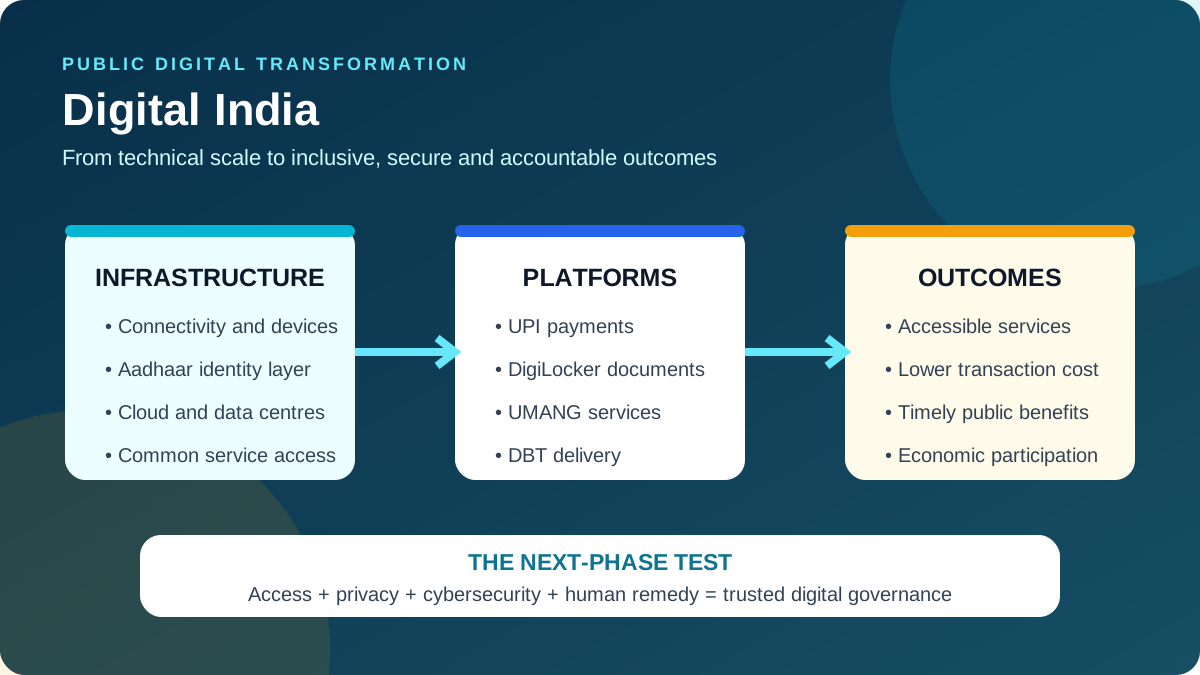
What is Digital India?
The programme was designed around three broad vision areas:
- digital infrastructure as a core utility, including connectivity, digital identity and access to service centres;
- governance and services on demand, with integrated, online and cashless delivery; and
- digital empowerment of citizens through access, digital literacy and content in Indian languages.
Digital India is therefore not one application. It is an umbrella connecting telecommunications, electronics manufacturing, e-governance, digital payments, public digital platforms, cybersecurity and skills. This distinction is important for UPSC and State PSC answers: digitisation converts information into digital form, digitalisation improves a process with technology, while digital transformation redesigns the institution itself.
Digital India achievements after ten years
A June 2025 government review recorded a sharp expansion in both access and public platforms. The figures below are dated benchmarks, not timeless claims.
| Area | Official milestone | Why it matters |
|---|---|---|
| Internet access | Connections rose from 25.15 crore in 2014 to 96.96 crore in 2024 | A larger base for online learning, commerce and public services |
| 5G | 4.74 lakh towers covered 99.6% of districts by the 2025 review | Rapid network rollout, though district coverage is not the same as universal household access |
| BharatNet | 2.18 lakh Gram Panchayats connected with high-speed internet | Backbone for rural public institutions and last-mile providers |
| UPI | 1,867.7 crore transactions worth ₹24.77 lakh crore in April 2025 | Low-friction, interoperable retail payments |
| DigiLocker | 53.92 crore users by June 2025 | Verifiable digital documents reduce repeated paperwork |
| UMANG | About 2,300 services in 23 languages in the 2025 review | A common access layer for many government services |
NPCI data show that UPI continued to grow: in May 2026 it processed about 23.20 billion transactions worth ₹29.90 lakh crore. The DBT Bharat dashboard, viewed in July 2026, reported cumulative transfers above ₹52.58 lakh crore across hundreds of schemes. These are signs of scale, but transaction totals alone do not measure whether a beneficiary obtained the correct entitlement on time.
How digital public infrastructure works
India’s model is increasingly discussed as digital public infrastructure (DPI). DPI provides shared building blocks on which government and private innovators can create services.
- Identity layer: Aadhaar can support identification and authentication where a law or valid purpose permits it.
- Payments layer: UPI connects banks and payment applications through interoperable rules.
- Documents and consent: DigiLocker supplies verifiable records, while consent-based systems should give people meaningful control over data sharing.
- Service layer: portals such as UMANG, DBT systems and sector platforms use these components to deliver benefits.
The main policy advantage is reusability. Every department need not build identity verification, payment rails or document exchange from zero. The corresponding risk is concentration: failure, exclusion or weak safeguards in a shared layer can affect many services at once.
Economic and governance impact
MeitY’s measurement report estimated that the digital economy contributed 11.74% of India’s national income in 2022–23 and projected 13.42% for 2024–25. The estimate covers more than consumer internet companies; it includes information and communication industries, digital platforms and the digital component of traditional sectors.
Four effects are especially relevant:
- lower transaction costs: instant payments and digital records reduce time and paperwork;
- more portable services: a person can access documents and some entitlements beyond the issuing office;
- better audit trails: electronic workflows can improve traceability, although an audit trail is useful only when institutions act on it;
- new markets: small firms and creators can reach customers through digital payments, commerce and service platforms.
The strongest claim is not that technology removes the state, but that it can make the state faster, more legible and easier to audit. Human assistance and offline alternatives remain essential when connectivity, literacy or authentication fails.
Major gaps in Digital India
| Gap | Why headline statistics can mislead | Better policy response |
|---|---|---|
| Digital divide | A connected district may still contain households without affordable devices, reliable signal or electricity | Measure meaningful use, affordability, speed and device access by gender, disability and income |
| Exclusion | A portal may be online while authentication, language or documentation blocks the claimant | Assisted access, offline fallback and time-bound human appeal |
| Privacy | Consent can become a compulsory checkbox where bargaining power is unequal | Data minimisation, purpose limitation, clear notices and enforceable rights |
| Cybersecurity | Higher transaction volume increases the attack surface for fraud and data theft | Secure-by-design procurement, audits, incident reporting and user compensation rules |
| Platform accountability | Automated decisions may be difficult to understand or challenge | Explainability, independent oversight and accessible grievance systems |
For women and children, access and safety must be addressed together. LearnPro’s analysis of technology for women and children explains how platforms can expand services while reproducing device, privacy and safety inequalities. Our related discussion of women’s digital safety examines platform design and online harm.
Data protection after the 2025 Rules
The Digital Personal Data Protection Act, 2023 created the national framework for processing digital personal data. The Digital Personal Data Protection Rules, 2025 operationalised important parts of that framework. Compliance should not be reduced to displaying a privacy notice. Public systems need a lawful purpose, collect only necessary data, secure it, define retention, respect applicable rights and provide usable remedies.
Children, welfare beneficiaries and people compelled to use a monopoly public portal need stronger design safeguards because their consent may not resemble a free commercial choice.
Priorities for the next phase
- Move from coverage to quality: publish service-level data on uptime, speed, failed transactions and appeal resolution.
- Build multilingual and accessible interfaces: test with users who have low literacy, disabilities and basic devices.
- Guarantee an offline alternative: no eligible person should lose an essential benefit solely because a device or authentication fails.
- Strengthen cyber resilience: require independent audits, rapid incident disclosure, secure software supply chains and trained local staff.
- Make grievance redressal visible: provide a tracking number, a reasoned decision and escalation to a human authority.
- Use open standards carefully: interoperability can reduce lock-in, but access controls and liability must travel with the data.
- Audit algorithms: high-impact automated decisions should be tested for accuracy, discrimination and contestability.
UPSC and State PSC relevance
Digital India connects GS Paper II topics—governance, transparency, welfare delivery and rights—with GS Paper III topics such as infrastructure, cybersecurity, innovation and inclusive growth. A balanced answer should use dated achievements, distinguish access from outcomes, and connect technology with constitutional values.
Mains practice question: Digital public infrastructure has increased the scale and speed of governance in India, but inclusion and accountability determine its legitimacy. Discuss with examples from Digital India.
Conclusion
Digital India’s first decade built infrastructure and platforms at exceptional scale. The next decade should be judged by a stricter test: can every eligible person use a safe service, understand the decision and obtain a timely remedy when the system fails? Scale creates opportunity; rights, resilience and institutional accountability convert it into public value.
Frequently asked questions
When was Digital India launched?
Digital India was launched on 1 July 2015 to expand digital infrastructure, deliver services on demand and digitally empower citizens.
Is Digital India the same as digital public infrastructure?
No. Digital India is a broad government programme. Digital public infrastructure refers to shared digital building blocks such as identity, payments and document exchange used by many services.
What are major achievements of Digital India?
Major achievements include wider internet and 5G coverage, BharatNet connectivity, very large-scale UPI payments, DigiLocker documents, UMANG services and digitally delivered benefits.
What is the biggest challenge for Digital India?
The central challenge is converting technical reach into inclusive, reliable and rights-respecting outcomes, especially for people facing affordability, literacy, language, disability or authentication barriers.
Why is Digital India important for UPSC?
It links governance, welfare delivery, transparency and rights with infrastructure, cybersecurity, innovation and inclusive growth across GS Papers II and III.
Primary references
- Press Information Bureau: Ten Years of Digital Progress
- NPCI: UPI product statistics
- DBT Bharat: official transfer dashboard
- MeitY: Estimation and Measurement of India’s Digital Economy
- MeitY: Digital personal data protection framework





Sources and further reading
- Press Information Bureau: Ten Years of Digital Progresspib.gov.in
- NPCI: UPI product statisticsnpci.org.in
- DBT Bharat: official transfer dashboarddbtbharat.gov.in
- MeitY: Estimation and Measurement of India’s Digital Economymeity.gov.in
- MeitY: Digital personal data protection frameworkmeity.gov.in