
Newspaper editorial analysis for UPSC should not mean copying a columnist’s opinion into a notebook. An editorial is useful because it identifies a public issue, competing arguments and possible consequences. Your notes become exam-ready only after those claims are mapped to the syllabus, checked against primary sources and compressed into material that can answer a Prelims statement or a Mains question.
Objective: Convert one editorial into a one-page note containing verified facts, constitutional or legal anchors, multidimensional analysis, a Prelims question and a Mains answer framework—in about 20 minutes.
Why editorials cannot be used as notes directly
An editorial is an argument written for public debate. UPSC questions, by contrast, test conceptual clarity, factual accuracy, institutional understanding and balanced judgement. The two formats overlap, but they are not identical.
- Selective evidence: A columnist may use facts that support one conclusion while omitting counter-evidence.
- Unclear syllabus link: A strong opinion may still be irrelevant to a specific GS paper or optional subject.
- Time-sensitive claims: Numbers, appointments, court proceedings and scheme details may have changed after publication.
- Persuasive language: Words such as “historic”, “failure”, “unprecedented” or “anti-growth” are judgements, not facts.
- Poor retrieval: Long paragraphs are difficult to revise before the examination.
The right approach is to treat the editorial as a lead. It tells you what to investigate; it does not finish the investigation for you.
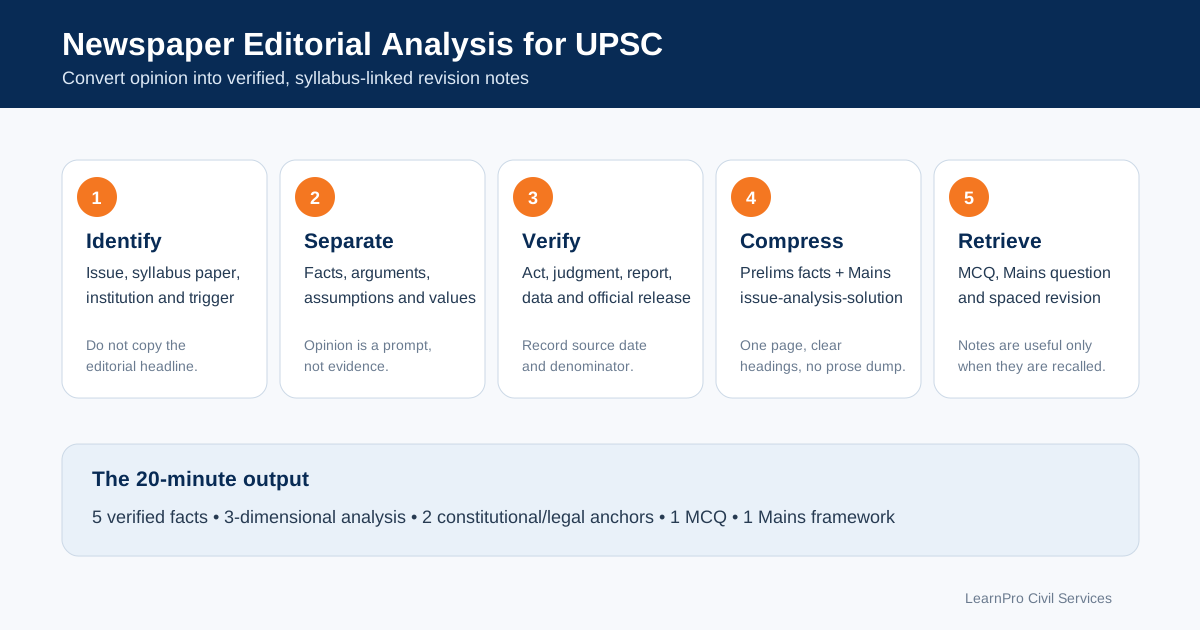
Five-step method for newspaper editorial analysis for UPSC
Step 1: Identify the issue, not the headline
Write the underlying issue in six to ten words. “A setback for federalism” is an opinionated headline; “Centre–State fiscal relations” is the issue. “Cities are becoming unliveable” may become “urban heat, planning and public health”. This neutral label helps you find the correct syllabus location and prevents the columnist’s framing from controlling your notes.
Then record:
- GS paper and exact syllabus phrase;
- the event that triggered the editorial;
- the principal institution—Parliament, court, ministry, regulator, local body or international organisation;
- whether the issue is primarily legal, economic, social, environmental, ethical or international.
Step 2: Separate four kinds of sentences
| Type | How to recognise it | What to do |
|---|---|---|
| Fact | A verifiable date, number, legal provision or institutional act | Check it against a primary or authoritative source. |
| Argument | A stated cause, consequence or policy claim | Record the reasoning and look for a counter-argument. |
| Assumption | An unstated link on which the argument depends | Ask whether the relationship is proven or merely plausible. |
| Value judgement | Language about what is fair, desirable, excessive or inadequate | Translate it into constitutional values or ethical principles. |
This classification is especially useful for Mains. A balanced answer can accept the editorial’s valid concern while identifying limits in its evidence or proposed solution.
Step 3: Verify through a source hierarchy
Do not open ten websites for every claim. Use the most authoritative source appropriate to the claim.
| Claim in the editorial | Preferred source | What to capture |
|---|---|---|
| Act, rule or statutory definition | India Code or the Gazette | Exact provision, extent, commencement and exceptions. |
| Government decision or scheme | Ministry website, Cabinet release or Press Information Bureau | Objective, target group, funding, implementing agency and date. |
| Bill or legislative comparison | Bill text, standing-committee report and PRS Legislative Research | Proposed change, current law, key issues and legislative status. |
| Judgment | Supreme Court of India or relevant High Court | Case, bench/date, legal issue, holding and operative direction. |
| Economic or social data | MoSPI, RBI, NFHS, Census or responsible ministry | Reference period, unit, denominator, geography and revision status. |
| Public finance or audit finding | Budget documents, Finance Commission or CAG of India | Scope of audit, period, finding and official response. |
A newspaper report can help locate a document, but your note should cite the document wherever possible. This source habit also improves the authority of UPSC Mains answer writing.
Step 4: Build separate Prelims and Mains layers
One topic should not become two unrelated notebooks. Keep a common issue page with two clearly marked layers.
Prelims layer
- two definitions;
- two constitutional, statutory or institutional facts;
- one current development with its date;
- one common confusion or exception;
- one self-made multiple-choice question.
Mains layer
- one-sentence context;
- three causes or structural drivers;
- three consequences across different dimensions;
- existing constitutional, legal and policy mechanisms;
- implementation gaps;
- a practical, prioritised way forward;
- one balanced concluding line.
For an example of a current-affairs article organised around evidence, constraints and reforms, see LearnPro’s analysis of India’s export strategy and global value chains.
Step 5: Convert notes into retrieval practice
Highlighting is not revision. Close the source and answer three prompts from memory:
- What is the issue and why does it matter?
- Which three verified facts or provisions anchor it?
- What would a balanced policy response contain?
Create one MCQ immediately and write a 150- or 250-word answer within the week. Revisit the note after one day, seven days and one month. If you cannot recall the structure, shorten or reorganise it rather than adding more material.
The 20-minute editorial-to-notes workflow
| Time | Task | Output |
|---|---|---|
| 0–3 minutes | Read headline, opening, conclusion and topic sentences | Neutral issue statement and syllabus tag. |
| 3–7 minutes | Mark facts, arguments, assumptions and value judgements | A claim list; no full-sentence copying. |
| 7–13 minutes | Open two or three primary sources | Verified provision, latest data and institutional position. |
| 13–17 minutes | Write Prelims and Mains layers | Five facts plus issue–analysis–solution framework. |
| 17–20 minutes | Create one question and recall without looking | MCQ, Mains prompt and revision date. |
A difficult editorial may require more research. Stop after establishing a reliable base and place unanswered claims in a “verify later” box. Guessing to finish within 20 minutes defeats the method.
Data hygiene: how to avoid factual errors
UPSC options frequently become wrong because one qualifier is changed. Treat every statistic as a complete data object, not a memorable number.
- Reference period: Financial year, calendar year, survey round or census year?
- Unit: Rupees, dollars, percentage, percentage points, index value or physical quantity?
- Denominator: Share of GDP, population, workforce, households or government expenditure?
- Coverage: India, selected states, rural areas, urban areas, formal sector or all workers?
- Price basis: Current prices or constant prices? Nominal or real growth?
- Status: Provisional, revised, advance estimate or final?
- Authority and date accessed: Record both beside the number.
Never combine figures from different definitions or years merely because they appear to describe the same issue. If sources disagree, preserve the disagreement and explain the methodology.
Worked example: converting an urban-heat editorial
Suppose an editorial argues that Indian cities are unprepared for extreme heat. Do not copy its rhetoric. Convert it as follows:
- Issue: Urban heat risk, planning and public health.
- Syllabus: GS-I urbanisation; GS-II health and local governance; GS-III disaster management and climate adaptation.
- Verify: IMD terminology, National Disaster Management Authority guidance, city heat-action plan, mortality or temperature data with dates.
- Prelims facts: Heat-wave criteria, relevant institutions, urban-heat-island concept, plan components and vulnerable groups.
- Mains dimensions: Land cover, housing, water, electricity, occupational exposure, public health, local finances and data gaps.
- Way forward: Ward-level risk mapping, cool roofs, shaded public spaces, water and health protocols, worker protection, early warning and heat-resilient building rules.
- Question: “Urban heat is as much a planning and inequality problem as a climate problem.” Discuss.
The result is neutral, sourced and reusable. The newspaper supplied the trigger; your method produced the UPSC note.
Common mistakes in editorial note-making
- Reading every editorial: Select by syllabus relevance, not newspaper prominence.
- Copying elegant phrases: UPSC rewards clear reasoning more reliably than borrowed rhetoric.
- Ignoring the counter-view: A Mains answer should acknowledge trade-offs and implementation constraints.
- Collecting without revising: Ten pages that are never recalled are less useful than one revisable page.
- Using coaching summaries as the final authority: They help comprehension, but laws, judgments and data should be verified at source.
- Forcing local examples into every answer: Use a case study only when it proves a relevant point.
- Adding unsupported numbers: A correct qualitative explanation is better than a doubtful statistic.
- Ignoring PYQs: Previous questions reveal the depth and angle at which UPSC tests the issue.
Weekly system for current affairs notes
Use daily notes for capture and a weekly page for consolidation:
- merge repeated coverage of the same issue;
- delete claims that could not be verified;
- update changed data or legal status;
- attach relevant PYQs;
- write one 250-word answer;
- move stable facts into subject notes;
- retain only the best example for each argument.
This prevents current affairs from becoming a separate, unmanageable subject. Use the LearnPro Current Affairs hub to connect daily developments with subject categories, and use a limited set of standard references such as those in the UPSC Prelims booklist for conceptual revision.
Conclusion
Effective newspaper editorial analysis for UPSC is a process of disciplined conversion: identify the issue, separate claim types, verify primary sources, compress the result and practise retrieval. The goal is not to preserve what a columnist wrote. It is to build accurate, balanced and reusable knowledge for Prelims, Mains and the Interview.
Frequently asked questions
How many newspaper editorials should a UPSC aspirant read daily?
Usually one or two syllabus-relevant editorials are sufficient. Selection and conversion matter more than volume. Skip pieces that contain no useful policy issue, institution, evidence or exam connection.
Should I make separate Prelims and Mains current-affairs notes?
Keep one topic page with two layers: a compact fact and institution section for Prelims, and an issue–analysis–solution framework for Mains. This reduces duplication and improves revision.
Which newspaper is best for UPSC editorial analysis?
Any reliable national newspaper can provide issue triggers. The decisive factor is whether you verify laws, judgments, official data and government decisions through primary sources instead of treating the newspaper as the final authority.
How long should one editorial note be?
A one-page note is a useful default. It should contain the issue, syllabus tags, five verified facts, three analytical dimensions, legal or constitutional anchors, a way forward and one practice question.
Can I quote an editorial in a UPSC Mains answer?
A short attributed idea may occasionally help, but clear analysis, constitutional values, committee findings, verified data and relevant examples are more reliable. Never present a columnist’s opinion as an established fact.
How do I know whether a statistic is safe to use?
Record the source, reference period, unit, denominator, coverage and whether the figure is provisional or revised. If any of these are unclear, verify the underlying report or omit the number.
What is the best way to revise editorial notes?
Use active recall and spaced review. Create one MCQ, one Mains question and revisit the note after one day, seven days and one month. Consolidate repeated issues weekly.





Sources and further reading
- India Codeindiacode.nic.in
- Press Information Bureaupib.gov.in
- PRS Legislative Researchprsindia.org
- Supreme Court of Indiasci.gov.in
- MoSPImospi.gov.in