
Source: Supreme Court records; Business Today and Kerala Kaumudi reports, November 2026
For Prelims: Article 124, Chief Justice of India, Memorandum of Procedure, Collegium system, Seniority convention, Women judges of the Supreme Court, Justice Fathima Beevi.
For Mains: Appointment of judges, short tenures of CJIs, diversity in the higher judiciary, role of dissent in constitutional adjudication.
Table of Contents
- Why in News?
- Profile at a Glance
- Her Notable Opinions
- How is the Chief Justice of India Appointed?
- Women in the Supreme Court
- Issues Highlighted
- Way Forward
- Conclusion
- UPSC Previous Year Questions (PYQs)
- Prelims Practice Question
- Mains Practice Question
- Frequently Asked Questions (FAQs)
- Related Reads on LearnPro
Why in News?
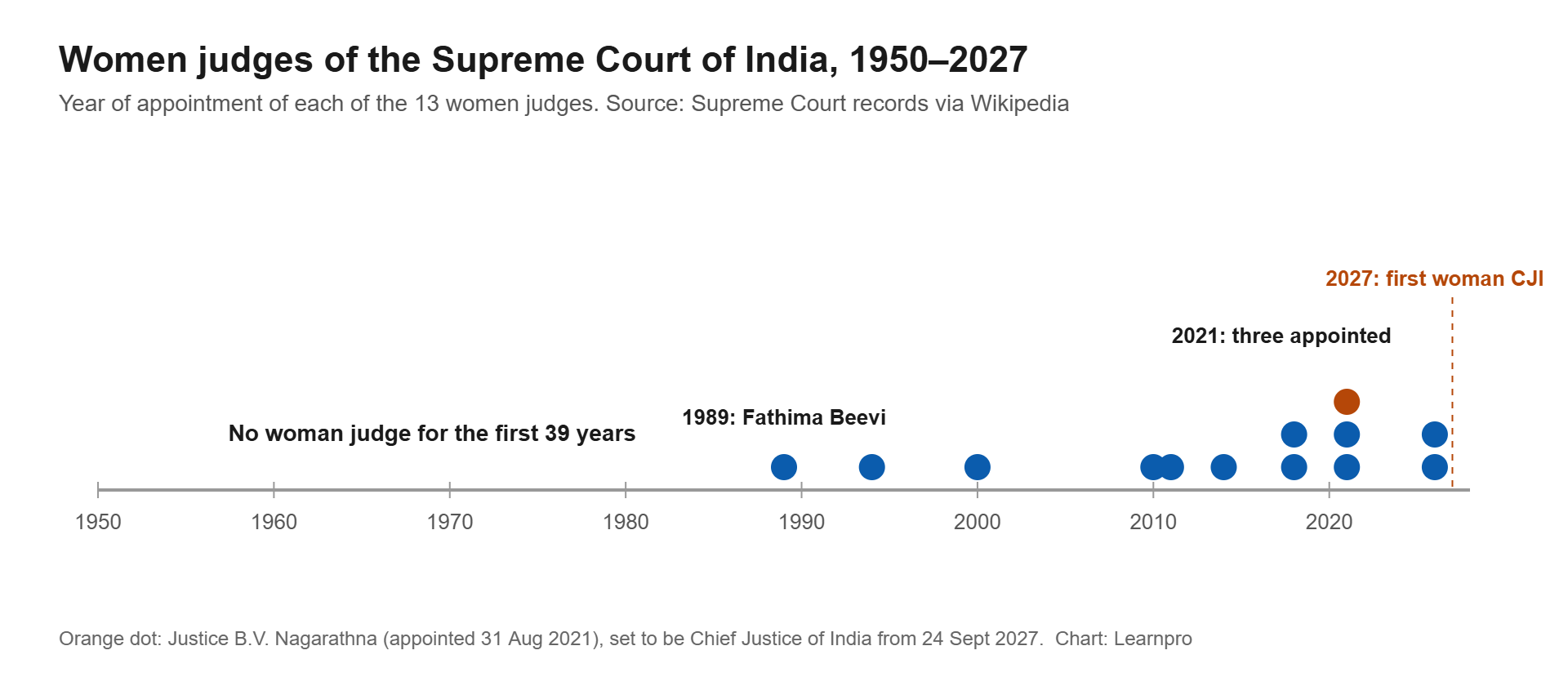
Justice B.V. Nagarathna was among the most searched names in India on 9 November 2026. She is set to become India’s first woman Chief Justice of India (CJI) on 24 September 2027 and will serve until her retirement on 29 October 2027 – a tenure of about five weeks. She has also been in the news for her remarks, while hearing a case on dearness allowance for Punjab government employees, that government jobs could be offered on a contractual basis to improve accountability.
Profile at a Glance
| Year | Milestone |
|---|---|
| 1962 | Born on 30 October in Bengaluru; daughter of Justice E.S. Venkataramiah, the 19th CJI (1989) |
| 1984 / 1987 | History graduate from Jesus and Mary College; law degree from Campus Law Centre, Delhi University |
| 1987 | Enrolled as an advocate; practised in Bengaluru in constitutional, administrative, commercial and family law |
| 2008 | Appointed Additional Judge of the Karnataka High Court (made permanent in 2010) |
| 2021 | Elevated to the Supreme Court on 31 August |
| 2027 | Due to become CJI on 24 September; retires on 29 October at the age of 65 |
When she takes office, she and her father will become the first father–daughter pair to have served as Chief Justice of India.
Her Notable Opinions
| Case | Majority view | Justice Nagarathna’s view |
|---|---|---|
| Demonetisation case (Vivek Narayan Sharma, 2023) | Upheld the 2016 note ban (4:1) | Lone dissent: the process was unlawful; such a move should have been done through legislation |
| Mineral rights taxation (2024, nine-judge Bench) | States can tax mineral rights; royalty is not a tax (8:1) | Dissent: royalty on mining leases is in the nature of a tax |
| Industrial alcohol (2024, nine-judge Bench) | States can regulate industrial alcohol (8:1) | Dissent: industrial alcohol is distinct from intoxicating liquor for human consumption |
| GM mustard (2024) | Split verdict | Raised concerns over the regulatory approval process and risk assessment |
How is the Chief Justice of India Appointed?
- Constitutional provision: Under Article 124(2), the President appoints every judge of the Supreme Court, including the CJI. The Constitution does not lay down a separate procedure for the CJI.
- Memorandum of Procedure (MoP): The senior-most judge of the Supreme Court considered fit to hold the office is appointed as CJI.
- Process: The Union Law Minister seeks the outgoing CJI’s recommendation; it is then sent to the Prime Minister, who advises the President.
- Tenure: There is no fixed term. Judges retire at 65 years, so the length of a CJI’s tenure depends on age and seniority.
- Removal: Only by the President on an address by both Houses of Parliament on grounds of proved misbehaviour or incapacity (Article 124(4)).
Women in the Supreme Court
- Justice M. Fathima Beevi became the first woman judge of the Supreme Court in 1989, 39 years after the court was set up.
- Only 13 women have ever served as Supreme Court judges; three are currently serving.
- In 2021, three women – Justices Hima Kohli, Bela M. Trivedi and B.V. Nagarathna – were appointed together, the most in a single year.
- Women are also under-represented in High Courts, though their share in the district judiciary is rising.
Issues Highlighted
- Short tenures: A five-week term leaves little time for administrative reforms, such as listing of cases or reducing pendency. Short tenures are common under the seniority rule; Justice K.N. Singh served for just 17 days in 1991.
- Diversity deficit: The first woman CJI comes 77 years after the Supreme Court was established, showing the slow pace of gender diversity.
- Opaque appointments: The collegium system is criticised for lack of transparency and limited diversity in selection.
- Value of dissent: Her dissents show how separate opinions can shape future legal debate, even when they do not decide a case.
Way Forward
- Minimum tenure: Consider a fixed minimum tenure for the CJI, as suggested by several experts, to allow continuity of reforms.
- Institutional reforms: Strengthen collective decision-making through the collegium and full court so that reforms outlast individual CJIs.
- Diversity in appointments: Appoint more women, and judges from varied backgrounds, at the High Court level, which is the main pipeline to the Supreme Court.
- Transparent MoP: Finalise a revised Memorandum of Procedure with clear criteria for appointments.
Conclusion
Justice Nagarathna’s elevation will be a historic milestone for the Indian judiciary. Though her tenure will be short, her independent voice on the Bench makes it symbolically powerful. It should also renew efforts to make the higher judiciary more diverse and to ensure CJIs have enough time to leave a lasting institutional impact.
UPSC Previous Year Questions (PYQs)
UPSC Prelims 2014
Q. The power to increase the number of judges in the Supreme Court of India is vested in?
- The President of India.
- the Parliament.
- The Chief Justice of India.
- the Law Commissio.
Show answer
Answer: (b) — See full explanation
UPSC Prelims 2019
Q. Consider the following statements: 1. The 44th Amendment to the Constitution of India introduced an Article placing the election of the Prime Minister beyond judicial review. 2. The Supreme Court of India struck down the 99th Amendment to the Constitution of India as being violative of the independence of judiciary. Which of the statements given above is/are correct?
- 1 only
- 2 only
- Both 1 and 2
- Neither 1 nor 2
Show answer
Answer: (b) — See full explanation
UPSC Prelims 2019
Q. Consider the following statements: 1. The motion to impeach a Judge of the Supreme Court of Indian cannot be rejected by the Speaker of the Lok Sabha as per the Judges (Inquiry) Act, 1968. 2. The Constitution of India defines and gives details of what constitutes ‘incapacity and proved misbehaviour’ of the Judges of the Supreme Court of India. 3. The details of the process of impeachment of the Judges of the Supreme Court of India are given in the Judges (Inquiry) Act, 1968. 4. If the motion for the impeachment of a Judge is taken up for voting, the law requires the motion to be backed by each House of the Parliament and supported by a majority of total membership of that House and by not less than two-thirds of total members of that House present and voting Which of the statements given above is/are correct?
- 1 and 2
- 3 only
- 3 and 4 only
- 1, 3 and 4
Show answer
Answer: (c) — See full explanation
Prelims Practice Question
Q. With reference to the Chief Justice of India, consider the following statements:
- The Constitution of India specifies that the senior-most judge of the Supreme Court shall be appointed as the Chief Justice.
- A judge of the Supreme Court holds office until the age of 65 years.
- Justice M. Fathima Beevi was the first woman judge of the Supreme Court of India.
Which of the statements given above is/are correct?
(a) 1 and 2 only
(b) 2 and 3 only
(c) 1 and 3 only
(d) 1, 2 and 3
Answer: (b) — The seniority rule is a convention under the Memorandum of Procedure, not a constitutional provision.
Mains Practice Question
Q. India will get its first woman Chief Justice in 2027, but only for about five weeks. Discuss the implications of short tenures of Chief Justices and the under-representation of women in the higher judiciary. Suggest reforms. (250 words)
Frequently Asked Questions (FAQs)
Who will be India’s first woman Chief Justice?
Justice B.V. Nagarathna, who is due to take office on 24 September 2027.
How is the Chief Justice of India appointed?
The President appoints the CJI under Article 124(2). By convention under the Memorandum of Procedure, the senior-most Supreme Court judge considered fit is appointed, on the outgoing CJI’s recommendation.
What is the retirement age of a Supreme Court judge?
65 years. There is no fixed tenure for the CJI.
Who was the first woman judge of the Supreme Court?
Justice M. Fathima Beevi, appointed in 1989.
Related Reads on LearnPro
- 10 Years of Demonetisation: Cash Use Unchanged, Digital Payments Soar
- Call for Changing Collegium System
- Justice Varma Case: Revisiting NJAC
- SC to ‘consider’ plea to revive NJAC