The RBI priority sector lending rules for small finance banks were revised on 20 June 2025. From financial year 2025–26, the overall PSL target for a Small Finance Bank (SFB) is 60% of Adjusted Net Bank Credit (ANBC) or Credit Equivalent of Off-Balance Sheet Exposures (CEOBE), whichever is higher. The earlier target was 75%. The change gives SFBs more room to diversify, but it does not remove their financial-inclusion mandate.
UPSC relevance: GS Paper III—banking, inclusive growth, agriculture and MSME credit; Prelims—PSL categories, SFBs, ANBC and PSLCs. Focus keyword: RBI priority sector lending rules for small finance banks.
What exactly changed in the SFB PSL target?
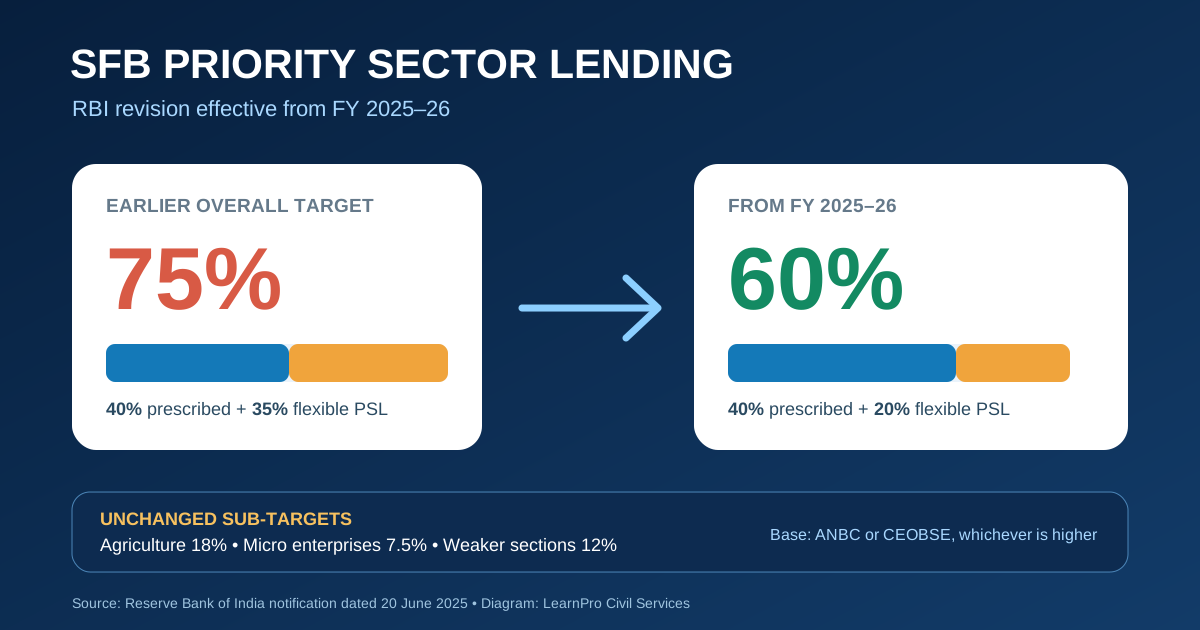
| Component | Earlier rule | From FY 2025–26 |
|---|---|---|
| Prescribed PSL allocation across sub-sectors | 40% of ANBC/CEOBSE | 40%—unchanged |
| Additional flexible PSL component | 35% | 20% |
| Overall SFB PSL target | 75% | 60% |
| Base | ANBC | ANBC or CEOBSE, whichever is higher |
The 20% flexible component can be allocated to one or more PSL sub-sectors where the bank has a competitive advantage. The reform therefore changes the quantity of compulsory PSL, not the definition of priority sectors or the core 40% architecture.
What is a Small Finance Bank?
An SFB is a differentiated bank licensed by RBI to further financial inclusion. It accepts deposits and provides credit, with particular emphasis on small business units, small and marginal farmers, micro and small industries and unorganised-sector entities. Unlike a payments bank, an SFB can lend.
| Institution | Can accept deposits? | Can lend? | Core role |
|---|---|---|---|
| Universal commercial bank | Yes | Yes | Full range of banking business |
| Small Finance Bank | Yes | Yes | Financial inclusion with a small-borrower orientation |
| Payments bank | Yes, subject to its regulatory framework | No | Payments, remittances and small savings access |
| NBFC-MFI | Cannot accept demand deposits like a bank | Yes | Microfinance within the applicable NBFC framework |
SFBs remain subject to their licensing and prudential requirements in addition to the PSL directions. A lower PSL target does not convert them into ordinary universal banks.
What is priority sector lending?
Priority sector lending directs an identified share of bank credit towards activities and borrowers considered important for socio-economic development but often underserved by normal credit markets. RBI’s 2025 Master Directions list eight broad categories:
- Agriculture;
- Micro, Small and Medium Enterprises;
- export credit;
- education;
- housing within prescribed limits;
- social infrastructure;
- renewable energy; and
- specified “other” loans, including eligible microfinance and vulnerable-borrower categories.
PSL is not a blanket interest subsidy and does not mean every loan in a named sector qualifies. Eligibility depends on the borrower, activity, limits, end use and documentation specified in RBI directions.
Which SFB sub-targets continue?
Under the updated RBI Master Directions, the following key SFB sub-targets are computed on ANBC or CEOBSE, whichever is higher:
| Sub-target | SFB requirement |
|---|---|
| Agriculture | 18% |
| Non-Corporate Farmers within agriculture | 14% |
| Small and Marginal Farmers within the NCF architecture | 10% |
| Micro Enterprises | 7.5% |
| Advances to Weaker Sections | 12% |
These categories overlap in some cases. For example, a loan to a small farmer can contribute to the agriculture, non-corporate farmer, small-and-marginal-farmer, weaker-section and overall PSL targets if it satisfies the rules.
Why did RBI reduce the overall requirement?
The RBI notification states the revised requirement; its practical logic can be understood from the stage of development of SFBs:
- Portfolio diversification: a 75% requirement concentrated balance sheets in a limited set of borrower and product segments.
- Risk management: greater room outside PSL can reduce correlated exposure to weather, local economies or unsecured microcredit cycles.
- Funding and profitability: a broader asset mix may improve pricing flexibility and earnings stability.
- Maturing institutions: SFBs need space to build secured retail, housing, vehicle and other compliant portfolios while continuing inclusion.
- Competitive neutrality: the revised 60% target remains materially higher than the 40% overall target for domestic commercial banks.
This is regulatory recalibration, not deregulation. SFBs still carry a higher overall PSL obligation and the same prescribed sub-targets that protect credit to priority groups.
Likely benefits and risks
| Possible benefit | Corresponding risk |
|---|---|
| More diversified loan book | Mission drift towards larger, easier-to-serve borrowers |
| Lower concentration risk | Reduced competition in marginal rural or microcredit markets |
| Better profitability and capital generation | Financial inclusion becomes a compliance floor rather than business strategy |
| Product innovation | Cross-selling or digital underwriting may weaken customer protection |
| Greater resilience of SFBs | Geographical and borrower concentration may persist despite sector diversification |
The reform should therefore be judged by outcomes: the number and quality of small-borrower accounts, rural presence, cost of credit, repayment suitability and grievance resolution—not only by a bank’s reported PSL percentage.
How does district-level weighting work?
RBI’s framework gives a 125% weight to incremental PSL in identified districts where per-capita PSL credit is comparatively low, while incremental credit in identified high-flow districts receives a 90% weight. Other districts receive 100% weight. The current lists are valid through FY 2026–27, subject to review.
This incentive seeks to reduce regional inequality in formal credit. It should be combined with branch access, business correspondents, digital connectivity and borrower capability. For the wider policy context, read LearnPro’s explainer on the National Strategy for Financial Inclusion 2025–30.
Can SFBs use Priority Sector Lending Certificates?
A Priority Sector Lending Certificate (PSLC) allows one bank to buy another bank’s achievement against a PSL target without transferring the underlying loan or credit risk. Under the revised directions, SFBs may purchase PSLCs only to meet sub-targets within their overall PSL target. This preserves the expectation that the overall portfolio remains substantially rooted in inclusion.
Direct lending quality still matters. Misclassification, weak end-use monitoring or unsuitable credit can harm borrowers even if numerical targets are met. The MSME angle can be studied with LearnPro’s note on enhancing the competitiveness of MSMEs in India, while rural-credit issues are linked to agricultural credit and rural growth.
What should regulators and SFBs do next?
- Track mission outcomes: disclose borrower size, geography, first-time formal borrowers and effective cost of credit.
- Strengthen underwriting: combine cash-flow assessment with consent-based digital data and human verification.
- Prevent over-indebtedness: enforce household-level repayment assessment and monitor multiple lending.
- Use diversification for resilience: avoid replacing one concentration with another, such as unsecured urban retail.
- Improve customer protection: use clear pricing, local-language communication, fair recovery and time-bound grievance redress.
- Evaluate district incentives: measure whether weighted credit reaches productive activity and excluded borrowers.
UPSC-ready analysis
Core argument: reducing the SFB PSL target from 75% to 60% can improve balance-sheet resilience without abandoning inclusion because the 40% prescribed component and sub-targets remain. The regulatory challenge is to prevent mission drift.
Mains conclusion: a sound SFB framework must balance three objectives—financial inclusion, depositor safety and institutional viability. RBI should use granular outcome disclosure and supervision so that greater portfolio flexibility produces stronger banks as well as better credit access.
Official sources
- RBI notification of 20 June 2025—Review of PSL norms for SFBs
- RBI Master Directions—Priority Sector Lending, 2025
- RBI FAQs on Priority Sector Lending
- RBI National Strategy for Financial Inclusion—role of SFBs
Frequently asked questions
What is the new PSL target for Small Finance Banks?
From FY 2025–26, an SFB must meet an overall PSL target of 60% of ANBC or CEOBSE, whichever is higher. The previous target was 75%.
Did RBI remove the 40% prescribed PSL component?
No. SFBs must continue allocating 40% across prescribed PSL sub-sectors. Only the additional flexible component was reduced from 35% to 20%.
What is ANBC?
Adjusted Net Bank Credit is the regulatory credit base used for PSL calculation after specified additions and deductions under RBI directions.
Are SFBs and payments banks the same?
No. Both are differentiated banks, but an SFB can lend while a payments bank cannot undertake lending from its own balance sheet.
Why is PSL important?
PSL directs formal bank credit towards sectors and borrowers important for development but often underserved, including agriculture, micro enterprises and weaker sections.