
Prelims facts, Mains analysis and current-affairs linkage
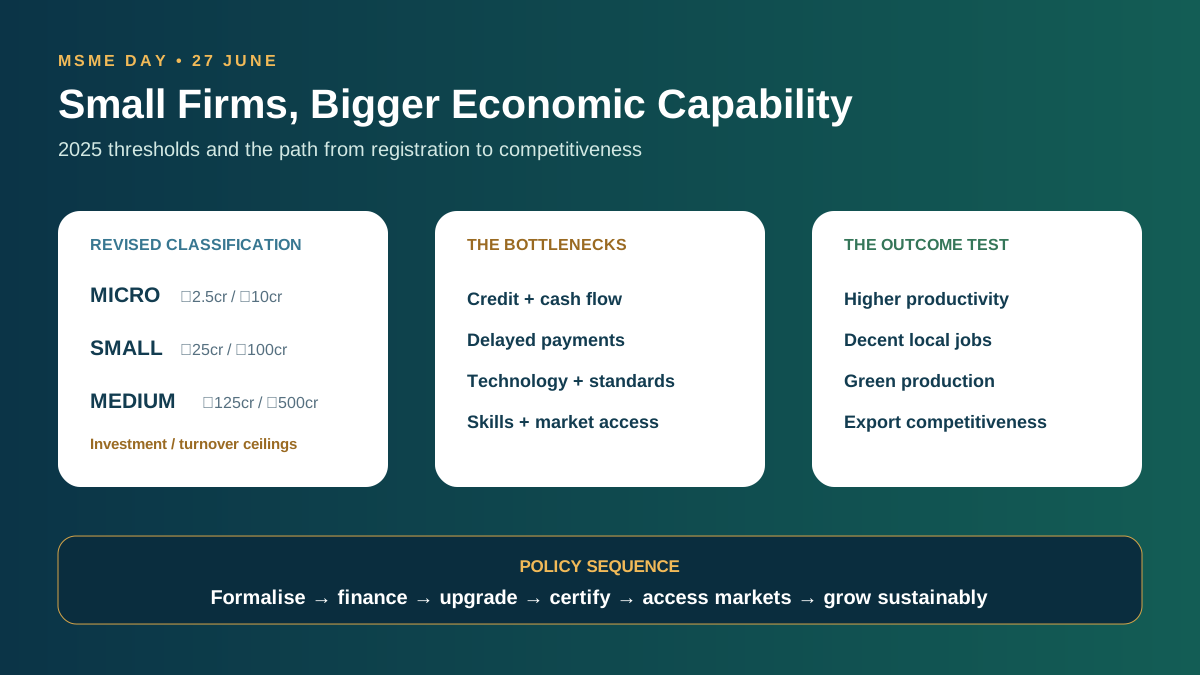
MSME Day 2025, observed on 27 June, focused global attention on small firms as drivers of sustainable growth and innovation. In India, the observance coincided with an important policy change: revised investment and turnover limits for micro, small and medium enterprises took effect on 1 April 2025.
The sector’s scale is large, but its policy challenge is not merely registration. India must help small firms become more productive, creditworthy, technologically capable, green and integrated with domestic and global value chains.
Why is MSME Day observed?
The United Nations General Assembly designated 27 June as Micro-, Small and Medium-sized Enterprises Day through resolution A/RES/71/279. The UN estimates that MSMEs account for about 90% of businesses, 60–70% of employment and roughly half of GDP worldwide.
The 2025 message stressed innovation and sustainable industrial development while recognising persistent barriers in finance, markets, technology and global value chains. These constraints are especially important for women, youth and entrepreneurs outside large cities.
Revised MSME definition from 1 April 2025
India uses a composite criterion: an enterprise must remain within both the investment and turnover limits for its category. The definition applies to manufacturing and services.
| Category | Investment ceiling | Turnover ceiling |
|---|---|---|
| Micro | ₹2.5 crore | ₹10 crore |
| Small | ₹25 crore | ₹100 crore |
| Medium | ₹125 crore | ₹500 crore |
The 2025 revision raised the previous limits to reduce the fear that growth would immediately remove an enterprise from the support framework. However, a higher ceiling is not enough: firms need a predictable graduation path so that public support rewards capability rather than permanent smallness.
Why MSMEs matter to India’s economy
The Ministry of MSME’s current collaboration portal reports that the sector contributed 31.1% of GDP in 2023–24 and 48.58% of goods and services foreign trade in 2024–25. Administrative registrations through Udyam and the Udyam Assist Platform expanded formal visibility, especially for informal micro enterprises.
- Employment: small firms absorb workers across manufacturing, trade and services, often close to where people live.
- Regional balance: clusters spread economic activity beyond metropolitan centres.
- Exports: MSMEs supply garments, leather, engineering goods, pharmaceuticals, food products and services.
- Entrepreneurship: entry costs are lower than in capital-intensive large industry.
- Value chains: small suppliers provide parts, logistics and specialised services to larger companies.
- Inclusion: micro enterprises support artisans, women, youth and historically under-represented groups.
Formalisation: Udyam and Udyam Assist
Udyam Registration is the official, zero-fee government registration system. Entrepreneurs should avoid private sites that imitate it. Registration creates a verifiable identity that can support access to priority-sector credit, procurement and MSME schemes.
The Udyam Assist Platform brings informal micro enterprises identified through regulated lenders into the formal framework. Formalisation should reduce information gaps, but it must produce real benefits; otherwise, firms face compliance costs without better credit, insurance or market access.
Core constraints
1. The credit gap
Small firms often lack immovable collateral, formal accounts and long credit histories. Cash-flow lending, account-aggregator data, digital invoices and credit guarantees can help, but automated scoring must be explainable and must not exclude new or remote enterprises.
2. Delayed payments
Under the MSMED Act, an agreed payment period to a micro or small enterprise cannot exceed 45 days. Delays force suppliers to borrow for working capital and can turn an otherwise viable order into a loss. The Samadhaan mechanism and facilitation councils matter, but prevention through e-invoicing, procurement discipline and buyer accountability is better than prolonged dispute resolution.
3. Low productivity and technology adoption
Many firms use ageing machinery and have limited access to design, testing, cloud software, cybersecurity or quality certification. Shared technology centres and cluster-based common facilities can spread fixed costs.
4. Market access and standards
Government e-Marketplace, e-commerce and export platforms expand reach, but competition requires consistent quality, packaging, logistics, traceability and after-sales service. Standards should be phased and supported, not diluted.
5. Skills and management
Entrepreneurs need bookkeeping, costing, inventory, digital marketing and labour-management skills. Worker upskilling is essential when automation changes tasks.
6. Climate and energy costs
Smaller firms have less capital for efficient motors, clean heat, rooftop solar, waste treatment and climate-resilient facilities. Green rules without affordable finance may lead to exclusion; finance without performance measurement may subsidise cosmetic change.
Important policy instruments
| Instrument | Problem addressed |
|---|---|
| CGTMSE | Credit guarantee for eligible collateral-free lending |
| RAMP | Institutional and market support to improve MSME performance |
| TReDS | Invoice discounting to release working capital |
| MSME Samadhaan | Delayed-payment claims by micro and small enterprises |
| ZED certification | Quality, resource efficiency and lower environmental impact |
| GeM procurement | Access to government buyers through a digital marketplace |
| CHAMPIONS | Grievance redressal, handholding and scheme guidance |
A better strategy for competitive MSMEs
- Shift from loan targets to productive finance: measure additional investment, sales, survival and jobs created.
- Enforce payment discipline: publish buyer payment performance and integrate invoices with procurement and tax systems.
- Build cluster capability: provide common testing, design, treatment, logistics and training facilities.
- Support technology extension: help firms select and implement practical digital and energy-efficiency tools.
- Link skills to firm demand: local colleges and ITIs should work with clusters on actual production needs.
- Prepare firms for exports: support certification, customs, standards, packaging and trade finance.
- Make the green transition bankable: combine energy audits with affordable credit and verified savings.
- Use gender-responsive support: address collateral, mobility, care work, networks and procurement access for women entrepreneurs.
The strategy also overlaps with India’s wider startup ecosystem and innovation policy. A startup may pursue a scalable innovation, while MSME is a statutory size classification; the two categories can overlap but are not identical.
UPSC and State PSC relevance
MSME Day 2025 links GS Paper II governance and welfare with GS Paper III employment, industrial policy, inclusive growth, exports and technology. For Prelims, learn the revised 2025 thresholds. For Mains, connect credit and formalisation with productivity, delayed payments, quality, clusters and green transition.
Mains practice question: Formal registration and expanded credit are necessary but insufficient for transforming Indian MSMEs into productive and globally competitive enterprises. Discuss.
Conclusion
MSMEs are vital because they connect growth with local employment and entrepreneurship. India’s next step must move beyond celebrating scale. The real test is whether a registered micro firm can receive payment on time, finance modern equipment, meet standards, train workers and reach larger markets. Productivity with inclusion should be the central objective of MSME policy.
Frequently asked questions
When is MSME Day observed?
The United Nations observes Micro-, Small and Medium-sized Enterprises Day annually on 27 June.
What is the micro-enterprise limit from April 2025?
Investment must not exceed ₹2.5 crore and turnover must not exceed ₹10 crore.
What are the limits for a small enterprise?
Investment must not exceed ₹25 crore and turnover must not exceed ₹100 crore.
How quickly should a buyer pay a micro or small supplier?
The agreed period cannot exceed 45 days under the MSMED Act framework.
Is a startup automatically an MSME?
No. Startup recognition concerns age, innovation and other eligibility rules, while MSME classification is based on investment and turnover. An enterprise may qualify for both.
Official references
Get course, notes, test-series and answer-writing guidance for UPSC and State PSC preparation.