
Tags: GS Paper 2 – Fundamental Rights (Article 19), Government Policies; GS Paper 3 – Cyber Security, Role of Media and Social Networking Sites
For Prelims: Section 69A IT Act, Section 79 safe harbour, IT Rules 2021, Rule 3(1)(d), Sahyog portal, I4C, Grievance Appellate Committee, Shreya Singhal (2015), synthetically generated information
For Mains: Balancing free speech and online harms, transparency and due process in content blocking, platform accountability
Why in News?
Social media users have reported many posts, reels and accounts being blocked across Instagram, Facebook and X, with notices saying the content is “unavailable in India”. This followed two MeitY advisories (8 and 10 October 2026) issued during protests, and the IT (Intermediary Guidelines and Digital Media Ethics Code) Amendment Rules, 2026, which cut the time allowed for takedowns.
What do the 2026 Amendments Change?
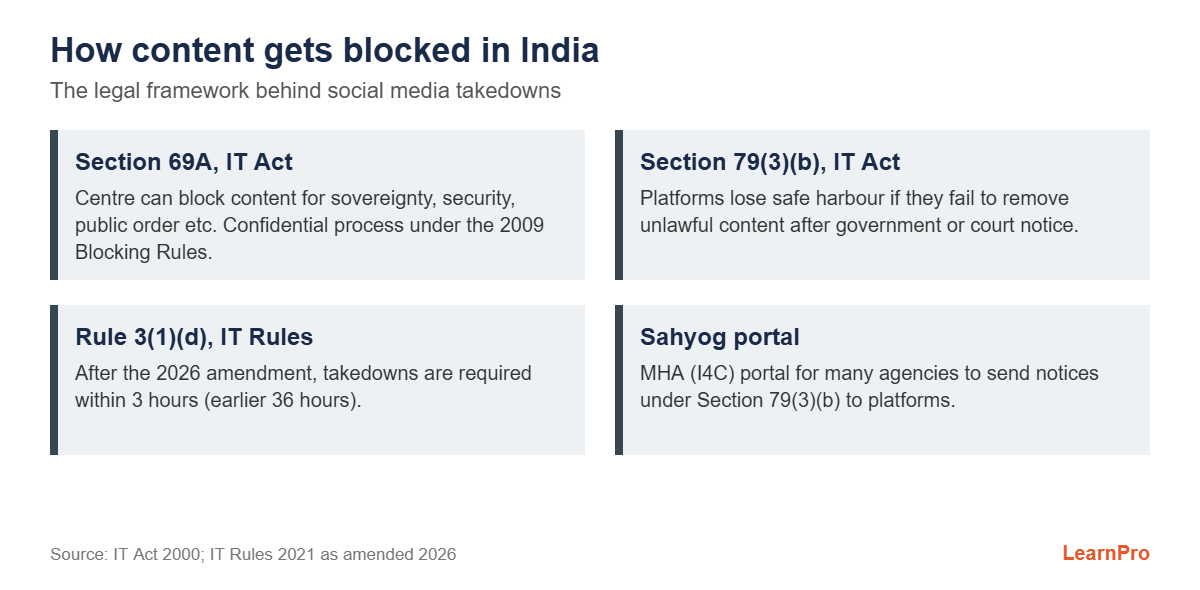
- Under amended Rule 3(1)(d), once an intermediary has actual knowledge through a court order or a reasoned notice from an authorised government officer, it must remove the content within 3 hours, down from 36 hours.
- Tighter obligations on synthetically generated information (deepfakes and AI-altered audio and video), including labelling and identification.
- Shorter timelines for grievance redressal.
Three Key Legal Provisions
- Section 69A, IT Act, 2000: The Centre can direct blocking in the interest of sovereignty, defence, security, friendly relations with foreign states, public order, or to prevent incitement. The procedure is under the Blocking Rules, 2009, and orders are confidential. It was upheld in Shreya Singhal v. Union of India (2015) because of its procedural safeguards.
- Section 79(3)(b): An intermediary loses its ‘safe harbour’ immunity if it does not remove unlawful content after receiving actual knowledge from the government or a court.
- Rule 3(1)(d), IT Rules, 2021: Sets out the due-diligence timeline for acting on such knowledge.
The Sahyog Portal
- Run by the Indian Cyber Crime Coordination Centre (I4C) of the MHA. Central and State agencies use it to send takedown notices to platforms under Section 79(3)(b).
- X Corp challenged it as a parallel blocking route without the safeguards of Section 69A. The Karnataka High Court dismissed the challenge in 2025, and an appeal is pending.
Concerns
- Free speech (Article 19(1)(a)): Large-scale or automated blocking may go beyond the reasonable restrictions allowed under Article 19(2).
- Due process: Users often get no notice or reasons. Confidential orders make challenges difficult.
- Over-compliance: A 3-hour deadline pushes platforms to remove content without proper review.
- Many authorities: Several agencies can issue notices, with little central oversight.
What can Users Do?
- Complain to the platform’s Grievance Officer, then appeal to the Grievance Appellate Committee (GAC) under the IT Rules.
- File a writ petition in a High Court under Article 226. Courts have asked for blocking orders to be shared with affected users.
Way Forward
- Require reasoned, time-bound and reviewable orders, with notice to users wherever possible.
- Publish regular transparency reports on government takedown requests.
- Bring in a modern, Parliament-approved law (such as the proposed Digital India Act) with independent oversight.
Frequently Asked Questions (FAQs)
1. Which section of the IT Act empowers the Centre to block online content?
Section 69A.
2. What is ‘safe harbour’?
Protection from liability for intermediaries for third-party content, under Section 79, subject to due diligence.
3. Which case upheld Section 69A and struck down Section 66A?
Shreya Singhal v. Union of India (2015).
Practice Question
Mains: Faster takedown timelines may improve online safety but threaten free expression. Critically examine the 2026 amendments to the IT Rules. (250 words)