
Tags: GS Paper 1 – Population and Associated Issues; GS Paper 2 – Fundamental Rights, Local Governance
For Prelims: Total Fertility Rate, replacement level fertility, Javed v. State of Haryana (2003), Article 21, reproductive autonomy, NFHS-5, Sample Registration System, demographic dividend
For Mains: Relevance of population control laws, demographic transition and ageing, reproductive rights and political participation
Why in News?
On 4 November 2026, the Supreme Court held that laws penalising people with more than two children have lost their relevance because of India’s falling fertility rate. The Bench was headed by Justice P.S. Narasimha. It said its 2003 judgment in Javed v. State of Haryana, which upheld such laws, needs to be reconsidered by a larger Bench. It also allowed a Maharashtra sarpanch, who had been disqualified for having more than two children, to continue in office.
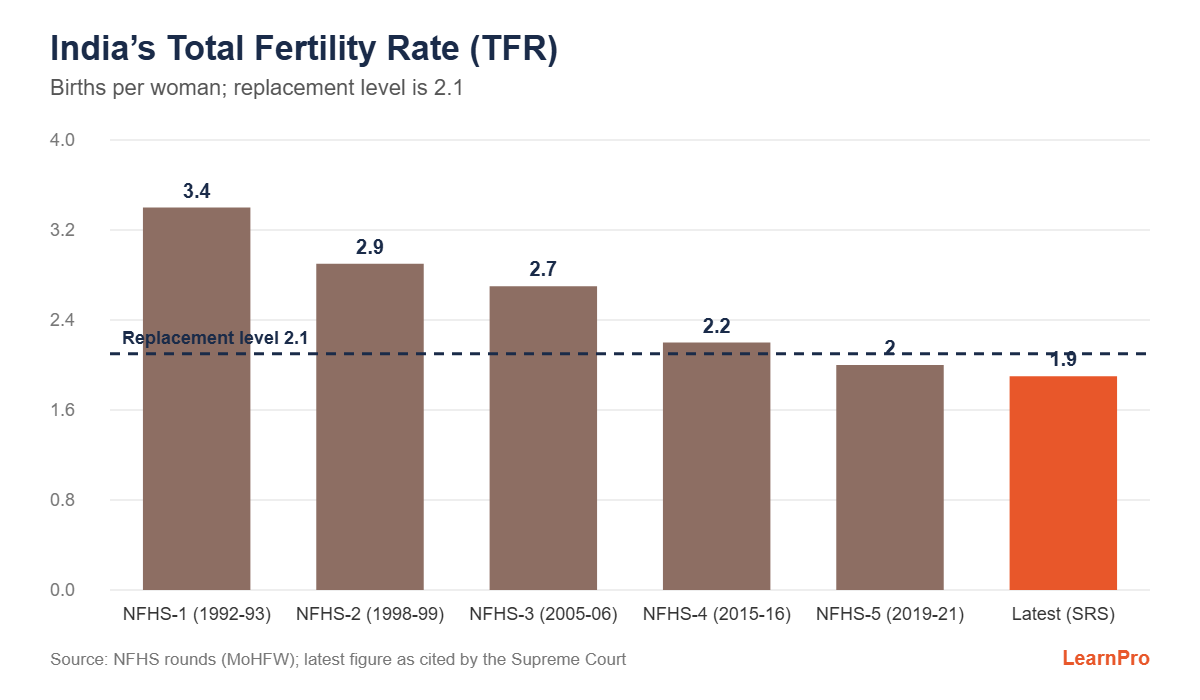
Summary
- India’s Total Fertility Rate (TFR) has fallen from 3.02 to 1.9, below the replacement level of 2.1.
- The share of people aged 60 and above rose from about 8.3% in 2014 to 9.7% in 2024. It is projected to reach nearly 15% by 2036.
- The Court said linking motherhood to political representation violates Article 21, including the right to reproductive autonomy.
- It said courts and society should now focus on encouraging healthy population growth instead of worrying about overpopulation.
What are Two-Child Norms?
- Meaning: Laws that disqualify people with more than two children from contesting local body elections, or deny them government jobs, promotions or welfare benefits.
- States: Various laws in Rajasthan, Haryana (the law upheld in Javed), Maharashtra, Odisha, Gujarat, Andhra Pradesh, Telangana, Uttarakhand and Assam. Some States, such as Haryana and Himachal Pradesh, later withdrew them.
- Javed v. State of Haryana (2003): A three-judge Bench upheld the Haryana Panchayati Raj Act provision, holding that population control is in the national interest and that the right to contest elections is a statutory, not a fundamental, right.
- National policy: The National Population Policy, 2000 favours voluntary, incentive-based family planning, not coercion. India has signed the ICPD (Cairo, 1994) Programme of Action, which rejects coercive population targets.
Why are These Laws Being Questioned?
- Demographic change: With TFR below 2.1 nationally, and as low as about 1.5–1.7 in several southern States, the reason for these laws (fear of overpopulation) no longer holds.
- Gender impact: Studies show such laws led to sex-selective practices, women being abandoned or deserted, and false claims about children to avoid disqualification.
- Exclusion of the poor: They hit poorer, rural, SC/ST and less-educated households hardest, since these groups have higher fertility.
- Fundamental rights: Forcing a choice between having children and taking part in democracy violates reproductive autonomy, which is part of Article 21 (Suchita Srivastava, 2009; K.S. Puttaswamy, 2017).
India’s Demographic Transition
- Demographic dividend: The working-age population is at its peak now, but the window will start closing in the 2040s.
- Ageing: More elderly people means pressure on pensions, health care and long-term care.
- Regional divergence: Southern States have low fertility, while Bihar, Uttar Pradesh and Meghalaya still have higher TFR. This has a bearing on delimitation and Finance Commission transfers.
- Global trend: China moved from its one-child policy (1980) to a three-child policy (2021) after its fertility fell sharply.
Way Forward
- States should repeal coercive two-child norms and move to a rights-based approach focused on maternal health, education and contraceptive choice.
- Prepare for an ageing society with universal pensions, geriatric care and silver-economy policies.
- Use the remaining demographic dividend through skilling and higher women’s workforce participation.
Conclusion
The Court’s remarks reflect India’s shift from fearing population growth to managing demographic change. Policy now needs to protect reproductive rights and prepare for an older population, instead of penalising family size.
Frequently Asked Questions (FAQs)
1. What is replacement-level fertility?
A TFR of about 2.1 children per woman, at which a population replaces itself from one generation to the next.
2. Which 2003 case upheld two-child norms for panchayat elections?
Javed v. State of Haryana.
3. What was India’s TFR according to NFHS-5?
2.0.
Practice Question
Mains: “India’s population challenge has shifted from numbers to age structure.” Discuss in the light of the debate on two-child norms. (250 words)