
Prelims facts, Mains analysis and current-affairs linkage
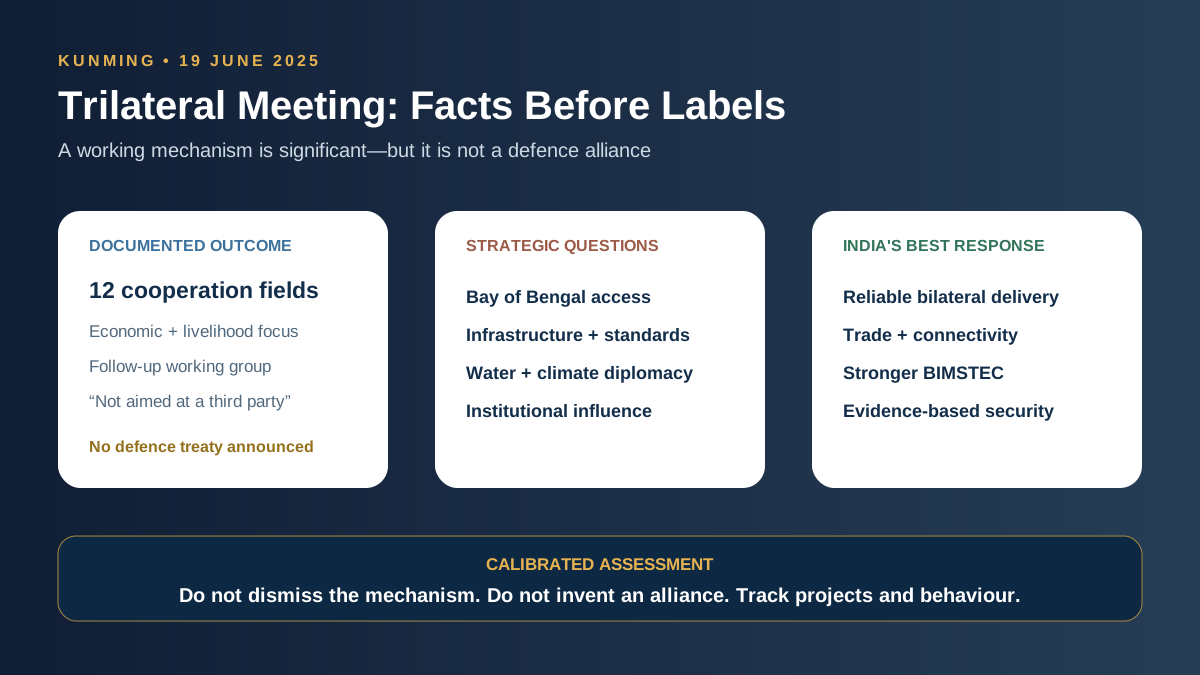
The China Pakistan Bangladesh trilateral meeting held in Kunming on 19 June 2025 created debate about a new strategic alignment in South Asia. The documented facts are narrower than the most dramatic headlines: officials agreed to explore practical cooperation in twelve fields and to create a working group. They did not announce a military alliance, mutual-defence treaty or formal regional organisation.
India should nevertheless study the mechanism carefully. China already has an exceptionally close strategic partnership with Pakistan and an expanding economic relationship with Bangladesh. Regular three-way coordination could influence trade, infrastructure, maritime affairs and regional institutions even without becoming an anti-India bloc.
What happened at the Kunming meeting?
China’s Ministry of Foreign Affairs records that the vice-foreign-minister/foreign-secretary-level meeting took place in Kunming, Yunnan. Participants included Chinese Vice Foreign Minister Sun Weidong, Bangladesh Acting Foreign Secretary Ruhul Alam Siddique and Pakistan Additional Foreign Secretary Imran Ahmed Siddiqui. Pakistan Foreign Secretary Amna Baloch joined the first phase by video.
The three sides agreed on five broad elements:
- cooperation based on good-neighbourliness, equality, mutual trust, openness and common development;
- a stated focus on economic development and livelihoods;
- projects across twelve fields;
- a working group to follow up the understandings; and
- an official assertion that the mechanism was not directed at a third party.
| Official cooperation fields | Potential strategic relevance |
|---|---|
| Industry and trade | Supply chains, investment standards and market access |
| Maritime affairs and water resources | Bay of Bengal connectivity, port access and regional resource diplomacy |
| Climate change and agriculture | Food security, disaster resilience and technology cooperation |
| Human resources, education and think tanks | Elite networks, narratives and long-term institutional influence |
| Health, culture and youth | Public diplomacy and people-to-people relationships |
What the meeting did not establish
Careful language is essential. The published record did not create:
- a mutual-defence commitment comparable to a military alliance;
- a permanent secretariat or founding treaty;
- a common currency, customs union or free-trade area;
- a joint armed command; or
- an explicit policy against India.
The phrase “trilateral nexus” is therefore an analytical interpretation, not the official name of a treaty organisation. At the same time, declared intent is only one part of strategic assessment. India must also examine capabilities, projects, financing terms, frequency of meetings and behaviour over time.
Why did the three countries find common ground?
China: influence and connectivity
China seeks stable access to markets, infrastructure corridors and political partnerships around its periphery. Bangladesh and Pakistan are both participants in the Belt and Road Initiative. A trilateral format can help Beijing present itself as a development partner and agenda-setter in South Asia.
Pakistan: economic and diplomatic space
Pakistan’s strategic relationship with China is long-standing. A wider format can connect the China–Pakistan Economic Corridor with broader commercial and diplomatic networks, while reducing Pakistan’s regional isolation.
Bangladesh: diversification and development
Bangladesh has strong reasons to maintain relations with multiple powers. Trade, infrastructure, health and climate cooperation can serve legitimate development needs. Participation should not automatically be treated as abandoning strategic autonomy or choosing a permanent camp.
Why does it matter for India?
1. A changing regional balance
India is South Asia’s largest economy and central geographical power, but neighbouring states have agency and multiple external choices. A China-convened format illustrates how regional diplomacy can develop without India.
2. Bay of Bengal and maritime implications
Maritime cooperation was expressly listed. The Bay of Bengal carries vital shipping routes and connects India’s eastern coast with Southeast Asia. Commercial port development is not automatically military, but port access, logistics, data and dual-use infrastructure require transparent assessment.
3. Connectivity and standards
Infrastructure finance can accelerate development, but debt terms, local procurement, environmental assessment and interoperability matter. India must offer credible, timely alternatives rather than expect neighbours to reject external finance.
4. Water and climate diplomacy
The agenda includes water resources and climate change. Transboundary rivers and Himalayan climate risks are central to the region. India should strengthen data sharing, basin-level cooperation and disaster preparedness without securitising every technical discussion.
5. Information and institutional influence
Think-tank, education, culture and youth exchanges build relationships that outlast a single government. India needs sustained scholarships, research partnerships and public diplomacy based on mutual respect.
How should India respond?
- Avoid binary diplomacy: neighbouring countries should not be forced to choose between India and China. India should compete through reliability and mutual benefit.
- Repair and deepen bilateral relationships: trade facilitation, visas, border management, energy connectivity and water cooperation with Bangladesh require patient engagement across political constituencies.
- Deliver connectivity on time: rail, road, inland-waterway, port and electricity projects gain strategic value only when completed and usable.
- Strengthen BIMSTEC: the 2025 summit adopted the Bangkok Vision 2030 and an agreement on maritime transport cooperation. This offers a transparent, seven-member framework for Bay of Bengal development. See LearnPro’s wider analysis of BIMSTEC and regional cooperation.
- Use economic instruments: faster border infrastructure, standards cooperation, value chains and local-currency settlement can make regional commerce easier.
- Protect security without alarmism: monitor dual-use infrastructure, cyber risks and military access through evidence, not rhetoric.
- Practise asymmetric generosity: as the largest economy, India can absorb some short-term costs in exchange for long-term regional trust.
BIMSTEC is not a mirror-image counter-bloc
BIMSTEC links Bangladesh, Bhutan, India, Myanmar, Nepal, Sri Lanka and Thailand. Its value lies in functional cooperation across the Bay of Bengal, not in reproducing great-power bloc politics. At its sixth summit in April 2025, members adopted the first BIMSTEC vision document and emphasised trade, connectivity, disaster management and security.
India can also use the Neighbourhood First and Act East policies to connect domestic growth in the Northeast with regional prosperity. Development partnerships should be demand-driven, transparent and locally owned.
UPSC and State PSC relevance
The China Pakistan Bangladesh trilateral is relevant to GS Paper II topics on India’s neighbourhood, bilateral relations and regional groupings, and to GS Paper III themes such as maritime security and infrastructure. In an answer, begin with the verified Kunming outcomes, assess risks without assuming an alliance, and propose a diplomatic-economic response.
Mains practice question: The China–Pakistan–Bangladesh trilateral mechanism is a test of India’s regional diplomacy, but not yet evidence of a formal anti-India alliance. Examine.
Conclusion
The Kunming meeting matters because it may institutionalise coordination among three significant regional actors. But analysis loses credibility when a working-group arrangement is described as an established military encirclement. India’s best answer is neither dismissal nor panic. It is confident neighbourhood diplomacy, faster delivery, strong maritime awareness and inclusive regional institutions.
Frequently asked questions
When was the China–Pakistan–Bangladesh trilateral meeting held?
It was held at vice-foreign-minister and foreign-secretary level in Kunming, China, on 19 June 2025.
Did the three countries form a military alliance?
No. The published outcome announced practical cooperation fields and a working group, not a defence treaty, joint command or mutual-defence clause.
Which sectors were included?
The twelve fields included industry, trade, maritime affairs, water, climate, agriculture, human resources, think tanks, health, education, culture and youth.
Was the mechanism officially directed against India?
The participants stated that it was not directed at any third party. India should still assess actual projects and behaviour as the mechanism develops.
What should India prioritise?
Reliable bilateral engagement, timely connectivity, stronger BIMSTEC cooperation, trade facilitation, water and climate diplomacy, and evidence-based monitoring of security risks.
Primary references
Get course, notes, test-series and answer-writing guidance for UPSC and State PSC preparation.