Nutritional security in India means more than supplying enough cereal. It means that people—especially children, adolescent girls, pregnant women and lactating mothers—receive a diverse, safe and nutritious diet, clean water, sanitation and basic health care. The National Food Security Act (NFSA), Mission Saksham Anganwadi and POSHAN 2.0, health programmes and food-fortification standards together form India’s policy framework.
UPSC relevance: GS Paper II—welfare schemes, health and vulnerable groups; GS Paper III—food security and agriculture; Essay—human capital and inclusive development. Focus keyword: nutritional security in India.
Why is nutritional security in India in the news?
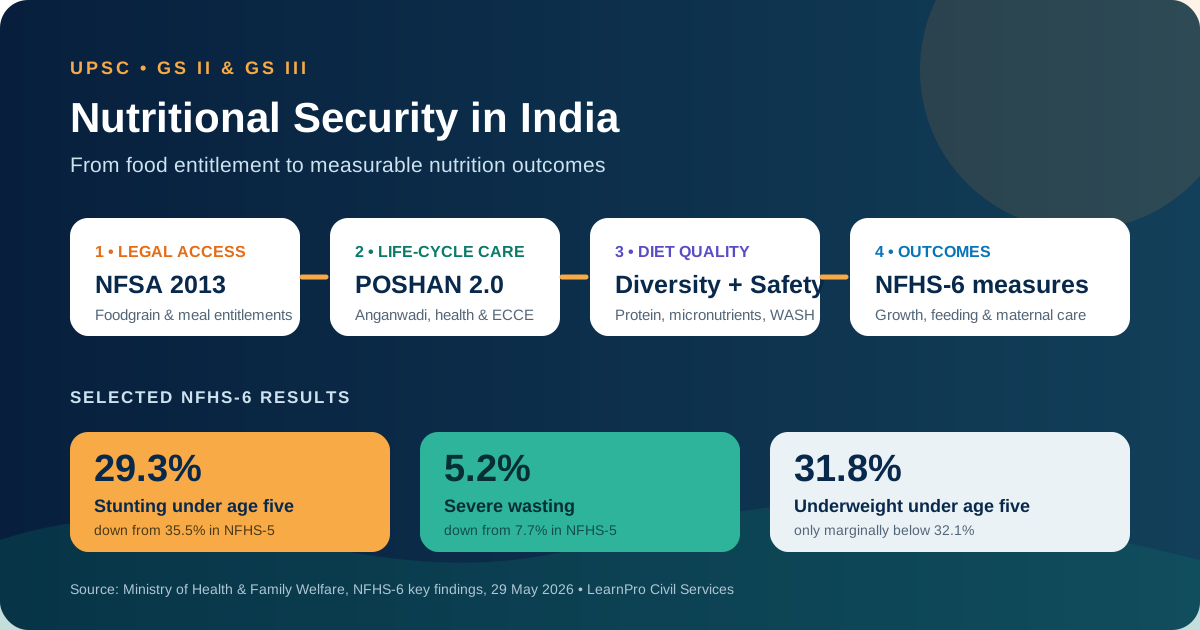
The Ministry of Health and Family Welfare released NFHS-6 (2023–24) on 29 May 2026. It reports improvement in several child-nutrition indicators: stunting among children under five declined from 35.5% in NFHS-5 to 29.3%; severe wasting fell from 7.7% to 5.2%; and underweight prevalence moved only marginally, from 32.1% to 31.8%. The mixed picture is important: progress is real, but a large burden remains.
Food security and nutrition security are not the same
| Idea | Main question | Typical policy instrument |
|---|---|---|
| Food availability | Is enough food produced or imported? | Agricultural production, trade and buffer stocks |
| Food access | Can a household obtain food regularly? | NFSA entitlements, income and social protection |
| Diet quality | Does the diet supply protein and micronutrients? | Diet diversity, supplementary nutrition and fortification |
| Nutrition outcome | Can the body absorb and use nutrients? | Health care, safe water, sanitation and care practices |
A household can receive rice or wheat and still face anaemia, stunting or poor child growth. Repeated infection, unsafe drinking water, weak maternal health, inadequate breastfeeding or a diet low in pulses, eggs, milk, vegetables and fruit can break the link between calories and health. This is why the shift from food security to nutrition security is a governance issue, not merely a change in terminology.
What does the National Food Security Act provide?
The National Food Security Act, 2013 converts access to specified food entitlements into a legal right. The law permits coverage of up to 75% of the rural population and 50% of the urban population under the Targeted Public Distribution System—about two-thirds of the population at the statutory design stage.
- Priority households are entitled to 5 kg of foodgrains per person per month.
- Antyodaya Anna Yojana households are entitled to 35 kg per household per month.
- Pregnant women and lactating mothers have maternity and meal-related entitlements subject to the Act and schemes framed under it.
- Children receive age-appropriate meals through Anganwadi and school-meal arrangements.
- The Act provides for grievance redress, transparency and social audit.
NFSA is the foundation of access, but cereal delivery alone cannot complete nutritional security in India. Exclusion errors, outdated beneficiary lists, portability failures and uneven grievance systems can weaken the legal promise. The policy debate on updating NFSA beneficiary lists must therefore balance accuracy with protection against wrongful exclusion.
How does POSHAN 2.0 change the approach?
Mission Saksham Anganwadi and POSHAN 2.0 combines Anganwadi Services, POSHAN Abhiyaan and the Scheme for Adolescent Girls within an integrated nutrition-support framework. It covers children below six, pregnant women, lactating mothers and specified adolescent girls, while also supporting early-childhood care and Anganwadi modernisation.
Its six-service Anganwadi package includes:
- supplementary nutrition;
- pre-school non-formal education;
- nutrition and health education;
- immunisation;
- health check-ups; and
- referral services.
The programme recognises that child growth depends on convergence. The Union government sets policy and planning, while States handle day-to-day implementation. Anganwadi workers, ASHAs, ANMs, schools, public-distribution authorities and local bodies must work as a connected last-mile system.
Where does food fortification fit?
Food fortification adds specified micronutrients to commonly consumed staples. FSSAI’s Food Safety and Standards (Fortification of Foods) Regulations, 2018 prescribe standards and quality parameters for fortified foods such as rice, wheat flour, milk, edible oil and salt.
Fortification can reach a large population without requiring a major change in eating habits. It is useful against “hidden hunger”, but it is not a substitute for dietary diversity. A sound policy must:
- use evidence to identify the deficiency and target population;
- maintain safe minimum and maximum nutrient levels;
- test premix quality and nutrient stability across the supply chain;
- monitor total intake where several fortified products overlap; and
- continue investment in pulses, vegetables, fruit, animal-source foods where culturally and economically appropriate, sanitation and primary health care.
Biofortification is different: it raises a crop’s nutrient content through breeding or biotechnology. LearnPro’s note on biofortified potatoes explains the distinction.
What does NFHS-6 tell us?
| Indicator | NFHS-5 | NFHS-6 | Reading |
|---|---|---|---|
| Stunting, children under five | 35.5% | 29.3% | Clear improvement in chronic undernutrition |
| Severe wasting, children under five | 7.7% | 5.2% | Improvement, but acute undernutrition persists |
| Underweight, children under five | 32.1% | 31.8% | Only marginal improvement |
| Breastfeeding within one hour of birth | 41.8% | 50.1% | Better early feeding practice |
| Complementary food at 6–8 months | 45.9% | 59.5% | Improved, but not universal |
| IFA for at least 180 days in pregnancy | 26.0% | 37.8% | Large gap remains |
These national averages should not hide differences between States, districts, social groups and income levels. Nor should declining undernutrition obscure India’s growing burden of overweight, obesity and diet-related non-communicable disease. The result is a double burden of malnutrition: deprivation and excess can exist in the same population, community or even household.
Why do implementation gaps continue?
- Household diets remain cereal-heavy. Nutritious foods may be physically available but unaffordable.
- Women’s nutrition is intergenerational. Poor adolescent and maternal nutrition affects birth weight and later child growth.
- Water and disease matter. Diarrhoea, parasitic infection and poor sanitation reduce nutrient absorption.
- Frontline capacity varies. Vacancies, training gaps, infrastructure and supply interruptions affect Anganwadi quality.
- Data systems need safeguards. Digital tracking can improve monitoring, but poor connectivity or authentication must not deny food.
- Scheme silos persist. Food, health, sanitation, agriculture and social-protection departments often measure separate outputs instead of shared nutrition outcomes.
A practical way forward
- Protect universal minimums and target extra support: retain reliable food access while using district and life-cycle data for intensified nutrition services.
- Diversify the food basket: make pulses, millets and locally appropriate nutrient-rich foods more accessible without destabilising procurement.
- Strengthen the first 1,000 days: connect maternal nutrition, antenatal care, breastfeeding, complementary feeding and infection control.
- Measure outcomes, not distribution alone: track growth, diet diversity, anaemia, service quality and exclusion alongside tonnes of grain supplied.
- Use fortification carefully: enforce FSSAI standards, independent testing and surveillance of micronutrient intake.
- Empower local institutions: strengthen social audits, grievance redress and community monitoring.
- Build resilient supply: climate-resilient agriculture, storage and diversified production support nutrition as well as food availability. See LearnPro’s analysis of resilient agricultural production systems.
UPSC answer framework
In a Mains answer, begin with the distinction between calorie access and nutrition outcomes. Explain NFSA as a rights-based floor, POSHAN 2.0 as a life-cycle and convergence programme, and fortification as a targeted micronutrient tool. Use NFHS-6 data to show both progress and the remaining gap. End with diet diversity, maternal health, WASH, accountable delivery and outcome-based monitoring.
Probable question: “India has built a strong architecture for food entitlement, but nutritional security requires action beyond the foodgrain basket.” Discuss with reference to NFSA, POSHAN 2.0 and recent nutrition data.
Conclusion
Nutritional security in India requires a chain that works from farm and market to household, mother and child. NFSA protects access; POSHAN 2.0 connects nutrition with care and early-childhood services; health and sanitation programmes improve absorption; and fortification can address specific micronutrient gaps. NFHS-6 shows meaningful progress, but underweight prevalence, uneven service quality and the double burden of malnutrition demand sustained, locally accountable action.
Frequently asked questions
What is nutritional security?
Nutritional security is reliable access to a diverse, safe and adequate diet, together with health care, clean water, sanitation and care practices that allow the body to use nutrients effectively.
How is nutritional security different from food security?
Food security focuses on availability, access and stability of food. Nutritional security additionally considers diet quality, micronutrients, disease, sanitation, maternal health and actual nutrition outcomes.
What population does NFSA cover?
The NFSA framework permits coverage of up to 75% of the rural population and 50% of the urban population under the Targeted Public Distribution System.
What is Mission POSHAN 2.0?
It is an integrated nutrition-support programme combining Anganwadi Services, POSHAN Abhiyaan and the Scheme for Adolescent Girls, with attention to young children, pregnant women, lactating mothers, specified adolescent girls and early-childhood care.
Is fortified food the same as a diverse diet?
No. Fortification adds specified micronutrients to staple foods. It can address selected deficiencies, but it cannot provide the full benefits of a varied diet or replace health, sanitation and care services.
What are the latest NFHS-6 child-nutrition figures?
NFHS-6 reports stunting among children under five at 29.3%, severe wasting at 5.2% and underweight prevalence at 31.8%.
Official sources
- Ministry of Health and Family Welfare: NFHS-6 key findings, 29 May 2026
- Department of Food and Public Distribution: implementation of NFSA
- National Food Security Act, 2013
- Ministry of Women and Child Development: Mission Saksham Anganwadi and POSHAN 2.0
- FSSAI: Food Safety and Standards (Fortification of Foods) Regulations