India–South Africa submarine cooperation has developed from a general defence relationship into an operational safety partnership. At the ninth Joint Defence Committee (JDC) meeting in Johannesburg on 23–24 June 2025, the two countries exchanged two newly signed agreements in the submarine domain.
The public release did not disclose the formal titles or full clauses of those two documents. What is confirmed is the wider framework: the Indian and South African navies had already signed an Implementing Agreement on Submarine Rescue Support Cooperation in September 2024. It enables India to provide rescue assistance when a South African submarine is in distress or involved in an accident.
What was agreed at the ninth Joint Defence Committee?
India’s Defence Secretary Rajesh Kumar Singh led the Indian delegation, while Acting Secretary for Defence Dr Thobekile Gamede headed the South African side. The JDC reviewed cooperation through two sub-committees:
- Defence Policy and Military Cooperation; and
- Defence Acquisition, Production, Research and Development.
The Ministry of Defence stated that two submarine-cooperation agreements were exchanged and that both sides discussed defence-industry capabilities and future areas of mutual interest. Because the release did not publish the agreements, claims that they created specific surveillance, intelligence-sharing or weapons arrangements should be treated as speculation.
Timeline of India–South Africa submarine cooperation
| Date | Development | Why it matters |
|---|---|---|
| 1996 | Defence-equipment cooperation MoU | Established the modern bilateral defence framework |
| 2000 | Defence cooperation was upgraded through a new MoU | Broadened institutional engagement |
| Aug–Sep 2024 | Navy-to-Navy talks and the Submarine Rescue Support Cooperation Implementing Agreement | Created an operational basis for Indian rescue support |
| October 2024 | INS Talwar joined IBSAMAR VIII off Simon’s Town | Improved interoperability among India, Brazil and South Africa |
| May 2025 | First joint submarine sea-training programme was reported | Moved cooperation from paperwork to crew-level preparation |
| June 2025 | Two submarine-domain agreements exchanged at the ninth JDC | Expanded and institutionalised the cooperation |
| August 2025 | Indian specialists completed rescue-seat certification on SAS Manthatisi | Tested compatibility with India’s rescue system |
The rescue-seat certification was reported as India’s first such certification for a friendly foreign navy. Its value is technical: a rescue vehicle cannot safely dock with a disabled submarine unless the mating interface, measurements, pressure conditions and procedures have been verified in advance.
How does deep-submergence submarine rescue work?
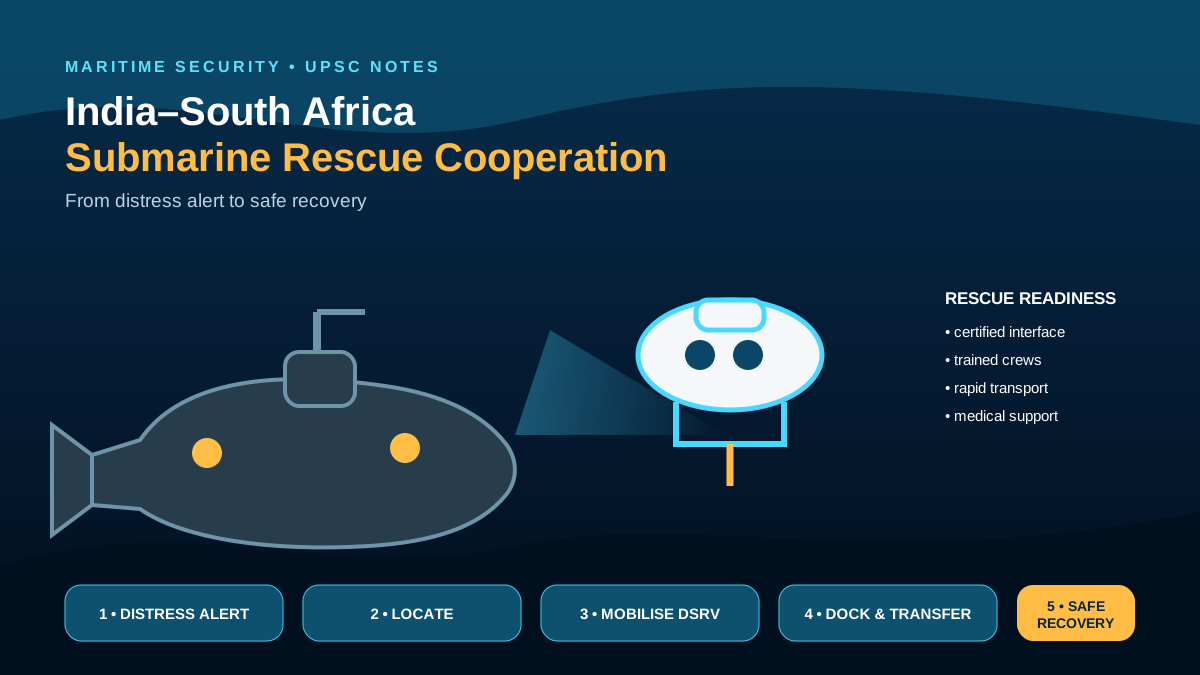
A submarine may become disabled because of collision, flooding, fire, equipment failure or another emergency. If the hull remains intact on the seabed, survivors may wait for external rescue. A Deep Submergence Rescue Vehicle (DSRV) is designed to descend to the submarine, mate with its rescue seat or escape hatch, and transfer personnel to the surface in repeated sorties.
- Distress alert: the affected navy identifies the submarine’s last known position and probable condition.
- Search and location: aircraft, ships, sonar and remotely operated systems narrow the position.
- Mobilisation: the rescue system, operators, medical team and support equipment move to the nearest suitable port or ship.
- Site preparation: rescuers inspect the hull, clear debris and confirm pressure and angle.
- DSRV mating: the vehicle forms a seal over the submarine’s rescue seat.
- Personnel transfer: submariners enter the DSRV and are carried to safety.
- Medical support: rescued personnel may need treatment for pressure-related injury, cold, dehydration or trauma.
The system is therefore more than a submersible. It includes command arrangements, transport, a launch-and-recovery platform, sonar, remotely operated vehicles, diving support, medical care and trained teams.
What does India contribute?
India operates two complete submarine-rescue systems, positioned to support its eastern and western seaboards. The capability allows the Indian Navy to mobilise a DSRV and associated equipment for a distressed submarine. India has also built experience through exercises and mutual-rescue arrangements with friendly navies.
Under the 2024 agreement, this capability can provide rescue cover to South African submarine crews when required. Such support is valuable because submarine accidents are rare but time-critical, and maintaining an independent national DSRV system is costly. International rescue networks allow navies to share specialised capability while conducting compatibility checks in peacetime.
Why does South Africa matter strategically?
South Africa sits beside the sea route around the Cape of Good Hope, connecting the Indian and Atlantic Oceans. Cooperation with its navy gives India an important partner on the western edge of the wider Indian Ocean maritime system.
- Operational reach: rescue cooperation supports Indian naval activity far from home bases.
- Sea-lane security: the Cape route becomes especially important when traffic through the Red Sea and Suez corridor is disrupted.
- African partnership: the arrangement strengthens India’s security engagement with African coastal states.
- South–South cooperation: two Global South partners share training and specialised capability.
- Trust: submarine procedures and interfaces are sensitive; cooperation signals a high level of professional confidence.
For a broader geographic view, read LearnPro’s notes on India’s strategic focus in the Indian Ocean Region.
How is this different from a military alliance?
| Submarine rescue cooperation | Military alliance or combat arrangement |
|---|---|
| Focuses on saving crews in distress | Focuses on collective defence or combat commitments |
| Requires technical compatibility and emergency access | May require common threat assessments and operational planning |
| Can be offered across different strategic alignments | Usually reflects a closer geopolitical alignment |
| Does not automatically create basing rights | May include logistics, basing or force-deployment provisions |
The India–South Africa arrangement should therefore be understood first as humanitarian-operational naval cooperation. It can build strategic trust, but it is not evidence of a mutual-defence treaty or a permanent Indian military presence in South Africa.
Connection with IBSAMAR and AIKEYME
Submarine rescue is one part of a larger maritime relationship. IBSAMAR is the trilateral naval exercise of India, Brazil and South Africa. Its eighth edition took place around Simon’s Town in October 2024, with harbour and sea phases designed to improve professional cooperation.
South Africa also participated in the 2025 Africa India Key Maritime Engagement (AIKEYME), co-hosted by India and Tanzania. AIKEYME focused on collaborative responses to shared maritime challenges such as piracy, trafficking and information sharing. Together, bilateral rescue arrangements and multilateral exercises create different layers of preparedness.
This fits the wider debate covered in maritime-security imperatives in the Indian Ocean and India’s role in IORA maritime cooperation.
Benefits for India and South Africa
- Lives protected: compatible procedures shorten the response time after an accident.
- Training value: crews learn distress communication, escape, rescue and medical protocols.
- Interoperability: certification identifies technical problems before a real emergency.
- Defence diplomacy: practical cooperation creates trust without requiring an alliance.
- Industry links: the JDC also provides a forum for maintenance, production and research discussions.
- Regional public good: deployable rescue capability can support a wider network of partner navies.
Limits and implementation challenges
- Distance: rescue equipment must travel thousands of kilometres; rapid airlift, ports and support ships are essential.
- Time pressure: survivors have limited air, power and life-support capacity.
- Weather and depth: sea state, seabed angle, damage and pressure may prevent safe mating.
- Compatibility: certification must be updated when submarines or rescue systems change.
- Communication: authorities need a pre-agreed chain for distress information and clearances.
- Readiness: an agreement is useful only if crews train, equipment remains serviceable and mobilisation is rehearsed.
- Transparency: governments must protect operational details while publishing enough information to avoid exaggerated claims.
UPSC relevance
India–South Africa submarine cooperation connects GS Paper II themes—bilateral relations, Africa policy, BRICS and the Global South—with GS Paper III themes such as maritime security, defence technology, disaster response and the Indian Ocean Region.
Possible Mains question: Submarine rescue cooperation demonstrates how defence diplomacy can create regional public goods without a formal alliance. Discuss with reference to India–South Africa maritime relations.
Conclusion
The importance of India–South Africa submarine cooperation lies in preparedness. The 2024 rescue agreement, 2025 JDC exchanges, joint training and rescue-seat certification convert diplomatic intent into a workable safety system. Its strategic effect is real, but it should not be overstated: the arrangement is primarily about saving submariners, building interoperability and strengthening maritime trust across the Indian and Atlantic Ocean interface.
Frequently asked questions
What is the India–South Africa submarine cooperation agreement?
The two navies signed an Implementing Agreement in September 2024 for submarine rescue support. It allows India to provide rescue assistance to South African submarine crews in distress, subject to agreed procedures.
What happened at the ninth Joint Defence Committee meeting?
At the Johannesburg meeting on 23–24 June 2025, India and South Africa exchanged two newly signed agreements in the submarine domain. The public release did not disclose their complete titles or clauses.
What is a DSRV?
A Deep Submergence Rescue Vehicle is a specialised submersible that can descend to a disabled submarine, form a seal with its rescue hatch and transfer trapped crew members to the surface.
Is the agreement a military alliance?
No. It is an operational rescue arrangement focused on crew safety and interoperability. It does not by itself create collective-defence obligations, permanent basing rights or a combat alliance.
Why is South Africa important for India’s maritime strategy?
South Africa lies beside the Cape of Good Hope route linking the Indian and Atlantic Oceans. It is also an important African and BRICS partner and a participant in exercises such as IBSAMAR and AIKEYME.
Official references
- Ministry of Defence: Ninth India–South Africa Joint Defence Committee
- Ministry of Defence: Submarine Rescue Support Cooperation Implementing Agreement
- Ministry of Defence: INS Talwar and IBSAMAR VIII
- Indian Navy: AIKEYME 2025