
Gig workers social security has become a central labour-policy issue as app-based delivery, ride-hailing, home services and online freelance work expand. Platforms can lower entry barriers and offer flexible schedules, but workers often bear the cost of vehicles, fuel, waiting time, accidents and demand fluctuations without the protections normally attached to employment.
India’s four labour codes took effect on 21 November 2025. The Code on Social Security, 2020 formally recognises gig and platform workers and provides a framework for welfare schemes. Recognition is important, but it does not by itself settle minimum wages, employment status, algorithmic control or access to every employee benefit.
Who is a gig worker?
The Code on Social Security defines a gig worker as a person who performs work or participates in a work arrangement and earns from such activities outside a traditional employer–employee relationship. A platform worker is engaged through an online platform to access organisations or individuals for specific services or activities.
| Work arrangement | Typical example | Regulatory question |
|---|---|---|
| Location-based platform work | Ride-hailing, delivery, home repair | Who bears vehicle, accident, waiting-time and local safety costs? |
| Online platform work | Design, coding, data annotation, tutoring | Which jurisdiction and contract rules apply? |
| Independent gig work | Short project obtained without a digital intermediary | Is the person genuinely self-employed or economically dependent? |
| Ordinary employment arranged by an app | Work with close control over hours, price and discipline | Does the contractual label conceal an employer–employee relationship? |
The app is not the decisive feature. A court or authority should examine actual control, economic dependence, integration into the business and the worker’s ability to set price, choose clients and build an independent enterprise.
How large is India’s gig economy?
NITI Aayog estimated about 7.7 million gig workers in 2020–21 and projected 23.5 million by 2029–30. The projection is a planning estimate, not a live count. e-Shram data provide registration figures but do not capture every worker or prove active platform work.
A Labour Ministry reply listed state-wise platform-worker registrations on e-Shram as of 5 August 2025. Maharashtra recorded 80,332; West Bengal 32,274; Andhra Pradesh 26,690; and Uttar Pradesh 23,379. These figures show the reach of registration, not the total size of the platform workforce.
Why do gig workers seek minimum wages?
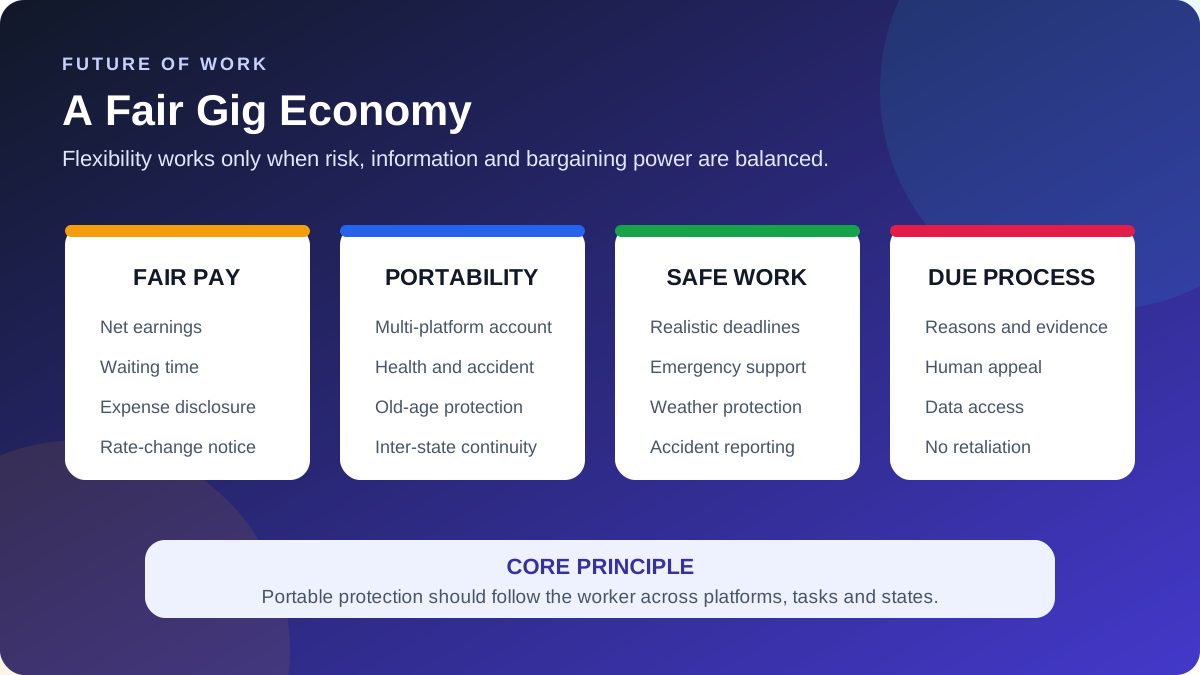
Platform advertisements often show gross earnings. Workers must deduct fuel, vehicle depreciation, phone and data, insurance, maintenance and unpaid waiting time. Incentives may change quickly, and a worker may need to stay logged in for long hours to reach a target.
A meaningful earnings standard should therefore distinguish:
- engaged time: time spent completing an accepted task;
- available time: reasonable time logged in and ready for work;
- gross platform payment: fare, fee and incentive before costs; and
- net earnings: payment after necessary work expenses.
A per-task rate can appear adequate while producing less than the minimum wage per hour after expenses and waiting. Regulation should require platforms to display the calculation in a machine-readable earnings statement.
Do gig workers automatically receive minimum wages?
The Code on Wages, 2019 seeks broad minimum-wage coverage, but platform workers are expressly defined under the Social Security Code as working outside a traditional employer–employee relationship. Recognition for social security does not automatically decide that every gig worker is an employee for wage-law purposes.
Two legal routes therefore remain important:
- correct classification: where a platform exercises employer-like control, the worker can argue that the true relationship is employment regardless of the contract’s label; and
- a specific earnings floor: Parliament or a state can create a platform-work standard that applies without forcing every genuinely independent worker into the employee category.
The second route should specify whether waiting time and expenses count; otherwise a nominal floor may offer little protection.
Social Security Code provisions
| Provision | What it does | Limit |
|---|---|---|
| Section 113 | Provides registration of unorganised, gig and platform workers | Registration is an access gateway, not a benefit by itself |
| Section 114 | Allows schemes for life and disability cover, accident insurance, health and maternity, old-age protection and crèche support | Entitlement depends on notified schemes and implementation |
| Aggregator contribution | May be set between 1% and 2% of annual turnover for scheduled aggregators | Cannot exceed 5% of the amount paid or payable to gig and platform workers |
| Section 141 | Establishes a Social Security Fund and separate accounts for specified sources | Governance, collection and benefit delivery need transparent rules |
| Section 112 | Permits helplines and facilitation centres | Workers still need accessible local assistance and appeals |
The Code says the start date for aggregator contributions is to be notified. Therefore, one must verify the applicable notification and scheme before claiming that every platform is already paying a fixed 2% levy. The statutory range is not the same as an automatically operative rate.
What benefits should be portable?
A worker may use several apps in one week and move between cities. Benefits attached to one platform or one continuous employment spell do not match this reality. A portable system should credit contributions to the worker’s account across platforms while protecting privacy.
- accident and disability protection from login to safe return after the task;
- health and maternity support with continuity across platforms;
- old-age savings with worker, aggregator and public contributions where appropriate;
- income support during verified injury or temporary incapacity;
- crèche and care support designed for non-standard hours; and
- skill and transition accounts usable when technology changes demand.
Algorithmic management and worker rights
Platforms allocate tasks, calculate incentives, rank performance and deactivate accounts through software. These decisions can exercise substantial control without a human supervisor.
Minimum procedural rights should include:
- plain-language terms: advance notice of pay, incentive and penalty changes;
- reasoned decisions: specific grounds and evidence before suspension or deactivation;
- human review: a timely appeal to a person authorised to reverse the automated decision;
- data access: downloadable records of tasks, ratings, deductions, complaints and earnings;
- non-discrimination audits: tests for biased allocation, pricing or discipline; and
- freedom of association: no retaliation for joining a union or worker organisation.
Customer safety and fraud prevention justify rapid temporary measures in serious cases, but they do not justify indefinite black-box punishment.
Occupational safety in platform work
Delivery and ride-hailing workers face traffic injury, heat, pollution, violence and pressure created by unrealistic delivery times. Home-service workers may enter unfamiliar premises, while content moderators face psychological harm.
Platforms influence these risks through routing, targets, incentives and interface design. Safety regulation should require realistic time estimates, an emergency contact, accident reporting, protective equipment where necessary, and no penalty for stopping during dangerous weather.
State innovation: Karnataka’s 2025 law
The Karnataka Platform Based Gig Workers (Social Security and Welfare) Act, 2025 and its 2025 Rules provide a state-level statutory model. State initiatives can register workers and aggregators, create a welfare board and fund, and impose transaction-linked or prescribed contributions within their legal design.
State experimentation is valuable because labour conditions vary, but portability requires interoperable records and coordination with the central Social Security Code. A worker should not lose accumulated protection when crossing a state border.
A balanced regulatory model
| Policy objective | Recommended rule |
|---|---|
| Fair pay | A net hourly earnings floor using transparent expense and waiting-time rules |
| Flexibility | No exclusivity clause; allow multi-homing and genuine choice of schedule |
| Social protection | Portable benefits funded by platforms, workers and government according to capacity |
| Due process | Notice, evidence, human appeal and restoration for wrongful deactivation |
| Data rights | Access, correction, portability, minimal collection and purpose limitation |
| Innovation | Outcome-based duties that do not prescribe one business model for every platform |
UPSC and State PSC relevance
Gig workers social security links GS Paper II welfare governance and rights with GS Paper III employment, digital platforms and inclusive growth. In an answer, distinguish a gig worker from an employee, cite Sections 113–114, explain the aggregator-contribution range, and address wages, algorithms and federal coordination.
Mains practice question: Formal recognition of gig workers is necessary but insufficient for decent work. Examine India’s new social-security framework and suggest protections for wages and algorithmic management.
Conclusion
India need not choose between platform innovation and worker protection. Flexibility is valuable when it is real, not when risk is simply transferred to the weaker party. A portable safety net, transparent net-earnings floor, safe work design and meaningful appeal against automated decisions can make the gig economy productive as well as fair.
Frequently asked questions
Who is a gig worker under Indian law?
A gig worker earns from a work arrangement outside a traditional employer–employee relationship, as defined by the Code on Social Security, 2020.
When did India’s four labour codes take effect?
The Central Government brought the four labour codes into effect from 21 November 2025.
What social-security benefits can be provided to gig workers?
Section 114 permits schemes for life and disability cover, accident insurance, health and maternity benefits, old-age protection, crèche support and other notified benefits.
How much can aggregators contribute?
The Code permits a notified rate from 1% to 2% of annual turnover, capped at 5% of the amount paid or payable to gig and platform workers.
Do all gig workers automatically receive minimum wages?
No. Social-security recognition does not by itself resolve employment classification or create a clear platform-specific net-earnings floor for every gig arrangement.
Primary references
- India Code: Code on Social Security, 2020
- India Code: Section 114 schemes and aggregator contribution
- Ministry of Labour and Employment: labour codes and 2026 Rules
- NITI Aayog: India’s Booming Gig and Platform Economy
- India Code: Karnataka Platform Based Gig Workers Act, 2025





Sources and further reading
- India Code: Code on Social Security, 2020indiacode.nic.in
- India Code: Section 114 schemes and aggregator contributionindiacode.nic.in
- Ministry of Labour and Employment: labour codes and 2026 Ruleslabour.gov.in
- NITI Aayog: India’s Booming Gig and Platform Economyniti.gov.in
- India Code: Karnataka Platform Based Gig Workers Act, 2025indiacode.nic.in