
India manufacturing policy aims to create productive jobs, deepen domestic value chains and move Indian firms into higher-technology exports. China’s Made in China 2025 (MIC2025) offers useful lessons because it combined sector priorities, infrastructure, finance, standards and large-scale industrial coordination. It also offers warnings about excess capacity, opaque subsidies and trade conflict.
India should therefore study the operating system behind China’s manufacturing rise, not copy every instrument. The right objective is a competitive and innovative economy in which support is conditional on learning, local capability and export performance—not permanent protection.
What was Made in China 2025?
China’s State Council announced MIC2025 in 2015 as a ten-year plan to upgrade the country from a large manufacturer to a strong manufacturing power. The name referred to the plan’s horizon, not an end to industrial policy in 2025.
It identified ten priority areas:
- next-generation information technology;
- high-end computerised machines and robotics;
- aerospace and aviation equipment;
- maritime engineering equipment and high-tech ships;
- advanced rail equipment;
- energy-saving and new-energy vehicles;
- electrical equipment;
- new materials;
- biomedicine and high-performance medical devices; and
- agricultural machinery.
The programme’s practical tools included public procurement, subsidised finance, research support, industrial parks, local supplier targets, standards, mergers and coordination between central and provincial authorities. Later policy language changed, but the focus on advanced manufacturing continued.
What did China achieve?
China remained the world’s largest manufacturing country for the fifteenth consecutive year in 2024. World Bank data put its manufacturing value added at about $4.66 trillion in 2024, compared with about $493 billion for India. The figures use current US dollars and should not be confused with manufacturing’s percentage share of GDP.
China also developed deep capacity in electric vehicles, batteries, solar equipment, high-speed rail, shipbuilding, electronics and industrial machinery. By February 2025, its Ministry of Industry and Information Technology reported more than 30,000 basic-level smart factories, 1,200 advanced-level facilities and 230 excellence-level facilities.
China’s official assessment said the excellence factories had, on average, shortened product-development cycles by 28.4%, raised production efficiency by 22.3%, reduced defect rates by 50.2% and reduced carbon emissions by 20.4%. These are programme-reported averages, not proof that every factory achieved the same result.
The real lesson: manufacturing is an ecosystem
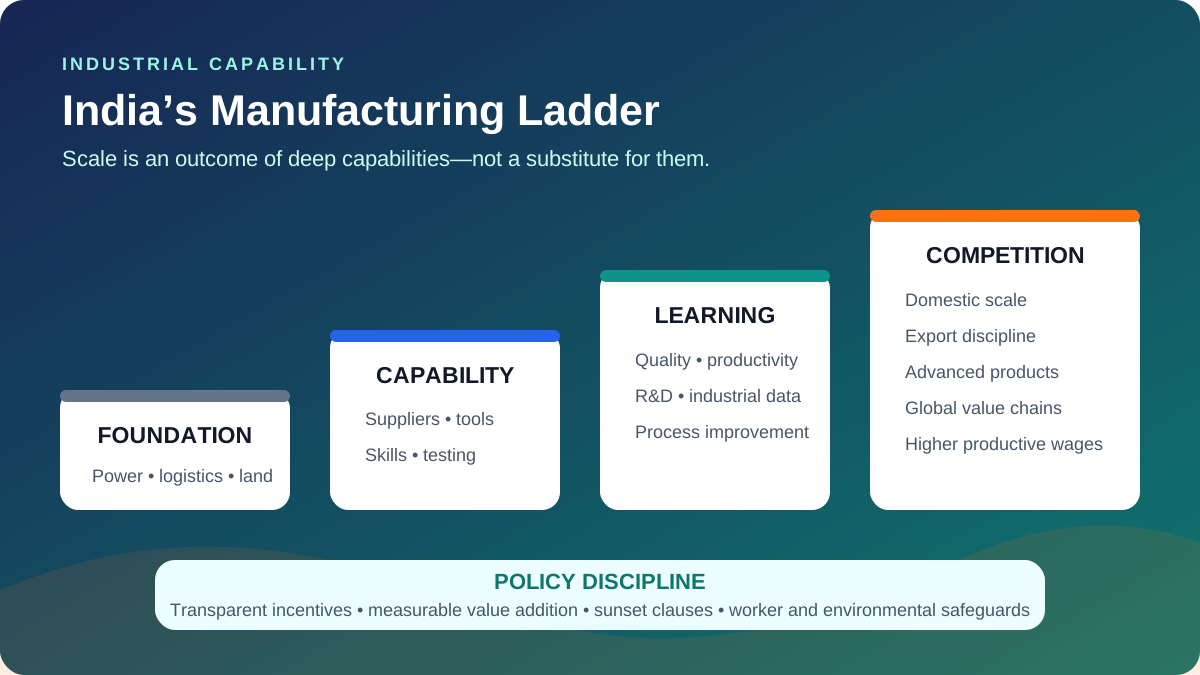
A final assembly plant cannot create broad industrial transformation by itself. Competitive manufacturing depends on a system:
| Capability | Why it matters | Typical failure when missing |
|---|---|---|
| Reliable infrastructure | Power, ports, rail, roads and logistics reduce time and inventory cost | Firms remain uncompetitive despite low wages |
| Supplier depth | Domestic components, tools and materials retain value and speed innovation | High imports make exports vulnerable to currency and supply shocks |
| Skills and shop-floor learning | Technicians, engineers and supervisors convert machines into quality output | Capital equipment is underused and defects remain high |
| Patient finance | New industries need time for learning and scale | Firms cannot invest through early low-margin years |
| Standards and testing | Certification builds trust and enables participation in global value chains | Products fail export or safety requirements |
| Competition and exports | External markets test cost, quality and delivery | Protected firms seek rent instead of productivity |
Where does India stand?
India has strengths in pharmaceuticals, automobiles and components, steel, chemicals, textiles, food processing and an expanding electronics sector. The Economic Survey 2025–26 reported that medium- and high-technology activities accounted for 46.3% of total manufacturing value added. Manufacturing GVA grew 7.72% in Q1 and 9.13% in Q2 of FY2025–26.
However, the scale gap with China remains very large. India also needs more labour-intensive factory jobs, stronger domestic component ecosystems and closer connections between research institutions and firms. Manufacturing performance should be measured through value addition, productivity, wages, exports and technology—not the gross value of assembled output alone.
What has PLI delivered?
India’s Production Linked Incentive schemes reward incremental sales or production in selected sectors. A March 2026 parliamentary reply reported the following cumulative results up to FY2025–26:
- investment: ₹2.16 lakh crore;
- sales or production: ₹20.41 lakh crore; and
- employment: 14.39 lakh, based on the programme’s reported measure.
These numbers show scale, but a rigorous evaluation must ask additional questions: How much activity was genuinely induced by the incentive? What share of value is domestic? Did supplier capability deepen? What was the public cost per durable job? Would production continue after the incentive period?
Lessons India can adapt from MIC2025
1. Choose capabilities, not only products
Support should build common capabilities—machine tools, power electronics, precision materials, industrial software, testing and design—that serve multiple sectors. Product-specific assembly incentives can otherwise create factories dependent on imported inputs.
2. Link incentives to learning
Public support should decline over time and depend on measurable productivity, quality, R&D, supplier development and export performance. Targets should be independently verified. Firms that do not learn should not receive indefinite protection.
3. Build industrial clusters with working institutions
A cluster is more than land and a gate. It needs reliable utilities, worker housing, logistics, common testing, apprenticeship networks, environmental treatment and rapid commercial dispute resolution. State governments and cities therefore matter as much as central ministries.
4. Use public procurement strategically
Government can create early demand for domestic innovation, but procurement should specify performance and life-cycle cost rather than favour an inefficient supplier forever. Transparent tenders and interoperability reduce capture.
5. Connect digital and physical production
AI inspection, sensors, digital twins and supply-chain data can improve quality and energy efficiency. LearnPro’s explainer on Digital India examines the infrastructure, privacy and governance conditions behind such transformation.
6. Treat skills as production infrastructure
Curricula should be designed with factories, but apprentices must learn portable skills rather than one firm’s narrow process. Industrial training institutes, polytechnics and engineering colleges need modern equipment, trained instructors and outcome data.
What India should not copy
- Indiscriminate subsidies: cheap credit can keep low-productivity firms alive and shift risk to banks or local governments.
- Excess capacity: simultaneous support by many states can produce more capacity than domestic or global demand can absorb.
- Opaque state support: hidden guarantees weaken fiscal accountability and provoke trade disputes.
- Forced localisation: unrealistic domestic-content rules may raise costs before suppliers can meet quality requirements.
- Environmental externalities: industrial growth that transfers pollution and health cost to communities is not genuine productivity.
- Suppression of competition: national champions without competitive pressure may become politically connected but technologically weak.
China’s experience also contributed to concerns about subsidies, market access and strategic dependency. India needs policy space, but it also benefits from a predictable rules-based trading system and access to global technology.
A better India manufacturing policy framework
- Set sector diagnostics: identify the exact missing capability—finance, technology, standards, skills or demand—before announcing an incentive.
- Publish an incentive ledger: disclose beneficiaries, public cost, milestones, verification and clawbacks.
- Measure domestic value addition: trace component and intellectual-property depth instead of relying only on invoice value.
- Support MSME upgrading: provide common testing, technology extension, quality certification and affordable working capital.
- Expand labour-intensive exports: improve logistics, predictable trade policy and flexible but rights-respecting employment systems for apparel, footwear, furniture, food processing and toys.
- Fund applied research: connect laboratories and universities with consortiums of firms and share intellectual-property rules clearly.
- Price environmental cost: combine clear standards with finance for cleaner technology and credible enforcement.
- Use sunset clauses: end support unless an independent review shows additional investment, capability and social benefit.
Employment and inclusion
Manufacturing strategy is justified partly by its ability to create jobs for workers moving from low-productivity agriculture. Automation does not remove this goal, but it changes the mix. India needs both high-tech sectors and labour-intensive value chains.
Industrial zones should provide safe transport, childcare, sanitation, worker housing and enforceable occupational safety. These are production investments because they increase labour-force participation and reduce turnover. Women’s employment should be tracked by occupation, wage and retention—not only total headcount.
UPSC and State PSC relevance
India manufacturing policy links GS Paper III topics on industrial policy, employment, infrastructure, global value chains, technology and inclusive growth. A strong answer should compare systems rather than slogans, cite current India and China data, and balance strategic support with competition and fiscal accountability.
Mains practice question: India can learn from the coordination behind Made in China 2025 without replicating its distortions. Discuss the capabilities and safeguards required for a competitive manufacturing strategy.
Conclusion
China’s most transferable lesson is that manufacturing strength is cumulative: suppliers, skills, standards, logistics, finance and research reinforce one another over years. India needs equal persistence, but with transparent subsidies, competitive discipline, worker protection and environmental accountability. The objective should be firms that can compete after support ends, not factories that exist only because support continues.
Frequently asked questions
What is Made in China 2025?
It was a ten-year industrial upgrading plan announced in 2015 to strengthen Chinese capability in ten advanced manufacturing sectors.
Is MIC2025 only about domestic production?
No. Its broader purpose was technological upgrading, supplier capability, quality, smart manufacturing and stronger positions in global value chains.
What is India’s Production Linked Incentive scheme?
PLI schemes provide incentives linked to incremental production or sales in selected sectors to attract investment and expand manufacturing scale.
What is the biggest manufacturing lesson for India?
Build complete ecosystems—suppliers, skills, infrastructure, standards, finance and research—rather than supporting final assembly alone.
Why can industrial subsidies be risky?
Poorly designed subsidies can create excess capacity, protect inefficient firms, hide fiscal liabilities and trigger trade disputes.
Primary references
- State Council of China: launch and ten sectors of Made in China 2025
- State Council of China: smart-factory progress
- PIB: PLI investment, production and employment data to FY2025–26
- Economic Survey 2025–26: India’s industrial performance
- World Bank: manufacturing value added data





Sources and further reading
- State Council of China: launch and ten sectors of Made in China 2025english.www.gov.cn
- State Council of China: smart-factory progressenglish.www.gov.cn
- PIB: PLI investment, production and employment data to FY2025–26pib.gov.in
- Economic Survey 2025–26: India’s industrial performancepib.gov.in
- World Bank: manufacturing value added datadata.worldbank.org