
India-Bhutan development cooperation is a long-term partnership built around Bhutan’s national priorities rather than isolated aid announcements. At the Development Cooperation Talks in New Delhi on 30 June 2025, the two countries reviewed the ₹10,000 crore support package for Bhutan’s 13th Five-Year Plan and approved 10 additional projects worth ₹1,113 crore.
The relationship has continued to evolve. By March 2026, hundreds of local community projects were under implementation, the 1,020 MW Punatsangchhu-II hydropower project had begun exporting electricity to India, and work was progressing on new cross-border connectivity. The policy question is how both countries can retain trust while improving delivery, economic diversification and environmental sustainability.
Why are India and Bhutan close partners?
The India-Bhutan Friendship Treaty of 2007 provides the modern framework for bilateral relations. It affirms peace, friendship, sovereign equality and close cooperation. Regular contact between the Bhutanese monarchy, elected governments and Indian leadership gives the partnership unusual continuity.
Bhutan matters to India because it is a trusted Himalayan neighbour, part of India’s Neighbourhood First policy and connected closely with the security and economy of the Northeast. India matters to Bhutan as its largest market, transit partner, source of essential supplies, development partner and buyer of surplus hydropower.
What happened at the June 2025 talks?
The Development Cooperation Talks are a formal bilateral mechanism for reviewing projects and adjusting support to Bhutan’s priorities. The 30 June 2025 meeting recorded:
- overall commitment: Nu/₹100 billion, or ₹10,000 crore, for the 13th Five-Year Plan period 2024–2029;
- first project-tied tranche: 61 Project-Tied Assistance (PTA) projects worth ₹4,958 crore already at different stages;
- first community tranche: 283 High Impact Community Development Projects (HICDPs) worth about ₹417 crore;
- economic stimulus: ₹750 crore released by that meeting under the Economic Stimulus Programme;
- programme grant: ₹100 crore released; and
- second PTA tranche: 10 projects worth ₹1,113 crore approved in healthcare, connectivity, urban infrastructure and livestock.
The two sides also allowed allocation changes where needs had evolved. This is important: development cooperation should follow outcomes and current priorities rather than freeze every budget line at the planning stage.
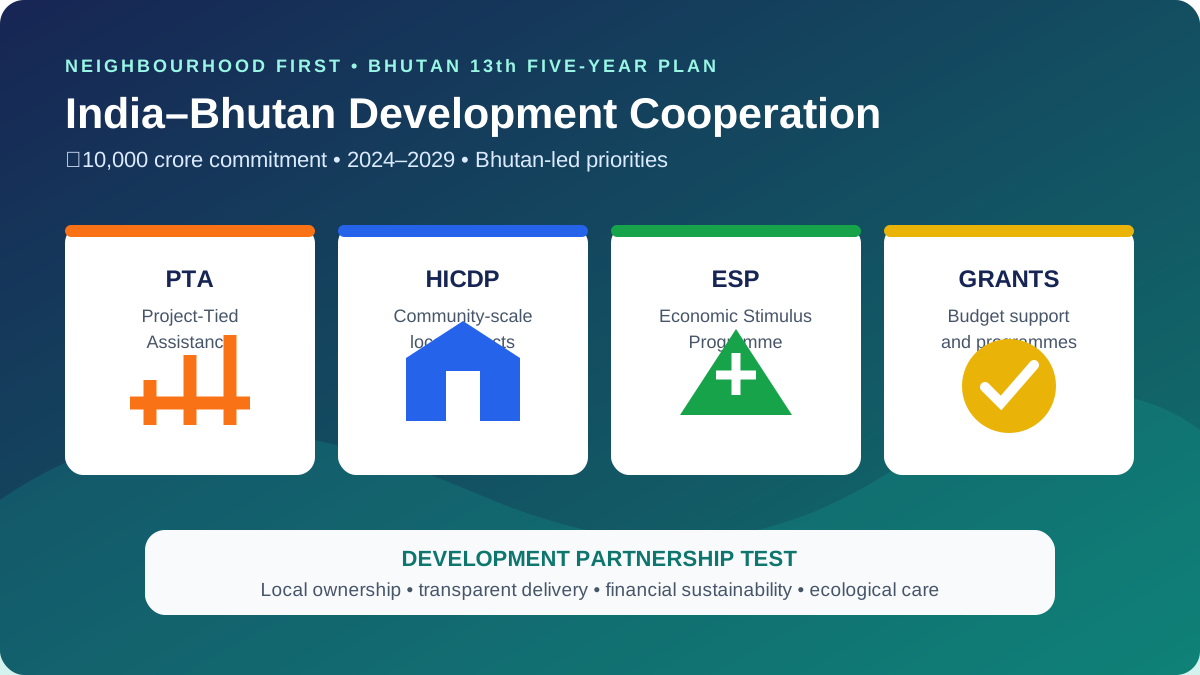
How is the ₹10,000 crore package structured?
| Window | Purpose | Illustrative sectors |
|---|---|---|
| PTA | Larger, identified projects tied to agreed outputs | Health, education, roads, digital systems, urban infrastructure |
| HICDP | Short-gestation projects implemented by local governments | Water, irrigation, farm roads, flood protection, waste management |
| ESP | Economic stimulus requested by Bhutan | Recovery, enterprise, credit and economic activity |
| Programme Grant | Budgetary support with broader programme flexibility | Plan priorities and public services |
Some Bhutanese updates refer to Nu/₹85 billion for Plan assistance and a separate Nu/₹15 billion Economic Stimulus Programme. Together they explain the publicly announced Nu/₹100 billion package. Converting ngultrum and rupees is straightforward in these documents because the Bhutanese ngultrum is pegged at par to the Indian rupee.
Community projects: latest implementation position
HICDPs are deliberately small and local. They aim to produce visible benefits through rural roads, drinking water, irrigation, agriculture infrastructure, township works and flood protection. They are implemented by Bhutanese local governments, which strengthens ownership.
At the third HICDP Committee meeting on 9 March 2026, the countries reviewed the first two batches and approved five more projects. Bhutan’s official release reported 571 projects worth Nu 8.46 billion under implementation, with Nu 4.97 billion released by India. These numbers update the 283-project position reported in June 2025.
Hydropower: the economic centrepiece
Hydropower cooperation gives Bhutan revenue from electricity exports and India access to renewable electricity. The partnership has supported projects including Chukha, Kurichhu, Tala and Mangdechhu.
A major update came on 11 November 2025 when the King of Bhutan and the Prime Minister of India inaugurated the 1,020 MW Punatsangchhu-II project. Electricity exports to India commenced. Both sides also agreed to work toward resuming and completing the 1,200 MW Punatsangchhu-I project, whose difficult geology and delays show the financial and engineering risks of large Himalayan infrastructure.
The next energy phase is broader than hydropower. The 2024 Joint Vision on Energy Partnership covers solar, green hydrogen, e-mobility, energy storage and new financing models. Diversification can reduce the dependence of bilateral economic ties on a small number of very large dams.
Connectivity and new growth areas
- Rail: proposed links between Kokrajhar and Gelephu and between Banarhat and Samtse would provide Bhutan’s first railway connectivity.
- Border infrastructure: integrated check posts and the Hatisar immigration facility can support trade, investment and access to Gelephu.
- Digital and fintech: RuPay, BHIM interoperability and digital connectivity reduce transaction costs.
- Space: the jointly developed India-Bhutan SAT and its ground station support data and technical capacity.
- Skills and youth: education, STEM exchanges and support for Gyalsung academies invest in human capability.
- Postal and logistics links: the 2026 India Post–Bhutan Post framework covers technology, e-commerce and capacity building.
For a focused connectivity case study, see LearnPro’s explainer on the India-Bhutan railway projects.
Strategic significance for India
- Trusted neighbourhood: stable relations reduce strategic uncertainty in a sensitive Himalayan region.
- Northeast connectivity: roads, rail and border facilities can connect Bhutan with Assam and West Bengal markets.
- Energy security: long-term electricity trade supports a more integrated regional power market.
- Regional model: Bhutan-led priorities and grant support offer an alternative to opaque or unsustainable infrastructure finance.
- People-to-people ties: education, tourism, culture and professional exchanges make the partnership broader than state diplomacy.
Challenges requiring careful management
- Project delay and cost escalation: Himalayan geology, land, procurement and limited construction seasons affect delivery.
- Economic concentration: Bhutan needs jobs and exports beyond hydropower, especially for young people.
- Environmental risk: dams, roads and urban projects must respect Bhutan’s ecological standards and community concerns.
- Debt and revenue risk: large energy projects require realistic tariffs, construction assumptions and repayment terms.
- Trade asymmetry: India is the dominant partner; policy must expand Bhutanese market access and productive capacity.
- Strategic sensitivity: India should support Bhutan’s security and development while respecting its sovereign choices, including its boundary negotiations with China.
A better implementation framework
- publish project milestones, releases, completion status and outcome indicators in a common dashboard;
- use independent engineering and environmental review for large infrastructure;
- prioritise maintenance and institutional capacity, not construction alone;
- procure more Bhutanese goods and services where competitive;
- expand scholarships, digital skills, startup links and private investment; and
- connect local HICDP outputs with water security, livelihoods and disaster resilience.
UPSC and State PSC relevance
India-Bhutan development cooperation belongs to GS Paper II: India and its neighbourhood, bilateral relations and development partnerships. It also connects with GS Paper III energy, infrastructure and environmental security. A strong answer should use the 2007 Treaty, the ₹10,000 crore 13th Plan package, HICDP implementation and Punatsangchhu-II as evidence.
Mains practice question: India-Bhutan relations demonstrate how development partnership, energy interdependence and strategic trust can reinforce each other. Discuss the achievements and emerging challenges.
Conclusion
The partnership works because it combines high-level trust with institutions that can review and revise projects. Its future success will depend less on headline commitments than on transparent delivery, economic diversification, ecological care and benefits visible to local communities. Bhutanese ownership and mutual sensitivity remain the most important strategic assets.
Frequently asked questions
How much has India committed for Bhutan’s 13th Five-Year Plan?
India announced Nu/₹100 billion, equal to ₹10,000 crore, for 2024–2029 across project-tied assistance, community projects, economic stimulus and programme grants.
What did the June 2025 talks approve?
The two countries approved 10 second-tranche PTA projects worth ₹1,113 crore in healthcare, connectivity, urban infrastructure and livestock.
What are HICDPs?
High Impact Community Development Projects are short-gestation local works in areas such as drinking water, irrigation, rural roads, flood protection and waste management.
What is the latest status of Punatsangchhu-II?
The 1,020 MW project was inaugurated in November 2025 and electricity exports to India commenced.
Which treaty frames modern India-Bhutan relations?
The revised India-Bhutan Friendship Treaty of 2007 provides the modern framework for peace, sovereign equality, friendship and cooperation.
Primary references and official updates
- Bhutan MFA: 13th Plan Talks and ₹10,000 crore package
- Bhutan MFA: Third HICDP meeting, March 2026
- Prime Minister of India: November 2025 joint press release
- Ministry of External Affairs: India-Bhutan relations and 2007 Treaty
- June 2025 Development Cooperation Talks and project approvals





Sources and further reading
- Bhutan MFA: 13th Plan Talks and ₹10,000 crore packagemfa.gov.bt
- Bhutan MFA: Third HICDP meeting, March 2026mfa.gov.bt
- Prime Minister of India: November 2025 joint press releasepmindia.gov.in
- Ministry of External Affairs: India-Bhutan relations and 2007 Treatymea.gov.in
- June 2025 Development Cooperation Talks and project approvalshindustantimes.com