
Tags: GS Paper 2 – Welfare Schemes, Governance, e-Governance, Transparency and Accountability
For Prelims: EPIC, Aadhaar Act 2016, Section 7 of Aadhaar Act, Direct Benefit Transfer, Election Laws (Amendment) Act 2021, Puttaswamy (Aadhaar) 2018, People’s Plan Campaign, JAM trinity
For Mains: Identity infrastructure for welfare delivery, exclusion errors, linking electoral and welfare databases, privacy concerns
Why in News?
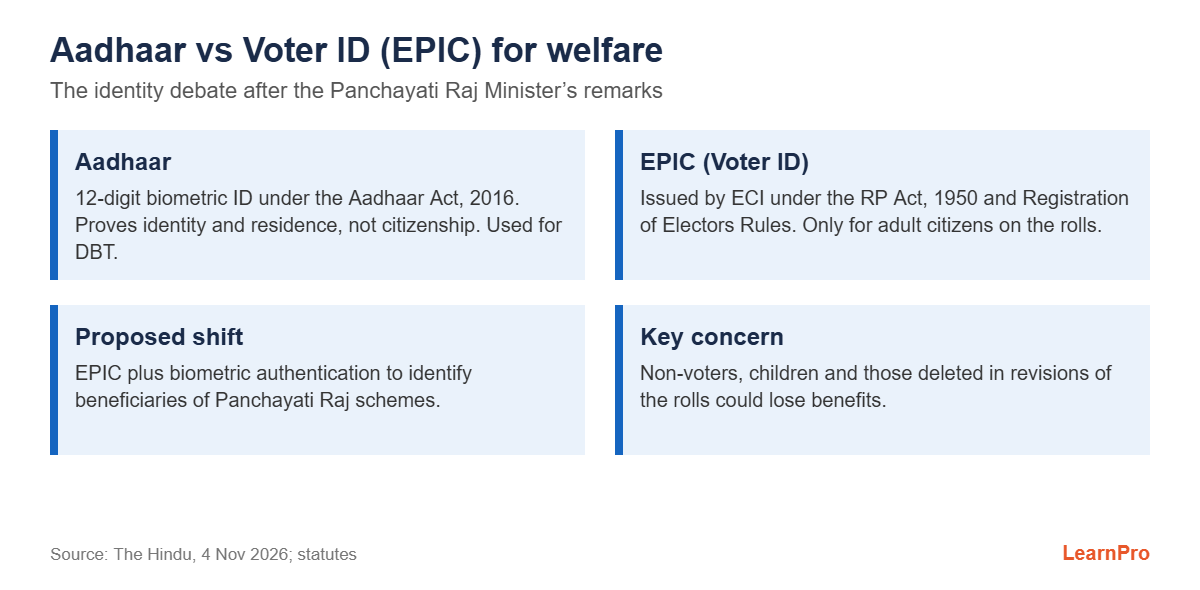
The Union Minister for Panchayati Raj, Rajiv Ranjan Singh, has said that Voter ID cards (EPIC) together with biometric authentication will be the basis for identifying beneficiaries and making payments under welfare schemes run by his Ministry, instead of Aadhaar. He argued that Aadhaar cards are easy to obtain fraudulently. The remarks came during the People’s Plan Campaign 2026-27, at a time when the Opposition is raising allegations of wrongful deletions from the electoral rolls.
Summary
- Beneficiaries would have to give their EPIC number along with biometrics to receive benefits.
- The government says this would remove ‘fraudulent’ beneficiaries.
- Critics warn that people missing from the electoral rolls could lose access to welfare.
Aadhaar vs EPIC: Legal Position
| Feature | Aadhaar | EPIC (Voter ID) |
|---|---|---|
| Law | Aadhaar (Targeted Delivery of Financial and Other Subsidies, Benefits and Services) Act, 2016 | RP Act, 1950 and Registration of Electors Rules, 1960 |
| Issuing body | UIDAI (statutory body under MeitY) | Election Commission of India |
| Who can get it | Any resident (182+ days), including children | Only adult citizens (18+) enrolled as voters |
| Proof of | Identity, not citizenship | Identity and eligibility to vote |
| Welfare use | Section 7 allows it to be required for subsidies funded from the Consolidated Fund | No statutory provision for welfare delivery |
Key Judgments and Laws
- K.S. Puttaswamy (Aadhaar) 2018: Upheld Aadhaar for welfare under Section 7, but said no one should be denied benefits for failure of authentication.
- Election Laws (Amendment) Act, 2021: Allows voluntary linking of Aadhaar with the electoral roll.
- Digital Personal Data Protection Act, 2023: Data may be used only for its stated purpose and only to the extent needed.
Concerns with the Proposed Shift
- Exclusion: Many legitimate beneficiaries have no EPIC, including children, adolescents, migrants enrolled elsewhere, and people deleted during roll revisions.
- Mixing different purposes: Tying welfare to voter status could create pressure around voting and make benefits dependent on electoral roll exercises.
- Legal basis: Using EPIC for welfare requires legislative backing and safeguards on data-sharing between the ECI and ministries.
- Biometric failures: Older people and manual workers often fail fingerprint authentication.
- Duplication: The JAM (Jan Dhan–Aadhaar–Mobile) DBT system already saves money through de-duplication. Moving away from it could disrupt payments.
Arguments in Favour
- EPIC is linked to a verified place of residence and is checked during roll revisions.
- Panchayat-level schemes are linked to residents of a local area, which EPIC records.
- It could reduce leakages caused by fraudulently issued Aadhaar cards.
Way Forward
- Allow multiple alternative identity documents, so no beneficiary is excluded for lack of one.
- Strengthen Aadhaar enrolment checks instead of moving away from the system.
- Carry out a privacy and exclusion impact assessment before linking databases, and provide offline options and grievance redress.
Conclusion
Welfare delivery should aim to minimise exclusion as well as leakages. Moving identification from Aadhaar to voter IDs without legal backing and safeguards could leave out the very people schemes are meant to reach.
Frequently Asked Questions (FAQs)
1. Which section of the Aadhaar Act allows Aadhaar to be mandated for subsidies?
Section 7.
2. Is linking Aadhaar with the voter ID mandatory?
No. It is voluntary under the Election Laws (Amendment) Act, 2021.
3. Does Aadhaar prove citizenship?
No. It proves identity and residence.
Practice Question
Mains: Examine the implications of using electoral identity cards as the basis for welfare delivery. Suggest safeguards to prevent exclusion. (150 words)