India’s chemical industry and global value chains are closely connected because chemicals are intermediate inputs for pharmaceuticals, textiles, electronics, automobiles, agriculture, construction and clean-energy equipment. In July 2025, NITI Aayog released a strategy report that identified India’s limited share in global chemical value chains, a large trade deficit and weak research intensity, but also set out a pathway for scale, technology and export growth.
The report is important for UPSC and State PSC preparation because it connects industrial policy, trade, logistics, skills, innovation and environmental regulation. Its figures are policy targets, not guaranteed outcomes, so they must be used with the correct year and context.
Why was the NITI Aayog report released?
Global chemical production is being reshaped by supply-chain diversification, demand for specialty chemicals, stricter environmental standards and the transition towards low-carbon production. India has a large domestic market and an established manufacturing base, yet the report says the sector remains fragmented and dependent on imported feedstock and several high-value chemicals.
| Indicator in the report | Position or target | What it means |
|---|---|---|
| India’s GVC share | 3.5% in 2023 | Participation is below the scale suggested by India’s domestic demand and industrial base. |
| Chemical trade deficit | USD 31 billion in 2023 | Imports of feedstock and specialty chemicals remain a major vulnerability. |
| R&D intensity | 0.7%, against a 2.3% global average | Domestic innovation and process development need more investment. |
| 2030 ambition | 5–6% GVC share | The strategy seeks higher production, exports and value addition. |
| Employment potential | About 7 lakh additional jobs by 2030 | Skills and industrial training become central to implementation. |
What is a chemical global value chain?
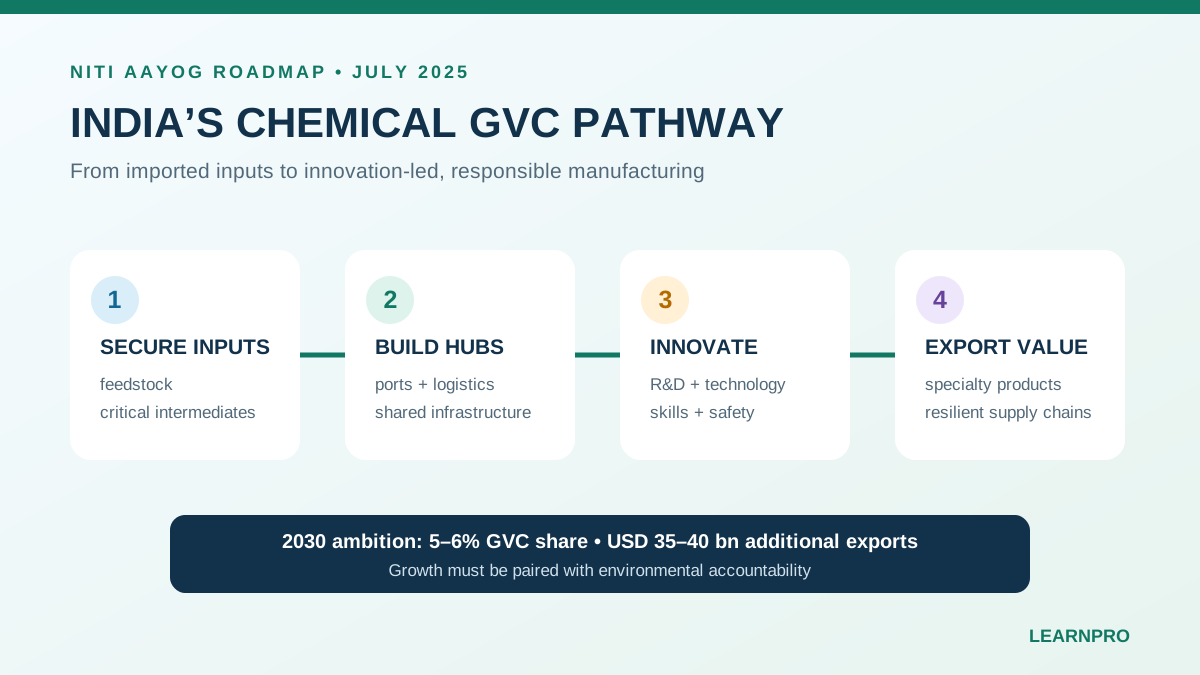
A global value chain (GVC) divides production across several countries. A firm may source crude-derived feedstock or minerals in one country, manufacture basic chemicals in another, convert them into specialty formulations elsewhere and finally supply an automobile, drug or electronic product manufacturer. A country gains more when it moves beyond low-margin bulk production into research, process technology, specialty products and reliable export networks.
Why does the chemical industry matter to India?
- Manufacturing multiplier: chemicals feed numerous downstream industries, so better quality and stable supply can improve competitiveness across the economy.
- Export opportunity: diversification by global buyers can create space for reliable Indian producers.
- Strategic resilience: domestic capability reduces exposure to a single source country for critical inputs.
- Regional development: well-planned clusters can attract processing, logistics, testing and service enterprises.
- Green transition: advanced materials, batteries, water treatment and low-carbon technologies all require chemical innovation.
This is similar to the transformation described in LearnPro’s analysis of India’s toy industry and export growth: scale alone is insufficient without standards, design, technology and market access.
Structural challenges identified by NITI Aayog
1. Import dependence and weak backward integration
When domestic plants depend on imported feedstock or critical intermediates, exchange-rate changes, shipping disruptions and geopolitical shocks increase costs. Backward integration can improve security, but it must be economically efficient and environmentally responsible.
2. Fragmented clusters and logistics costs
Chemical manufacturing needs common effluent treatment, testing facilities, storage, emergency response systems, pipelines and specialised port handling. Outdated or incomplete common infrastructure raises the cost of every firm, especially smaller producers.
3. Low research intensity
The report compares India’s R&D intensity of 0.7% with a 2.3% global average. Limited research spending makes it harder to develop proprietary processes, specialty molecules and safer production technologies.
4. Regulatory delay without regulatory certainty
Environmental clearance is necessary because chemical accidents and pollution can impose severe public costs. The real policy need is faster, transparent and technically rigorous decision-making, not weaker safeguards.
5. Skills gap
NITI Aayog reported a 30% shortfall in skilled professionals, particularly in green chemistry, nanotechnology and process safety. Training must cover plant operation as well as risk management, environmental monitoring and emergency response.
Seven intervention areas in the report
- World-class chemical hubs: upgrade existing clusters, develop new hubs and create an empowered central committee and a Chemical Fund for shared infrastructure and viability-gap support.
- Port infrastructure: form a chemical committee for ports and address specialised storage, handling and connectivity gaps, including development of eight high-potential clusters.
- Operating-expenditure support: consider time-bound incentives for incremental production, selected using import dependence, export potential and end-market criticality.
- Technology access and R&D: connect industry and academia through an interface involving the Department of Chemicals and Petrochemicals and the Department of Science and Technology; use partnerships where overseas technology is required.
- Accountable environmental clearance: monitor timelines and compliance, publish periodic performance reports and strengthen expert appraisal.
- Targeted trade policy: negotiate chemical-specific FTA provisions where appropriate, improve awareness and simplify origin documentation.
- Talent development: expand specialised institutes, improve teacher training and introduce industry-relevant courses in petrochemicals, polymer science and industrial safety.
2030 and 2040 vision: read the targets carefully
For 2030, the report envisages a 5–6% share of global chemical value chains, additional exports of USD 35–40 billion, around seven lakh skilled jobs and movement from the 2023 deficit towards net-zero chemical trade. Its longer-term scenario points to a USD 1 trillion chemical sector by 2040 and a substantially higher GVC share if the recommended reforms are implemented.
These numbers are a roadmap, not a forecast that will occur automatically. Outcomes depend on global demand, energy and feedstock prices, trade conditions, environmental performance, investment quality and the ability of governments and firms to coordinate.
How should policy balance growth and safety?
A successful chemical strategy must avoid a false choice between competitiveness and environmental protection. Shared treatment plants, real-time emissions monitoring, hazardous-waste tracking, safer chemistry and enforceable liability can reduce risk while predictable approval timelines improve investment certainty.
- link financial support to measurable production, export, safety and emissions outcomes;
- publish cluster-level environmental and accident data;
- prioritise technologies that reduce hazardous inputs, water use and energy intensity;
- support MSMEs with common testing, compliance and research facilities; and
- coordinate land use, ports, rail, pipelines and emergency services before approving expansion.
Smaller manufacturers can participate through clusters and supplier networks. Read the connected explainer on how collective scale can strengthen MSMEs.
UPSC and State PSC relevance
India’s chemical industry and global value chains fit GS Paper III themes of industrial growth, infrastructure, trade, employment, technology and environmental management. A strong answer should use the 2023 baseline, explain the bottlenecks, discuss NITI Aayog’s intervention package and add a safety-and-sustainability test.
Mains practice question: India’s chemical industry can become a major node in global value chains only if industrial scale is combined with innovation, logistics efficiency and environmental accountability. Discuss.
Conclusion
The NITI Aayog roadmap treats chemicals as an ecosystem rather than a collection of factories. India’s durable advantage will come from integrated clusters, skilled workers, process innovation, dependable regulation and high-value exports. Subsidies may help selected investments, but competitiveness must ultimately rest on productivity, safety and technology.
Frequently asked questions
What was India’s share in global chemical value chains in 2023?
NITI Aayog reported a 3.5% share in 2023.
How large was India’s chemical trade deficit in 2023?
The report placed the chemical trade deficit at USD 31 billion, linked partly to imported feedstock and specialty chemicals.
What is the report’s 2030 employment potential?
It envisages around seven lakh additional skilled jobs by 2030 if the proposed transformation is implemented.
Does faster environmental clearance mean weaker safeguards?
It should not. The report proposes transparent, accountable and time-bound appraisal; strong monitoring and compliance remain essential.
Why are chemical clusters important?
Clusters can share treatment plants, testing, storage, logistics, emergency response and other expensive infrastructure, reducing cost while improving safety.
Primary references
- NITI Aayog: Chemical Industry—Powering India’s Participation in Global Value Chains
- Press Information Bureau release, 3 July 2025