IPS deputation in CAPFs became a major service-reform issue after the Supreme Court’s judgment in Sanjay Prakash v. Union of India on 23 May 2025. The Court recognised the Group-A executive cadres of five Central Armed Police Forces as Organised Group-A Services for cadre-related purposes and ordered a time-bound review of their service structure.
The Court did not direct the immediate removal of every IPS officer. It ordered that deputation posts up to the Senior Administrative Grade (SAG) be progressively reduced within an outer limit of two years, balancing CAPF officers’ career mobility with operational requirements. The Union’s review petition was dismissed on 28 October 2025.
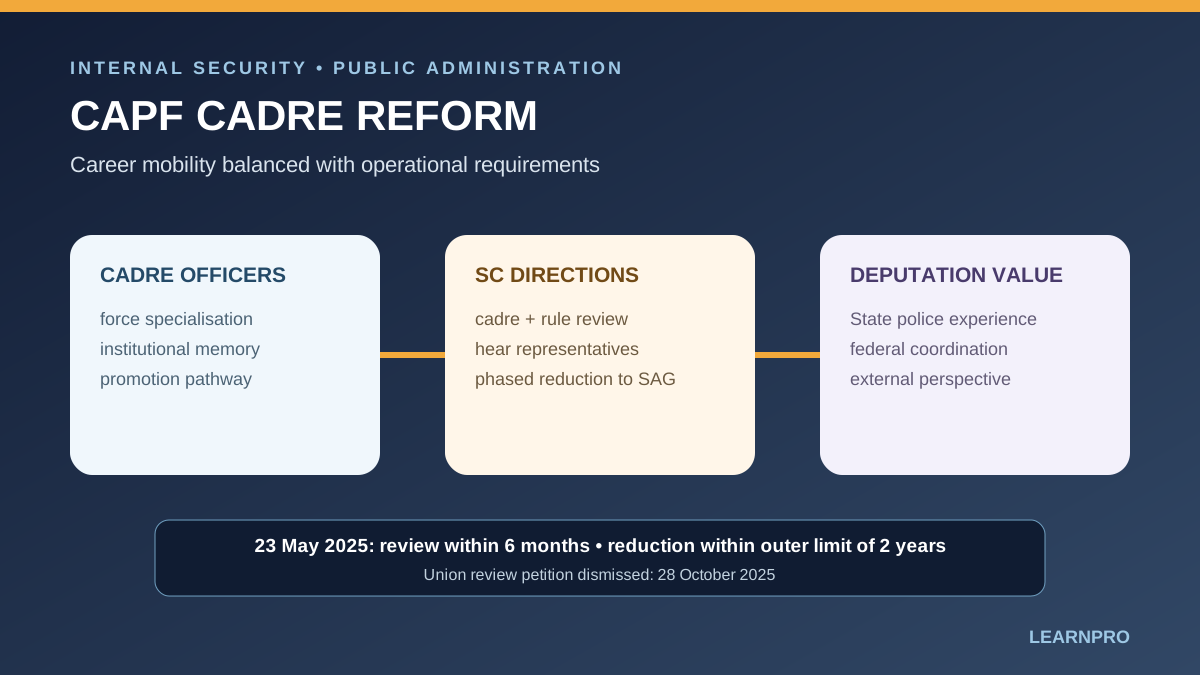
Judgment at a glance
| Point | Supreme Court direction |
|---|---|
| Case | Sanjay Prakash & Others v. Union of India & Others, 2025 INSC 779 |
| Date | 23 May 2025 |
| Forces covered | BSF, CRPF, CISF, ITBP and SSB Group-A executive cadres |
| Service status | Organised Group-A Service (OGAS) for cadre review and related matters |
| Cadre review | Review due in 2021 to be completed within six months |
| Recruitment rules | MHA to review them within six months after hearing cadre representatives |
| IPS deputation | Posts up to SAG to be progressively reduced within an outer limit of two years |
| Review petition | Dismissed by the Supreme Court on 28 October 2025 |
What are the CAPFs?
Central Armed Police Forces operate under the Ministry of Home Affairs and perform border guarding, internal security, protection of vital installations and other specialised duties. They are distinct from the Army, Navy and Air Force.
| Force | Core role |
|---|---|
| CRPF | Internal security, public order support and counter-insurgency |
| BSF | Guarding India’s borders with Pakistan and Bangladesh, with wartime support functions |
| ITBP | Guarding the India–China border and high-altitude duties |
| SSB | Guarding the India–Nepal and India–Bhutan borders |
| CISF | Security of airports, strategic installations and critical infrastructure |
Cadre officer and deputationist: what is the difference?
A cadre officer joins a particular CAPF, generally through direct recruitment as Assistant Commandant, and builds specialised experience within that force. A deputationist belongs to another service—commonly the Indian Police Service—and serves in the CAPF for a limited period at an authorised rank.
Deputation can bring State policing experience and strengthen Centre–State coordination. But if too many senior posts are reserved for outside officers, CAPF cadre officers may wait for years for promotion despite long operational experience.
What is Organised Group-A Service status?
An Organised Group-A Service has a structured hierarchy, regular cadre review and defined career progression. The Supreme Court had earlier recognised the status in Union of India v. Harananda. The 2025 judgment held that CAPFs could not be treated as OGAS for one benefit but denied related cadre consequences.
A central issue was Non-Functional Financial Upgradation (NFFU). NFFU can give eligible officers a higher pay level when officers of another qualifying Group-A service reach that level, even if the recipient is not promoted to the corresponding post. It reduces pay disadvantage but does not substitute for command responsibility, status or decision-making experience.
Why did CAPF officers challenge the system?
- Promotion stagnation: a limited number of senior cadre posts slows upward movement.
- Lateral entry: IPS deputation at DIG, IG and other senior levels occupies positions that cadre officers seek through promotion.
- Different eligibility paths: petitioners argued that deputationists could reach equivalent posts with shorter qualifying service.
- Delayed cadre review: the review due in 2021 had not been completed.
- Decision-making voice: cadre officers wanted greater representation in policies affecting their own forces.
- Morale: long stagnation can reduce motivation in services involving difficult and risky deployments.
The Union government’s argument
The Union argued that IPS officers are an important part of the command hierarchy. CAPFs often work with State police and civil administrations during elections, riots, insurgency, disaster or major security operations. Officers with State and district policing experience may support coordination and a broader administrative perspective.
The government also maintained that each force has distinct operational needs and that recruitment rules embody policy choices. The Court accepted that operational requirements matter; this is why it chose progressive reduction rather than abrupt abolition.
What the Supreme Court actually ordered
- complete the cadre review due in 2021 for all five forces within six months;
- review the service and recruitment rules under the relevant DoPT framework;
- give representatives of each CAPF cadre an opportunity to be heard;
- require DoPT to decide after receiving MHA’s action-taken reports; and
- progressively reduce deputation posts up to SAG within an outer limit of two years.
The direction applied up to SAG; it did not lay down the same rule for every apex post. Nor did it hold that all deputation is unconstitutional.
Why the review petition matters
The Union sought reconsideration of the May judgment. On 28 October 2025, a Bench of Justices Surya Kant and Ujjal Bhuyan rejected an open-court hearing and dismissed the review, finding no ground to revisit the ruling. The May directions therefore remained operative.
Benefits of stronger cadre leadership
- retains institutional memory built through long service in the same force;
- creates credible promotion incentives for young officers;
- places operational specialists in administrative decisions;
- reduces dependence on short-tenure external leadership; and
- aligns responsibility, expertise and career reward.
Risks of a poorly designed transition
- Silo formation: a fully closed cadre may weaken exchange with State policing systems.
- Vacancy pressure: rapid removal of deputation posts without promotion-ready officers can create gaps.
- Inter-force inconsistency: one formula may not suit border, industrial-security and internal-security forces equally.
- Litigation: vague rules invite new disputes over post classification and seniority.
- Token compliance: redesignating posts without real command authority will not solve stagnation.
A balanced reform model
- publish force-wise sanctioned strength, vacancies and deputation share by rank;
- complete cadre review on a fixed five-year cycle;
- use objective promotion boards and modern performance records;
- retain limited deputation where a documented skill or coordination need exists;
- create reciprocal, time-bound exposure for CAPF officers in police and security institutions;
- invest in leadership, technology, law and public-order training for cadre officers; and
- measure reform through vacancy time, promotion age, operational performance and morale.
This issue also concerns administrative fairness and institutional design. For connected topics, read LearnPro’s guides to the anti-defection law and phone tapping and the right to privacy.
UPSC and State PSC relevance
IPS deputation in CAPFs is relevant to GS Paper II under public services, judicial review and administrative reform, and GS Paper III under internal security. The key analytical balance is between specialised cadre progression and the wider policing perspective brought by deputation.
Mains practice question: Career stagnation in a security force is not merely a service matter; it can affect institutional capability. Examine with reference to cadre reform in the CAPFs.
Conclusion
The Supreme Court’s approach is neither an automatic victory for one service nor a rejection of inter-service experience. It requires the government to justify structure through evidence and provide CAPF officers a credible career path. The objective should be operationally capable forces in which specialised experience and outside perspective are used deliberately, not by institutional habit.
Frequently asked questions
Did the Supreme Court ban all IPS deputation to CAPFs?
No. It directed progressive reduction of deputation posts up to the Senior Administrative Grade within an outer limit of two years.
Which CAPFs were covered by the 2025 judgment?
The litigation covered the Group-A executive cadres of BSF, CRPF, CISF, ITBP and SSB.
What is SAG?
Senior Administrative Grade is a senior Group-A level that generally corresponds to the Inspector General tier in the forces discussed.
What is NFFU?
Non-Functional Financial Upgradation is a pay progression mechanism for eligible organised Group-A officers; it does not itself grant a higher command post.
Was the judgment reviewed?
The Union filed a review petition, but the Supreme Court dismissed it on 28 October 2025.
Primary and authoritative references
- Supreme Court judgment: Sanjay Prakash v. Union of India, 2025 INSC 779
- Supreme Court review order dated 28 October 2025
- Ministry of Home Affairs: Central Armed Police Forces