
India’s toy industry exports rose sharply as the country combined safety regulation, higher import duties, cluster support and domestic design promotion. Between FY 2014–15 and FY 2022–23, toy exports increased from US$96.17 million to US$325.72 million, while imports fell from US$332.55 million to US$158.7 million.
These figures represent a 239% rise in exports and a 52% fall in imports. They show a major change in trade direction, but they do not by themselves prove that India has become the world’s dominant toy producer. Quality, design, scale and access to global distribution remain the next tests.
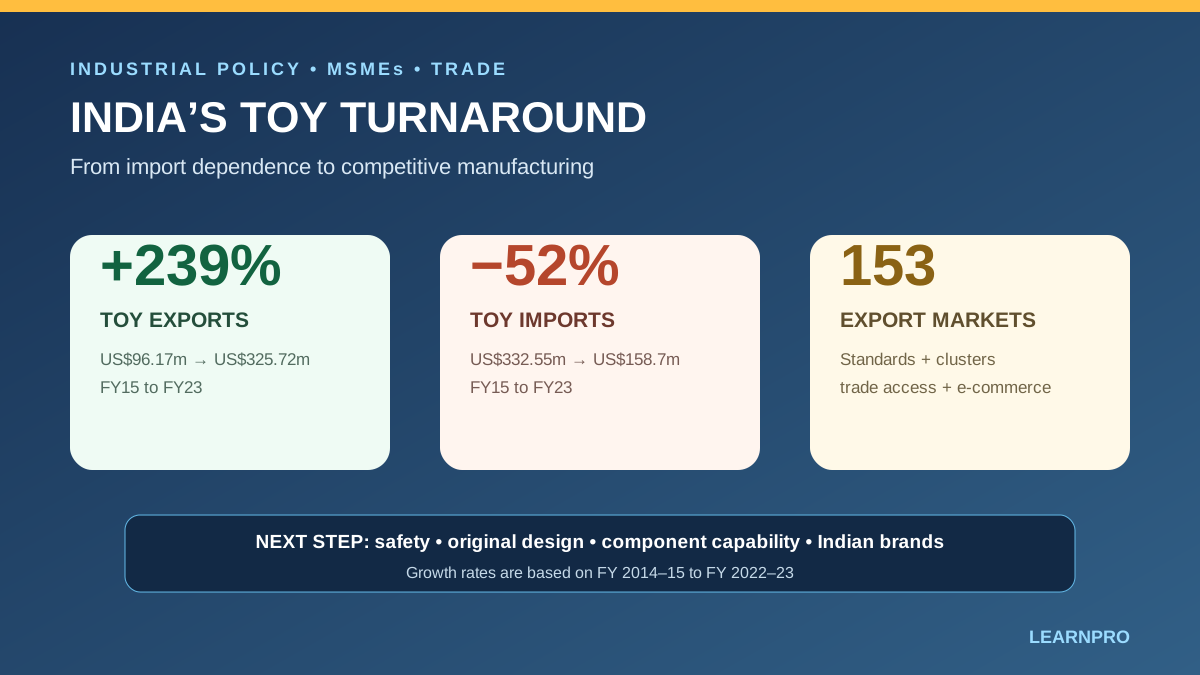
India’s toy trade transformation in data
| Indicator | FY 2014–15 | FY 2022–23 | Change |
|---|---|---|---|
| Toy exports | US$96.17 million | US$325.72 million | Up 239% |
| Toy imports | US$332.55 million | US$158.7 million | Down 52% |
| Manufacturing units | Doubled between 2014 and 2020, according to the DPIIT-commissioned study | Stronger domestic base | |
| Imported-input dependence | 33% | 12% by 2020 | Lower dependence |
A later government communication stated that Indian toys were reaching 153 countries. That is a measure of market reach, not market share: selling some products in many countries is different from commanding a large share of global value.
Why was India import-dependent earlier?
India has a rich tradition of wooden, cloth, clay and metal toys, but modern mass-market toys require consistent moulding, electronics, child-safety testing, packaging and large retail networks. The sector was fragmented and largely informal. Small firms faced high tool and mould costs, uncertain demand and limited certification capacity.
Low-priced imports, especially plastic and electronic toys, gained market share. Many did not meet adequate safety standards. Domestic makers were caught between inexpensive imports at one end and internationally branded products at the other.
The policy package behind the turnaround
1. Toys Quality Control Order
The Toys (Quality Control) Order, 2020 made compliance with specified Indian safety standards and the BIS Standard Mark compulsory from 1 January 2021. It applied to domestic and imported toys. The rules cover hazards such as small detachable parts, sharp edges, flammability and migration of harmful chemicals.
Quality regulation can protect children and stop substandard imports. However, certification also creates fixed costs. BIS therefore notified concessions and special arrangements for micro-scale units. In March 2023, the government reported 1,097 domestic toy licences, of which 1,061—96.7%—had gone to MSMEs.
2. Customs duty and import testing
Basic customs duty on many toys was raised from 20% to 60% in 2020 and then to 70% in 2023. Import consignments also faced sample testing. The measures created space for domestic firms, but protection works best as a temporary bridge to productivity. Permanent high tariffs without innovation can reduce competition and raise prices.
3. National Action Plan for Toys
The National Action Plan for Toys coordinates 14 ministries and departments through 21 action points. It connects toy design, manufacturing, education, quality, clusters, promotion and exports. Events such as Toycathon and the India Toy Fair attempted to link designers, students, manufacturers and buyers.
4. Cluster-based support
Toy clusters allow small producers to share testing laboratories, design centres, tools, packaging facilities and training. The policy used programmes such as SFURTI and MSE Cluster Development to support traditional and modern producers. Clusters matter because a micro enterprise cannot individually finance every specialised facility.
5. E-commerce and export access
Online marketplaces reduce the cost of reaching consumers and provide demand data. Trade agreements can also matter: zero-duty access in markets such as the UAE and Australia improves the competitiveness of Indian-made toys, provided they meet destination-country safety and labelling rules.
How the toy value chain works
| Stage | Capability required | Common bottleneck |
|---|---|---|
| Concept and design | Child development, culture, storytelling and intellectual property | Copying successful products instead of original design |
| Engineering | Safe materials, electronics, moulds and prototypes | High tooling cost and limited specialist skills |
| Production | Consistent quality, scale and traceability | Fragmented units and irregular orders |
| Testing | BIS and destination-market compliance | Laboratory cost and turnaround time |
| Brand and distribution | Packaging, e-commerce, retail and after-sales service | Low marketing budgets and weak global brands |
Traditional toys as an economic opportunity
Indian toy clusters can compete through cultural distinctiveness rather than price alone. Channapatna lacquerware, Kondapalli toys, Thanjavur dolls, Varanasi wooden toys and other traditions carry local knowledge and craft identity. Geographical indications, safe natural materials and contemporary design can connect artisans to premium markets.
Commercialisation must respect community ownership. A large company should not appropriate a traditional form without fair contracts, attribution and benefit sharing. Artisan clusters also need season-proof income, working capital and design partnerships—not only exhibitions.
Economic and social importance
- Employment: toy making can absorb designers, engineers, assemblers, artisans and home-based workers.
- MSME growth: many producers are micro or small firms, so shared infrastructure has large spillovers.
- Female employment: stitching, assembly, packaging and craft production can support women, if work is formal and fairly paid.
- Learning outcomes: well-designed educational toys can support play-based learning and foundational skills.
- Soft power: stories, games and characters can carry Indian culture to global audiences.
- Import resilience: local inputs and production reduce exposure to supply-chain disruption.
What could limit future export growth?
- Small global scale: the export growth rate starts from a low base.
- Design gap: manufacturing for another brand earns less than owning characters and intellectual property.
- Testing access: small units need affordable, geographically accessible laboratories.
- Electronics dependence: chips, motors and specialised components may still be imported.
- Safety enforcement: counterfeit BIS marks and untested informal products can damage consumer trust.
- Plastic waste: growth must include repairability, recycled materials and producer responsibility.
- Tariff dependence: firms must become productive enough to compete without indefinite protection.
A sustainable next-stage strategy
- build common mould, electronics and testing facilities in clusters;
- support original Indian characters, educational design and intellectual-property registration;
- help MSMEs meet EU, US and other destination-market standards;
- use public procurement for safe, inclusive classroom toys without favouring weak products;
- publish disaggregated trade data by product category and destination;
- promote non-toxic materials, durability, repair and recycling; and
- evaluate policy by productivity and export value addition, not only import reduction.
This transformation belongs to the wider manufacturing story. See LearnPro’s analysis of India’s manufacturing strategy and the India startup ecosystem.
UPSC and State PSC relevance
India’s toy industry exports are relevant to GS Paper III under industrial policy, MSMEs, trade, employment and Atmanirbhar Bharat. The best analytical argument is that standards, tariffs and clusters created domestic space, but long-term success requires productivity, original design and global safety compliance.
Mains practice question: India’s toy-sector turnaround shows both the potential and limits of strategic trade policy. Examine.
Conclusion
India reversed a large toy trade deficit through a coordinated policy package. The next phase is harder: moving from import substitution to durable global competitiveness. Export success will depend less on protection and more on safe products, original design, reliable scale and Indian-owned brands.
Frequently asked questions
How much did India’s toy exports grow?
Toy exports rose 239%, from US$96.17 million in FY 2014–15 to US$325.72 million in FY 2022–23.
How much did toy imports fall?
Imports fell 52%, from US$332.55 million in FY 2014–15 to US$158.7 million in FY 2022–23.
Are BIS standards compulsory for toys?
Yes. Toys covered by the Quality Control Order must meet the relevant Indian safety standard and bear the BIS Standard Mark under a licence.
What is the National Action Plan for Toys?
It is a coordinated plan with 21 action points across 14 ministries and departments covering design, education, quality, clusters, promotion and manufacturing.
Has India become the world’s largest toy exporter?
No. India has achieved rapid export growth and wider market reach, but its global share remains modest and the sector still faces scale, design and component challenges.
Primary and official references
- PIB: compulsory BIS certification for toy safety
- PIB: BIS licences granted to domestic toy manufacturers
- New India Samachar: toy exports to 153 countries
- DD News: DPIIT-commissioned toy industry study
- Ministry of MSME: Cluster Development Programme





Sources and further reading
- PIB: compulsory BIS certification for toy safetypib.gov.in
- PIB: BIS licences granted to domestic toy manufacturerspib.gov.in
- New India Samachar: toy exports to 153 countriesnewindiasamachar.pib.gov.in
- DD News: DPIIT-commissioned toy industry studyddinews.gov.in
- Ministry of MSME: Cluster Development Programmemy.msme.gov.in