
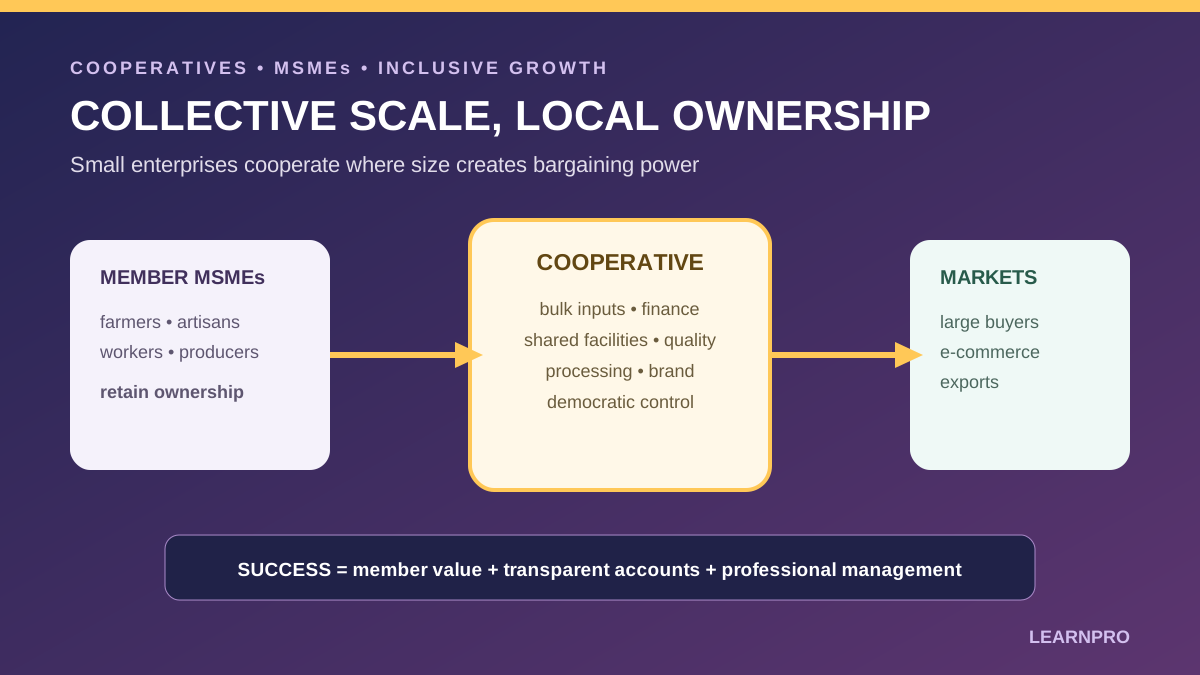
Cooperatives and MSMEs in India can reinforce each other because both organise economic activity beyond large corporations. An MSME is classified by its investment and turnover, while a cooperative is owned and democratically controlled by its members. When small producers pool purchasing, processing, finance and marketing, they can obtain the scale of a large enterprise without surrendering individual ownership.
The theme gained attention on 5 July 2025, the International Day of Cooperatives, during the UN International Year of Cooperatives. India’s Ministry of Cooperation also completed four years in July 2025 and the National Cooperative Policy 2025 was unveiled later that month.
Key facts at a glance
| Indicator | Official position |
|---|---|
| MSME share of GDP | 31.1% in FY 2023–24 |
| MSME share of goods and services trade | 48.58% in FY 2024–25, according to MSME Collab |
| People directly connected to cooperatives | About 29 crore |
| PACS network | About 1.01 lakh societies with roughly 13 crore members |
| Ministry of Cooperation | Created on 6 July 2021 |
| Global 2025 theme | “Cooperatives: Driving Inclusive and Sustainable Solutions for a Better World” |
MSME and cooperative are different concepts
| Feature | MSME | Cooperative |
|---|---|---|
| Basis | Economic size defined by investment and annual turnover | Ownership and governance model defined by member control |
| Purpose | May operate for private profit | Meets common economic or social needs of members |
| Voting | Depends on legal form and shareholding | Generally follows democratic member control |
| Overlap | A cooperative enterprise can also qualify as an MSME if it meets the applicable criteria | |
From 1 April 2025, a micro enterprise may have investment up to ₹2.5 crore and turnover up to ₹10 crore; the small limit is ₹25 crore and ₹100 crore; and the medium limit is ₹125 crore and ₹500 crore. Both criteria apply.
Why individual MSMEs struggle to scale
- Input disadvantage: small orders receive weaker prices and irregular supply.
- Credit constraints: firms lack collateral, formal records or predictable cash flow.
- Technology cost: modern machinery, testing and software are expensive for one unit.
- Market power: intermediaries and large buyers can dictate terms.
- Quality compliance: certification and traceability have high fixed costs.
- Delayed payments: small suppliers carry the working-capital burden of larger customers.
- Skill gaps: bookkeeping, export documentation, design and digital marketing are scarce.
How a cooperative creates collective scale
1. Bulk procurement
Members can aggregate demand for raw materials, energy, packaging, insurance and logistics. A transparent cooperative purchase contract reduces unit cost and supply uncertainty without requiring every member to merge into one company.
2. Shared processing and infrastructure
A common facility can house cold storage, grading, testing, design software, machinery or pollution-control equipment. This is particularly useful for food processing, textiles, handicrafts, fisheries and repair services.
3. Better access to finance
Regular member transactions produce data that lenders can assess. Cooperative banks and credit societies can combine local knowledge with formal underwriting. Rural cooperative banks have also been included as member lending institutions under CGTMSE, enabling eligible collateral-free credit with guarantee cover.
4. Processing and value addition
When farmers or artisans sell unprocessed output separately, much of the margin goes to traders. A member-owned enterprise can grade, process, package and brand the product, returning part of the value to members through better prices or patronage-linked surplus.
5. Market and export aggregation
A cooperative can supply a buyer who requires consistent volume, uniform specifications and delivery schedules. National Cooperative Exports Limited was created to aggregate cooperative products for global markets, though export success still requires quality, traceability and commercially viable orders.
Where the model works
| Sector | Shared function | Member benefit |
|---|---|---|
| Dairy | Collection, chilling, processing and brand | Assured procurement and value sharing |
| Agriculture | Inputs, storage, credit, processing and marketing | Lower costs and stronger price discovery |
| Fisheries | Equipment, ice, landing, cold chain and sales | Lower spoilage and better bargaining |
| Handloom and handicrafts | Design, raw material, quality and e-commerce | Market reach with artisan identity |
| Worker services | Contracts, equipment and social protection | More control over work and earnings |
| Renewable energy | Community generation, maintenance and billing | Local energy access and shared returns |
Current cooperative reforms relevant to MSMEs
- Multipurpose PACS: model bye-laws allow primary societies to enter more than 25 additional activities, including storage, dairy and services.
- PACS computerisation: a common software network aims to improve records, transparency and service delivery.
- New primary societies: the government plans two lakh new multipurpose PACS, dairy and fishery cooperatives in uncovered areas.
- National-level cooperatives: new entities focus on exports, organic products and improved seeds.
- National Cooperative Policy 2025: the policy seeks professional, inclusive, technology-enabled and competitive cooperatives.
- RAMP: the MSME programme supports market access, institutional capacity and enterprise reform through Centre–State plans.
Why cooperatives sometimes fail
Collective ownership does not automatically guarantee good management. Common problems include:
- political capture and interference in board decisions;
- elite domination despite formal one-member-one-vote rules;
- weak accounting, delayed audits and poor disclosure;
- professional managers being underpaid or overruled;
- inactive members and low participation by women or marginal groups;
- credit decisions based on influence rather than repayment capacity;
- dependence on subsidy instead of member value; and
- conflicts between social objectives and commercial discipline.
Governance safeguards
- member control: timely elections, accessible meetings and secret ballots;
- professional management: boards set policy while qualified executives run operations;
- transparent accounts: digital ledgers, independent audit and public annual reports;
- transaction-linked benefits: surplus distribution rewards genuine member participation;
- conflict rules: disclose related-party contracts and procurement interests;
- inclusive leadership: real participation by women, small producers and disadvantaged groups;
- market discipline: measure service quality, operating margin and member income; and
- federal clarity: respect State authority over most cooperatives and Union law for multi-State societies.
Cooperative, producer company or private platform?
| Model | Strength | Risk |
|---|---|---|
| Cooperative | Democratic control and local legitimacy | Political capture and slow decisions |
| Producer company | Company-law structure with producer ownership | Needs strong professional capacity |
| Private aggregator | Fast capital and technology deployment | Platform may capture data and bargaining power |
The correct form depends on the activity. Policy should not force every group into a cooperative; it should let members choose after understanding governance, tax, finance and liability implications.
For the wider enterprise context, read LearnPro’s analysis of India’s MSME sector and the toy industry’s export transformation.
UPSC and State PSC relevance
Cooperatives and MSMEs in India are relevant to GS Paper II under cooperative federalism and institutions, and GS Paper III under inclusive growth, credit, employment and rural industrialisation. The central analytical idea is that a cooperative can convert many small economic actors into one scalable market institution while preserving distributed ownership.
Mains practice question: Cooperatives can solve the scale problem of MSMEs, but only if democratic ownership is matched by professional management. Discuss.
Conclusion
Cooperatives can help MSMEs purchase together, process together and sell together. Their advantage is not smallness; it is scale without concentrated ownership. But this promise survives only when members receive measurable value, accounts are transparent and management remains commercially competent.
Frequently asked questions
Can a cooperative be an MSME?
Yes. A cooperative enterprise can register as an MSME if it satisfies the applicable investment and turnover criteria.
How do cooperatives help small businesses?
They pool procurement, infrastructure, finance, processing, certification, marketing and exports, reducing fixed costs for individual members.
What is one-member-one-vote?
It is the democratic principle that voting power is linked to membership rather than the amount of capital invested, subject to the governing law and bye-laws.
What are multipurpose PACS?
They are primary agricultural credit societies enabled through model bye-laws to offer additional activities such as storage, dairy, fisheries and other village services.
What is the biggest cooperative governance risk?
Political or elite capture can weaken member control, distort lending and procurement and turn the society into a subsidy-dependent institution.
Primary and official references
- Ministry of MSME: MSME Collab data
- Ministry of MSME: classification effective 1 April 2025
- Ministry of Cooperation: cooperative reform initiatives
- National Cooperative Policy 2025
- UN DESA: International Day of Cooperatives 2025
- Ministry of MSME: RAMP programme





Sources and further reading
- Ministry of MSME: MSME Collab datamy.msme.gov.in
- Ministry of MSME: classification effective 1 April 2025msme.gov.in
- Ministry of Cooperation: cooperative reform initiativescooperation.gov.in
- National Cooperative Policy 2025cooperation.gov.in
- UN DESA: International Day of Cooperatives 2025social.desa.un.org