
Source: The Hindu, 7 November 2026
For Prelims: Graded Response Action Plan (GRAP), Commission for Air Quality Management (CAQM), Air Quality Index (AQI), PM2.5 and PM10, BS-VI norms, National Clean Air Programme (NCAP).
For Mains: Air pollution in the Indo-Gangetic Plain, inter-State coordination, effectiveness of emergency vs structural measures, public health impacts.
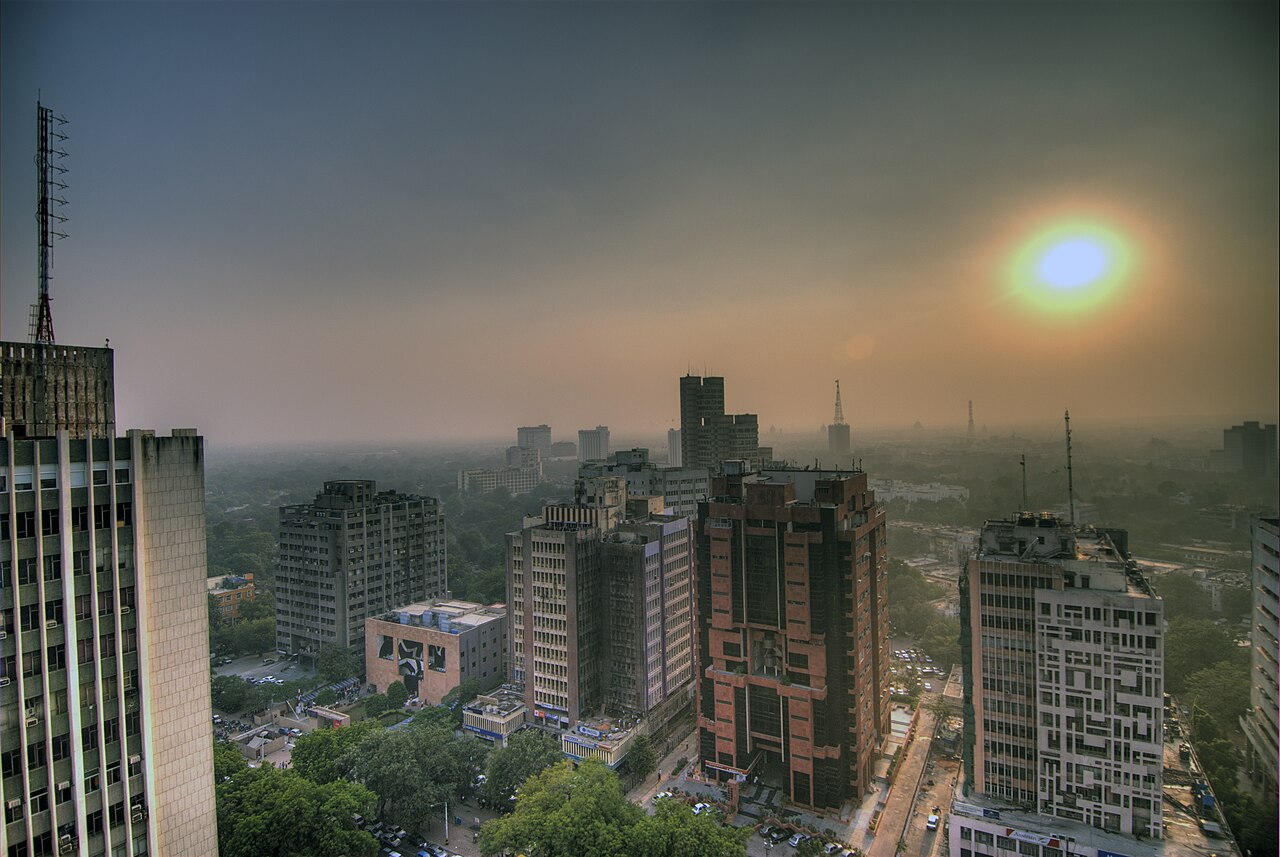
Table of Contents
- Why in News?
- Key Measures Announced
- What is the Graded Response Action Plan (GRAP)?
- Why does Delhi’s Air Quality Worsen in Winter?
- Challenges with GRAP
- Way Forward
- Conclusion
- UPSC Previous Year Questions (PYQs)
- Prelims Practice Question
- Mains Practice Question
- Frequently Asked Questions (FAQs)
- Related Reads on LearnPro
Why in News?
The Commission for Air Quality Management in NCR and Adjoining Areas (CAQM) has invoked Stage III of the Graded Response Action Plan (GRAP) across Delhi-NCR as air quality slipped towards the ‘severe’ category ahead of Deepavali. The governments of Delhi, Haryana, Uttar Pradesh and Rajasthan have been directed to enforce the curbs with immediate effect.
Key Measures Announced
- Vehicle curbs: Ban on BS-III petrol and BS-IV diesel light motor vehicles in Delhi and the five NCR districts of Gurugram, Faridabad, Sonipat, Ghaziabad and Gautam Buddha Nagar, once States issue implementation orders.
- Schools: Classes up to Grade V shifted to hybrid mode.
- Accountability: Gurugram’s civic body was directed to prosecute officials for failing to carry out anti-dust measures.
- Judicial relief: The Delhi High Court exempted lawyers and court staff from the ban on entry of non-Delhi-registered vehicles below BS-VI norms.
What is the Graded Response Action Plan (GRAP)?
- About: GRAP is a set of emergency, tiered measures to prevent further worsening of air quality once it crosses a certain threshold in Delhi-NCR.
- Origin: Notified by the Union Environment Ministry in January 2017, following the Supreme Court’s order in the M.C. Mehta vs Union of India case (2016).
- Implementing body: Initially enforced by the Environment Pollution (Prevention and Control) Authority (EPCA); since 2021, by the CAQM, a statutory body under the Commission for Air Quality Management in NCR and Adjoining Areas Act, 2021.
- Pre-emptive approach: The revised GRAP (2022 onwards) allows the CAQM to invoke a stage up to three days in advance based on AQI forecasts from the IMD and IITM, instead of waiting for levels to cross thresholds.
- Cumulative nature: Each higher stage includes all measures of the lower stages.
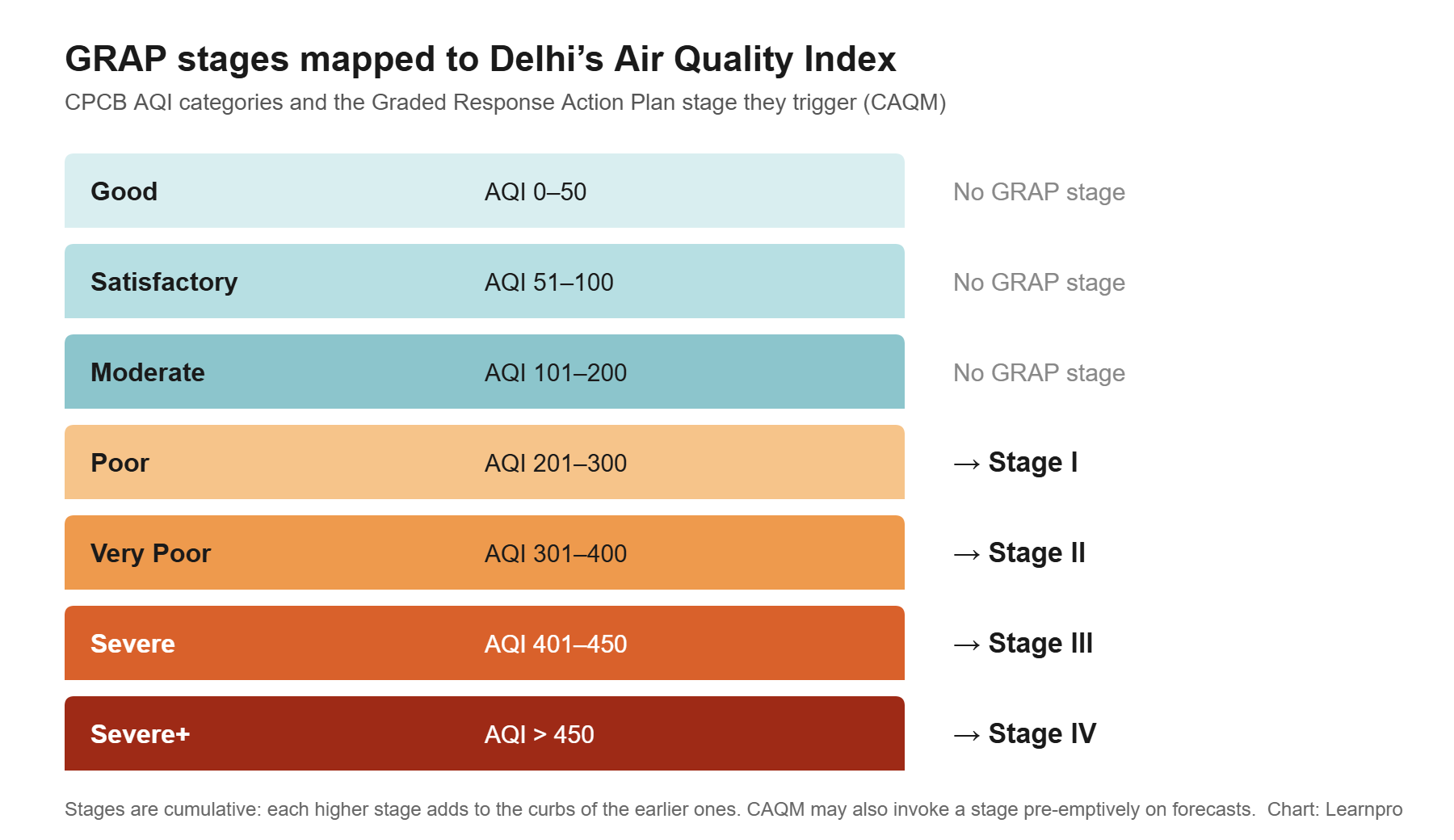
GRAP Stages at a Glance
| Stage | AQI range | Indicative measures |
|---|---|---|
| Stage I – Poor | 201–300 | Strict dust control at construction sites, mechanised road sweeping, ban on open burning of waste, action against visibly polluting and overage vehicles, ban on coal and firewood in hotels and eateries. |
| Stage II – Very Poor | 301–400 | Daily water sprinkling on roads, higher parking fees to discourage private vehicles, more CNG/electric bus and Metro services, regulated use of diesel generator sets. |
| Stage III – Severe | 401–450 | Ban on non-essential construction and demolition, closure of stone crushers and mining, ban on BS-III petrol and BS-IV diesel four-wheelers, hybrid classes for primary students. |
| Stage IV – Severe+ | Above 450 | Ban on entry of non-essential trucks into Delhi, halt on public linear projects, 50% work-from-home in offices, hybrid classes for more grades; States may consider odd-even schemes. |
Why does Delhi’s Air Quality Worsen in Winter?
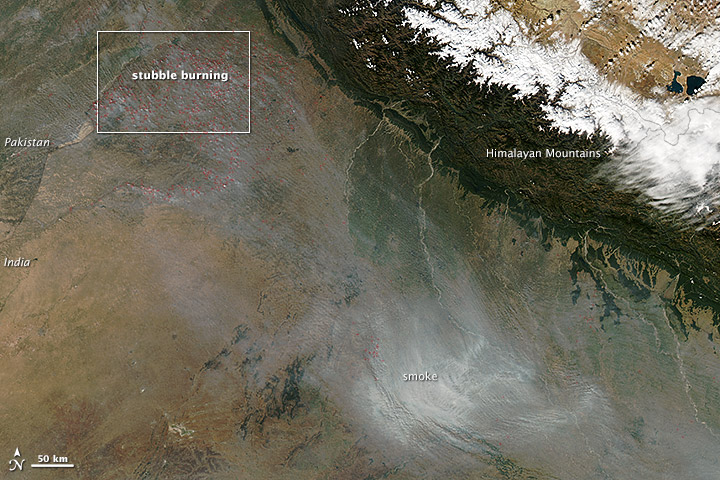
- Stubble burning: Burning of paddy residue in Punjab and Haryana in October–November adds a large share of PM2.5 on peak days.
- Meteorology: Low wind speeds, falling temperatures and temperature inversion trap pollutants close to the ground.
- Vehicular emissions: A large vehicle fleet is a steady year-round source of PM2.5 and nitrogen oxides.
- Dust: Road and construction dust is a major contributor to PM10.
- Industry and power plants: Emissions from industries and thermal plants in the NCR and surrounding areas.
- Firecrackers: Bursting of crackers around Deepavali causes short, sharp spikes despite bans.
About the Air Quality Index (AQI)
- Launched in 2014 by the Ministry of Environment, Forest and Climate Change.
- Covers eight pollutants: PM10, PM2.5, NO2, SO2, CO, O3, NH3 and Pb.
- Has six categories: Good, Satisfactory, Moderate, Poor, Very Poor and Severe.
Challenges with GRAP
- Reactive, not preventive: GRAP is an emergency tool; it cannot substitute for year-round structural action.
- Weak enforcement: Directions to prosecute officials in Gurugram show gaps in implementation at the local level.
- Inter-State coordination: Air pollution in the NCR is a regional, airshed-level problem spanning several States.
- Economic and social costs: Construction bans hit daily-wage workers; school closures affect learning.
- Data credibility: Debates over the placement of new monitoring stations and gaps in AQI data affect public trust.
Way Forward
- Airshed approach: Plan for the entire Indo-Gangetic Plain rather than city boundaries, with binding inter-State targets.
- Tackle crop residue: Expand in-situ (Happy Seeder, bio-decomposers) and ex-situ uses such as biomass co-firing and 2G ethanol; promote crop diversification away from paddy.
- Clean mobility: Faster shift to electric public transport, last-mile connectivity and scrapping of old vehicles.
- Strengthen NCAP: Link city funding to measured reductions in PM levels and expand monitoring to smaller towns.
- Real-time source apportionment: Use it to target the biggest polluters on any given day.
Conclusion
GRAP has brought predictability and pre-emptive action to Delhi-NCR’s pollution response, but repeated invocation of its higher stages every winter shows that emergency curbs alone cannot clean the air. Lasting results need sustained, region-wide action on farm fires, transport, dust and industry.
UPSC Previous Year Questions (PYQs)
UPSC Prelims 2016
Q. In the cities of our country, which among the following atmospheric gases are normally considered in calculating the value of Air Quality Index? 1. Carbon dioxide 2. Carbon monoxide 3. Nitrogen dioxide 4. Sulfur dioxide 5. Methane Select the correct answer using the code given below.
- 1, 2 and 3 only
- 2, 3 and 4 only
- 1, 4 and 5 only
- 1, 2, 3, 4 and 5
Show answer
Answer: (b) — See full explanation
UPSC Prelims 2022
Q. In the context of WHO Air Quality Guidelines, consider the following statements : 1. The 24-hour mean of PM 2.5 should not exceed 15 µg/m3 and annual mean of PM2.5 should not exceed 5 µg/m3. 2. In a year, the highest levels of ozone pollution occur during the periods of inclement weather. 3. PM10 can penetrate the lung barrier and enter the bloodstream. 4. Excessive ozone in the air can trigger asthma. Which of the statements given above are correct?
- 1, 3 and 4
- 1 and 4 only
- 2, 3 and 4
- 1 and 2 only
Show answer
Answer: (b) — See full explanation
Prelims Practice Question
Q. With reference to the Graded Response Action Plan (GRAP), consider the following statements:
- It is implemented by the Commission for Air Quality Management in NCR and Adjoining Areas.
- Stage III of GRAP is invoked when AQI is in the ‘Severe’ category (401–450).
- Measures under a higher stage replace those under the lower stages.
Which of the statements given above is/are correct?
(a) 1 and 2 only
(b) 2 and 3 only
(c) 1 and 3 only
(d) 1, 2 and 3
Answer: (a) — GRAP measures are cumulative; higher stages add to, not replace, lower-stage measures.
Mains Practice Question
Q. Despite the Graded Response Action Plan, Delhi-NCR faces severe air pollution every winter. Critically evaluate the effectiveness of emergency measures and suggest a long-term, region-wide strategy for clean air. (250 words)
Frequently Asked Questions (FAQs)
What is GRAP?
The Graded Response Action Plan is a set of emergency measures for Delhi-NCR that are triggered in stages as the Air Quality Index worsens.
Who implements GRAP?
The Commission for Air Quality Management in NCR and Adjoining Areas (CAQM), a statutory body under the CAQM Act, 2021. Earlier it was enforced by EPCA.
What are the four stages of GRAP?
Stage I – Poor (AQI 201–300), Stage II – Very Poor (301–400), Stage III – Severe (401–450) and Stage IV – Severe+ (above 450).
Are GRAP measures cumulative?
Yes. Each higher stage adds to the measures of the lower stages. CAQM can also invoke a stage in advance based on AQI forecasts.
Related Reads on LearnPro
- Delhi AQI After Deepavali: Why Official and Private Readings Differ
- Delhi Air Pollution: Supreme Court on GRAP and CAQM
- India’s Air Pollution Concern
- Mains practice: Why episodic severe air pollution persists in north India