
Tags: GS Paper 3 – Indian Economy: Poverty, Inclusive Growth; GS Paper 2 – Issues relating to Poverty and Hunger
For Prelims: World Bank poverty lines ($3.00 and $4.20 per day, 2021 PPP), Multidimensional Poverty Index, OPHI, NITI Aayog MPI, HCES 2022-23, Tendulkar and Rangarajan committees
For Mains: Measurement of poverty in India, inequality and regional concentration, quality of jobs for youth
Why in News?
The World Bank’s Poverty and Equity Brief for India (October 2026) says India has made “remarkable progress” in reducing poverty, both in income and in non-monetary terms. It counts this among the fastest reductions in poverty in the world.
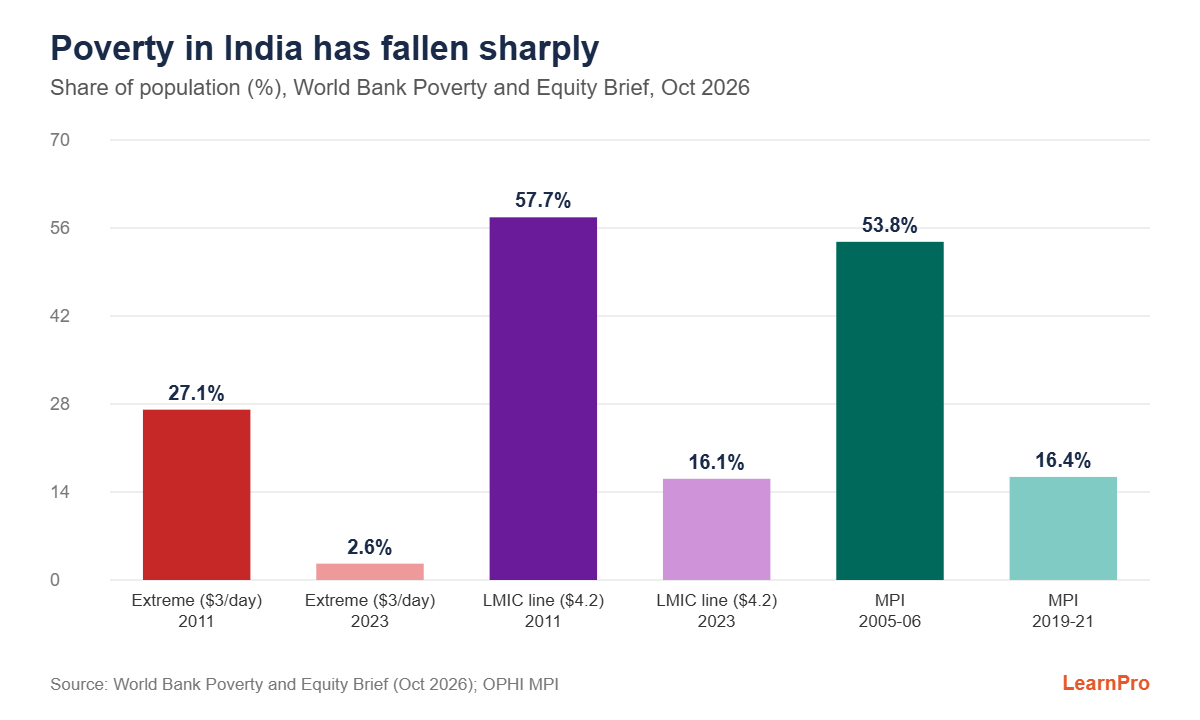
Key Findings
- Extreme poverty ($3.00 a day, 2021 PPP) fell from 27.1% (2011) to 2.6% (2023).
- Poverty at the Lower-Middle-Income Country line ($4.20 a day) fell from 57.7% to 16.1%, lifting about 496 million people out of poverty.
- Multidimensional poverty (OPHI MPI) fell from 53.8% (2005-06) to 16.4% (2019-21). The World Bank’s own MPI measure was 15.5% in 2022-23.
- Inequality: Median earnings of the top 10% of workers were about 13 times those of the bottom 10% in 2023.
- Concentration: A belt from Uttar Pradesh to West Bengal has about 57% of India’s poor.
- Jobs: Employment rose by about 134 million between 2017 and 2023, mainly because more rural women entered paid work. However, youth unemployment rose from 14.6% to 15.9% recently.
Understanding Poverty Measurement
- World Bank lines (revised in 2025 to 2021 PPP): $3.00 a day for extreme poverty, $4.20 for lower-middle-income countries and $8.30 for upper-middle-income countries.
- India’s official lines: The Tendulkar (2009) and Rangarajan (2014) committees. No official line has been adopted since.
- Multidimensional Poverty Index: Measures deprivation in health, education and standard of living using 10 indicators (12 in NITI Aayog’s national MPI).
- Data source: The Household Consumption Expenditure Survey 2022-23 (the first since 2011-12) made fresh estimates possible.
Drivers of the Decline
- Economic growth, and expansion of welfare such as free food grains (PMGKAY), housing, toilets, electricity, LPG and DBT.
- Growth in rural wages and non-farm jobs, and more women working.
- Financial inclusion through Jan Dhan accounts.
Concerns and Debates
- Changes in survey methods make comparisons over time less reliable.
- Many people sit just above the poverty line and could fall back after a shock.
- Rising inequality, and poverty concentrated in eastern and central States.
- Quality of jobs and youth unemployment.
Frequently Asked Questions (FAQs)
1. What is the World Bank’s current extreme poverty line?
$3.00 per person per day (2021 PPP).
2. Which three dimensions does the MPI cover?
Health, education and standard of living.
3. Which committee’s methodology was used for India’s 2011-12 official poverty estimates?
The Tendulkar Committee.