
Tags: GS Paper 3 – Indian Economy: Employment; GS Paper 2 – Vulnerable Sections; GS Paper 1 – Women
For Prelims: Periodic Labour Force Survey, unemployment rate, LFPR, WPR, decent work (ILO), SDG 8, informal employment, Code on Social Security 2020, e-Shram, gig workers
For Mains: Quality vs quantity of employment, informalisation, women’s work participation, labour codes and social security
Why in News?
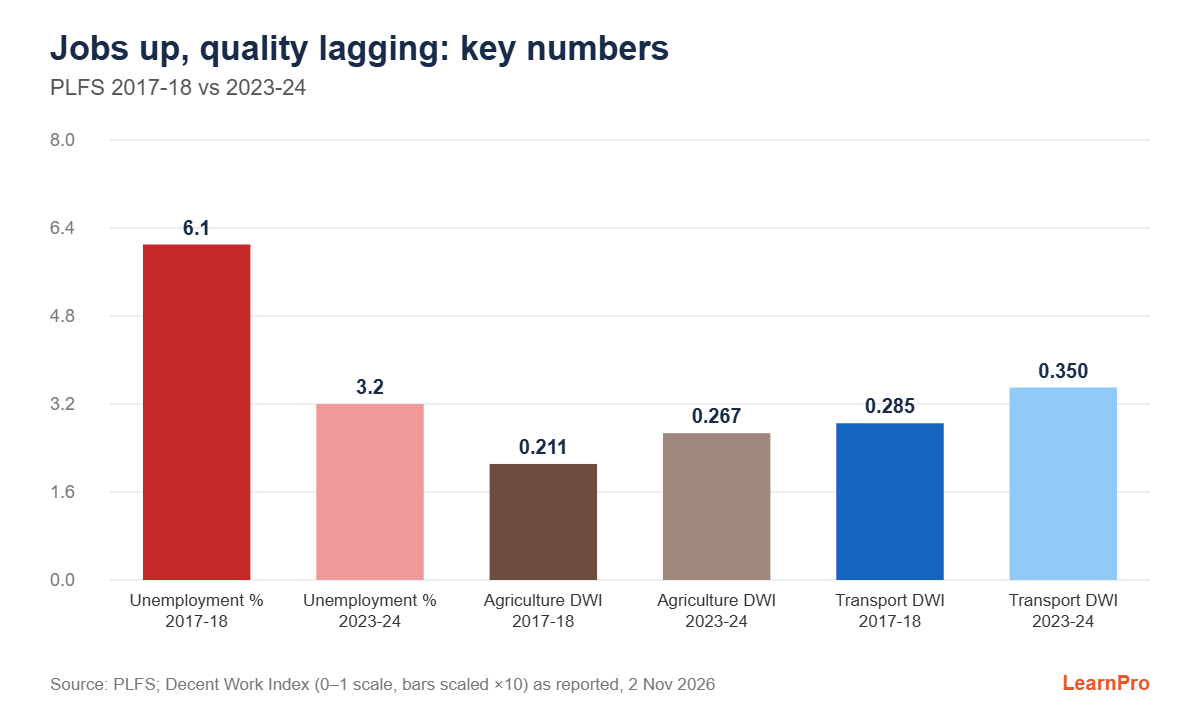
An analysis of PLFS 2017-18 and 2023-24 data shows that India’s unemployment rate fell from 6.1% to 3.2%, and female workforce participation rose. However, a multidimensional Decent Work Index (DWI) shows that job quality remains low. Most workers still lack written contracts, paid leave and social security.
Key Findings
- Agriculture: DWI improved only slightly, from 0.211 to 0.267, because most workers are self-employed or unpaid family helpers.
- Transport: Improved from 0.285 to 0.35 with the growth of logistics and platform work, but social security coverage is still limited.
- Informality: Nearly 90% of the workforce is informally employed, according to the India Employment Report 2024 (ILO–IHD).
- Caste and gender: Decent-work outcomes worsened for ST and OBC women while improving for men.
- States: Goa, Keralam, Tamil Nadu and Haryana do better. Bihar, Jharkhand and Uttar Pradesh lag behind.
Key Concepts
- Decent work (ILO): Productive employment with fair income, rights at work, social protection and social dialogue. It is part of SDG 8.
- PLFS: Conducted by the NSO since 2017. It gives the Labour Force Participation Rate (LFPR), the Worker Population Ratio (WPR) and the Unemployment Rate (UR), using the usual status and current weekly status approaches.
- Why low unemployment can hide distress: Poor people cannot afford to stay unemployed, so they take any work available, often low-paid self-employment or unpaid family work.
Reasons for the Decent Work Deficit
- A large agricultural workforce with low productivity.
- Growth that is capital- and skill-intensive and creates few formal jobs.
- More contract work, subcontracting and gig work.
- Many MSMEs operate below regulatory thresholds.
- Rising women’s participation is mostly in unpaid or self-employed work.
Policy Measures
- Labour Codes (2019–20, in force from November 2025): The Code on Social Security covers gig and platform workers.
- e-Shram portal: A national database of unorganised workers.
- Schemes such as PM-SYM (pensions), Ayushman Bharat, ELI (employment-linked incentive) and PLI.
Way Forward
- Support labour-intensive manufacturing (textiles, food processing, leather) and the care economy.
- Make social security portable and link it to workers, not employers.
- Provide childcare, safe transport and skilling for women.
- Track job quality regularly in official statistics.
Frequently Asked Questions (FAQs)
1. Which SDG covers decent work?
SDG 8: Decent Work and Economic Growth.
2. Which agency conducts the PLFS?
The National Statistics Office (MoSPI).
3. Which labour code covers gig workers?
The Code on Social Security, 2020.
Practice Question
Mains: “India’s employment challenge is less about jobs and more about decent jobs.” Discuss. (250 words)