
Tags: GS Paper 2 – Welfare Schemes for Vulnerable Sections; GS Paper 3 – Employment, Labour Reforms
For Prelims: Code on Social Security 2020, gig worker, platform worker, aggregator, e-Shram, Social Security Fund, aggregator contribution 1–2%, PM-JAY for gig workers
For Mains: Social security for gig and platform workers, implementation of the labour codes, Centre–State roles
Why in News?
On 30 October 2026, the Union Ministry of Labour and Employment notified the setting up of the National Social Security Board for Unorganised Workers (40 members) and the National Social Security Board for Gig & Platform Workers (22 members) under the Code on Social Security, 2020.
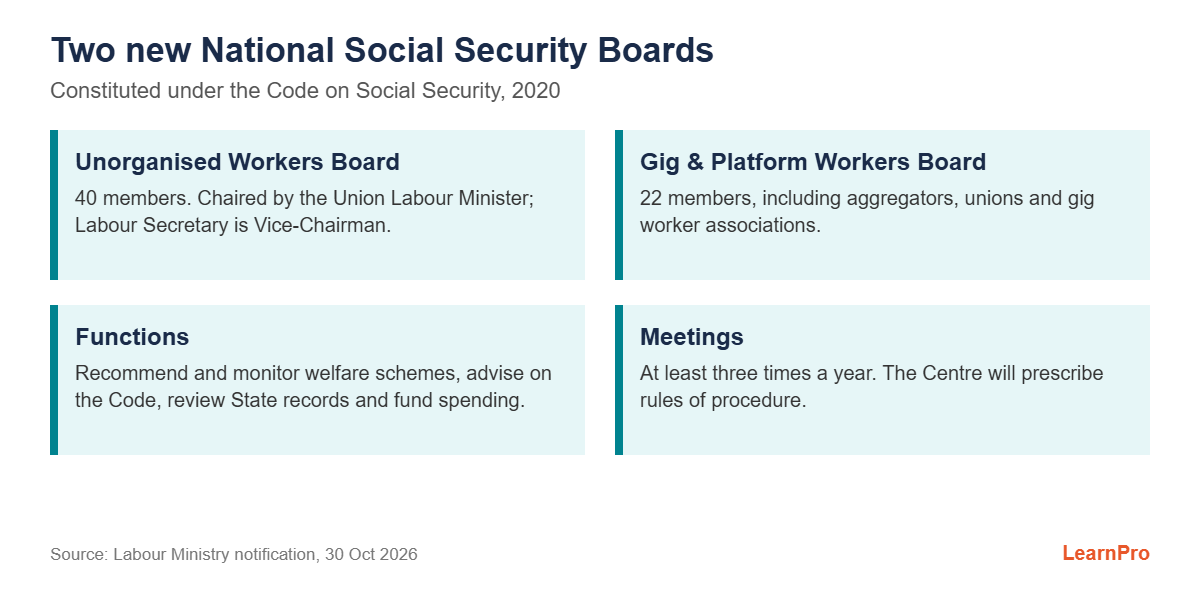
Composition and Mandate
- Chairman: The Union Labour Minister. Vice-Chairman: The Union Labour Secretary.
- Members: Representatives of the Centre and States, aggregator companies (food delivery, quick commerce, ride-hailing and home services), employers, civil society, trade unions and gig worker associations.
- Functions: Recommend and monitor welfare schemes, advise the Centre on administering the Code, review State-level record-keeping, and review spending from the social security fund.
- The Boards will meet at least three times a year.
Gig and Platform Workers: Key Definitions
- Gig worker: A person who works or takes part in a work arrangement and earns outside a traditional employer–employee relationship.
- Platform worker: A worker who gets work through an online platform that connects users and service providers.
- Aggregator: A digital intermediary or marketplace. Under the Code, aggregators must contribute 1–2% of annual turnover (capped at 5% of payments to workers) to a social security fund.
Why Does This Matter?
- Scale: NITI Aayog estimated India had 77 lakh gig workers in 2020-21, projected to reach 2.35 crore by 2029-30.
- No protection: Gig workers lack minimum wages, health insurance, accident cover and pensions, and face algorithmic control and arbitrary deactivation.
- Unorganised sector: About 90% of India’s workforce. Over 30 crore are registered on e-Shram.
Related Initiatives
- Budget 2025-26: Identity cards and e-Shram registration for gig workers, and coverage under PM-JAY.
- State laws: Rajasthan (2023), Karnataka (2025) and others have passed platform-worker welfare Acts with cess-based welfare boards.
- The four Labour Codes came into force in November 2025.
Concerns
- The Boards are advisory. Actual benefits depend on schemes being notified and funded.
- Questions about whether gig worker groups and opposition-ruled States are adequately represented.
- Overlap between central and State welfare boards and funds.
Way Forward
- Make benefits portable and linked to a universal ID, so workers keep them across platforms.
- Bring in transparency on algorithms, and grievance redress for deactivation.
- Collect aggregator contributions on time, and make the fund’s spending public.
Frequently Asked Questions (FAQs)
1. Under which law have the Boards been set up?
The Code on Social Security, 2020.
2. Who chairs the National Social Security Boards?
The Union Minister for Labour and Employment.
3. How much must aggregators contribute?
1–2% of annual turnover, capped at 5% of the amount paid to gig and platform workers.