
Tags: GS Paper 2 – Governance, Government Policies; GS Paper 3 – Indian Economy: Growth and Measurement
For Prelims: VISTAR, MoSPI, National Statistical Office, National Statistical Commission, Economic Census, PLFS, base year revision, Collection of Statistics Act 2008
For Mains: Importance of reliable official statistics for policymaking, data credibility debates, strengthening State statistical capacity
Why in News?
On 4 November 2026, the Union Cabinet approved VISTAR (Viksit Bharat Initiative for Statistical Transformation, Analytics & Research), a ₹4,371 crore scheme for 2026-27 to 2030-31. It aims to overhaul India’s statistical system at both the Central and State levels.
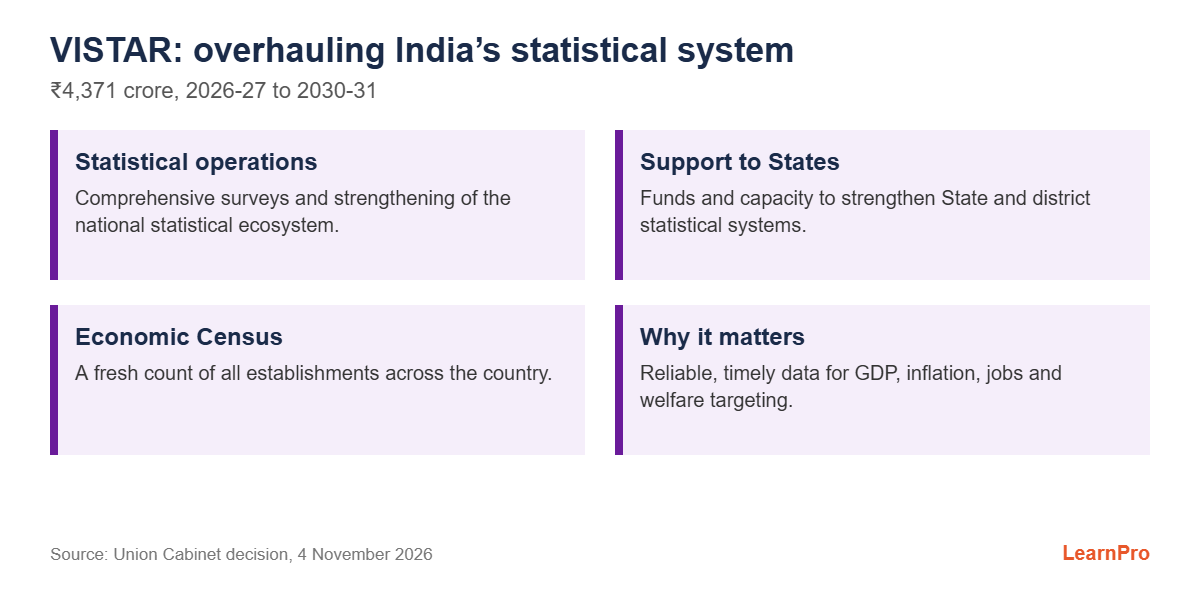
Components of VISTAR
- Comprehensive statistical operations: Large-scale surveys and a stronger national statistical ecosystem.
- Support for statistical strengthening: Help for States and Union Territories to build data systems down to the district level.
- Economic Census: A count of all non-farm establishments, both formal and informal.
India’s Statistical System: Key Institutions
- Ministry of Statistics and Programme Implementation (MoSPI): The nodal ministry. Its National Statistics Office (NSO) was formed in 2019 by merging the CSO and the NSSO.
- National Statistical Commission (NSC): Set up in 2006 on the recommendation of the Rangarajan Commission (2001). It is not yet a statutory body.
- Collection of Statistics Act, 2008: The legal basis for collecting statistics.
- Statistics is in the Concurrent List (Entry 45, List III, which covers inquiries, surveys and statistics).
- Key data products: GDP estimates, CPI and IIP, the Periodic Labour Force Survey (PLFS), the Household Consumption Expenditure Survey, the Annual Survey of Industries and the Economic Census.
Why is an Overhaul Needed?
- Credibility debates: Disputes over GDP methodology (2011-12 base year), the withheld 2017-18 consumption survey, and gaps in employment data.
- Outdated base years: Revisions of GDP, CPI and IIP base years are underway, with a new 2022-23 base.
- Weak State capacity: Most State Directorates of Economics and Statistics have too few staff and lack technology.
- Informal sector: Hard to measure. The 7th Economic Census (2019) faced delays.
- Policy demand: Targeting welfare schemes, Viksit Bharat goals and SDG monitoring all need detailed, timely data.
Recent Reforms
- Monthly and quarterly PLFS estimates (from 2025), and annual surveys of unincorporated enterprises (ASUSE).
- Use of administrative data (GST, EPFO) and the release of microdata through MoSPI portals.
- Steering committees to review survey methodology.
Way Forward
- Give statutory status and autonomy to the NSC, as the Rangarajan Commission recommended.
- Build integrated data infrastructure with strong privacy safeguards under the DPDP Act.
- Follow a predictable release calendar and transparent methodology to build public trust.
- Invest in State-level statistical cadres and skills in data science.
Conclusion
Good policy needs good data. VISTAR is an opportunity to modernise India’s statistical system. Its success will depend on whether it strengthens the independence and credibility of official statistics, and not only their technology.
Frequently Asked Questions (FAQs)
1. What does VISTAR stand for?
Viksit Bharat Initiative for Statistical Transformation, Analytics & Research.
2. Which commission recommended setting up the National Statistical Commission?
The Rangarajan Commission (2001).
3. In which list of the Seventh Schedule is ‘statistics’?
The Concurrent List.
Practice Question
Mains: “Credible statistics are a public good.” Discuss the challenges faced by India’s statistical system and how schemes like VISTAR can address them. (150 words)