
Tags: GS Paper 3 – Indian Economy: Mobilisation of Resources, Taxation
For Prelims: GST, CGST, SGST, IGST, GST Council (Article 279A), 101st Amendment, GST compensation cess, GST 2.0 rate rationalisation, destination-based tax
For Mains: Buoyancy of GST revenues, impact of rate rationalisation, Centre–State fiscal relations under GST
Why in News?
Gross GST collections rose 23% year-on-year to over ₹2.31 lakh crore in October 2026, helped by festive demand, according to government data released on 1 November. It is the second-highest monthly collection ever, after about ₹2.43 lakh crore in April, and the second straight month above ₹2 lakh crore.
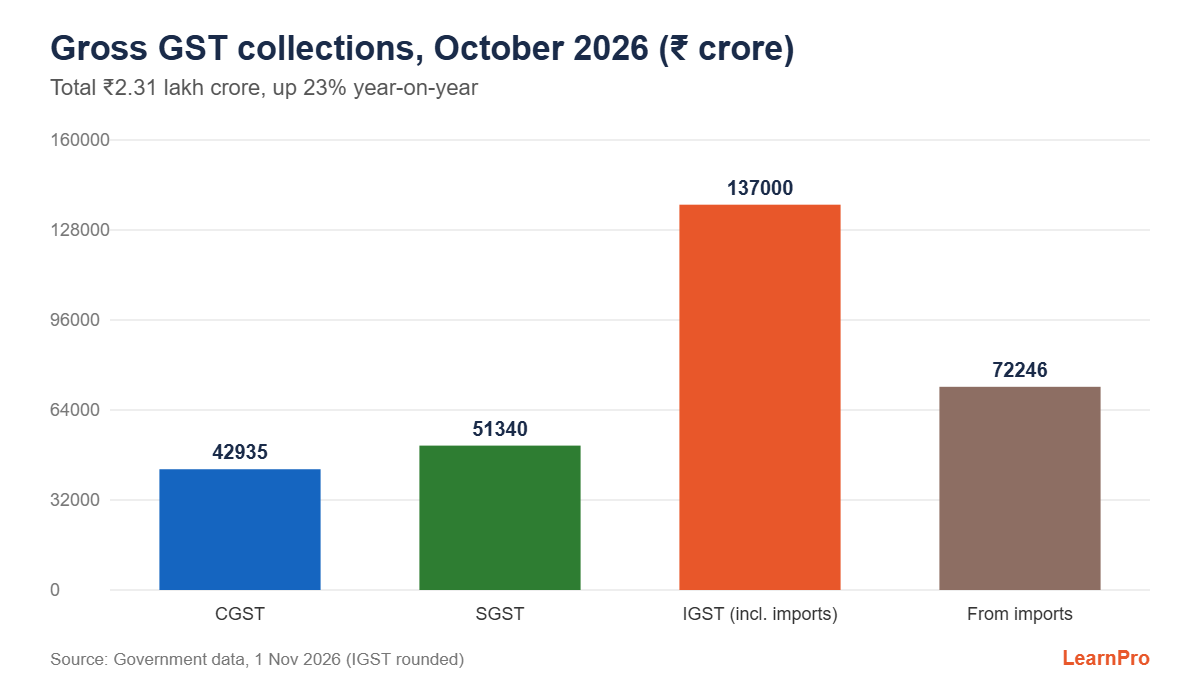
Key Data
- Collections from domestic transactions rose 16% to over ₹1.59 lakh crore. Revenue from imports rose 42% to ₹72,246 crore.
- CGST: ₹42,935 crore. SGST: ₹51,340 crore. IGST: over ₹1.37 lakh crore.
- The 22.9% growth was the fastest rate this financial year.
Understanding GST
- Introduced: 1 July 2017 through the 101st Constitutional Amendment Act, 2016. It is a destination-based tax on the supply of goods and services.
- CGST and SGST: Levied equally by the Centre and the State on supplies within a State.
- IGST: Levied by the Centre on supplies between States and on imports, and then divided between the Centre and the consuming State.
- GST Council (Article 279A): Chaired by the Union Finance Minister. The Centre has one-third of the voting weight and the States two-thirds. Decisions need a three-fourths majority.
- Outside GST: Alcohol for human consumption, and (for now) five petroleum products.
GST 2.0 Reforms
- In September 2025 the GST Council simplified the rate structure to mainly two slabs, 5% and 18%, with a 40% rate on sin and luxury goods. The 12% and 28% slabs were largely removed.
- Rates on many items of daily use, health insurance and some medicines were cut, to boost consumption.
- The compensation cess is being phased out after loans taken during COVID are repaid.
Significance of Rising Collections
- Shows strong consumption demand and better compliance through e-invoicing, e-way bills and data analytics.
- Suggests that lower rates have been partly offset by higher volumes.
- Gives the Centre and the States more room to spend.
Concerns
- Festive months raise collections, so the yearly trend matters more than a single month.
- Higher refunds and growing reliance on imports for revenue.
- States’ fiscal autonomy is limited, and the end of compensation hurts States with weaker tax bases.
- Inverted duty structures and classification disputes continue.
Frequently Asked Questions (FAQs)
1. Which Article provides for the GST Council?
Article 279A.
2. Who collects IGST?
The Centre, which then shares it with the destination State.
3. Which Amendment introduced GST?
The 101st Constitutional Amendment Act, 2016.