
Tags: GS Paper 2 – Federalism, Distribution of Legislative Powers; GS Paper 3 – Taxation
For Prelims: Entry 54 List II, Seventh Schedule, Article 246, Article 246A, 101st Constitutional Amendment, GST, cess and surcharge, S. Kodar v. State of Kerala
For Mains: Fiscal federalism after GST, taxing powers of States, judicial interpretation of legislative entries
Why in News?
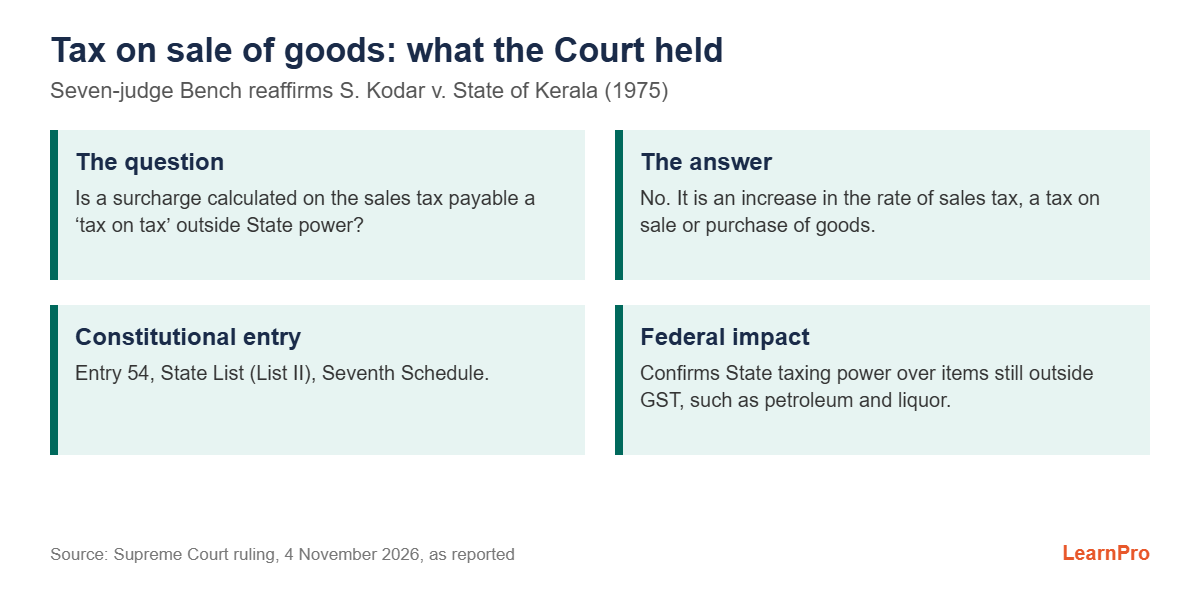
On 4 November 2026, a seven-judge Constitution Bench of the Supreme Court, led by CJI Surya Kant, held that an additional tax or surcharge calculated as a percentage of the sales tax payable falls within the States’ legislative competence. The Bench reaffirmed the 1975 ruling in S. Kodar v. State of Kerala. It held that such a levy is an increase in the rate of sales tax and therefore a tax on the sale or purchase of goods under Entry 54 of the State List. Justice K.V. Viswanathan wrote a separate concurring opinion.
Summary
- The petitions dated back to 1994. Dealers argued that a levy measured by the tax already payable is a ‘tax on tax’ and not a tax on the sale of goods.
- The States argued it was simply a higher rate of sales tax for a class of dealers, and that the way it is calculated does not change its nature.
- The Court agreed with the States: the nature of a tax matters, not how it is measured.
Key Constitutional Concepts
- Article 246 and the Seventh Schedule: Divide legislative powers between the Union (List I), the States (List II) and both (List III, Concurrent).
- Entry 54, List II: Originally covered taxes on the sale or purchase of goods other than newspapers. After the 101st Amendment (2016), it covers only petroleum crude, high-speed diesel, motor spirit (petrol), natural gas, aviation turbine fuel and alcoholic liquor for human consumption.
- Article 246A: Gives both Parliament and the States concurrent power to levy GST.
- Nature vs measure: Courts separate the subject of a tax from the measure used to calculate it. Using sales tax as the base for calculation does not change the subject, which remains the sale of goods.
Cess vs Surcharge
| Feature | Cess | Surcharge |
|---|---|---|
| Purpose | Levied for a specific purpose (for example, the Health and Education Cess) | Additional levy on an existing tax for general revenue |
| Union cesses and surcharges and the divisible pool | Excluded from the divisible pool (Article 270), so they are not shared with States | |
Significance
- Fiscal autonomy of States: After GST, States have few taxes of their own left. Taxes on petroleum products and liquor are among their largest revenue sources.
- Legal certainty: Settles disputes that had lasted three decades, along with the related refund claims.
- Federal balance: Reflects the Court’s approach of reading legislative entries broadly, as in Mohit Minerals (2022) on GST Council recommendations and Mineral Area Development Authority (2024) on royalty.
Concerns
- Layered levies on fuel raise prices for consumers and businesses.
- Keeping petroleum outside GST leads to cascading taxes and fragmented markets.
- The growing use of cesses and surcharges by the Union also reduces the shareable pool. Both levels of government are using such levies more and more.
Conclusion
By reaffirming S. Kodar, the Court has protected the States’ limited remaining power to tax goods. The wider debate on fiscal federalism, including bringing fuel under GST and limiting cesses, still needs to be settled through the GST Council and the Finance Commission.
Frequently Asked Questions (FAQs)
1. Which entry empowers States to tax the sale of petroleum and liquor?
Entry 54 of List II (State List).
2. Which Amendment introduced GST?
The 101st Constitutional Amendment Act, 2016.
3. Are Union cesses shared with States?
No. Under Article 270, cesses and surcharges are excluded from the divisible pool.
Practice Question
Mains: The GST regime has narrowed the fiscal space of States. In this context, discuss the significance of the Supreme Court’s ruling on States’ power to levy additional sales tax. (150 words)