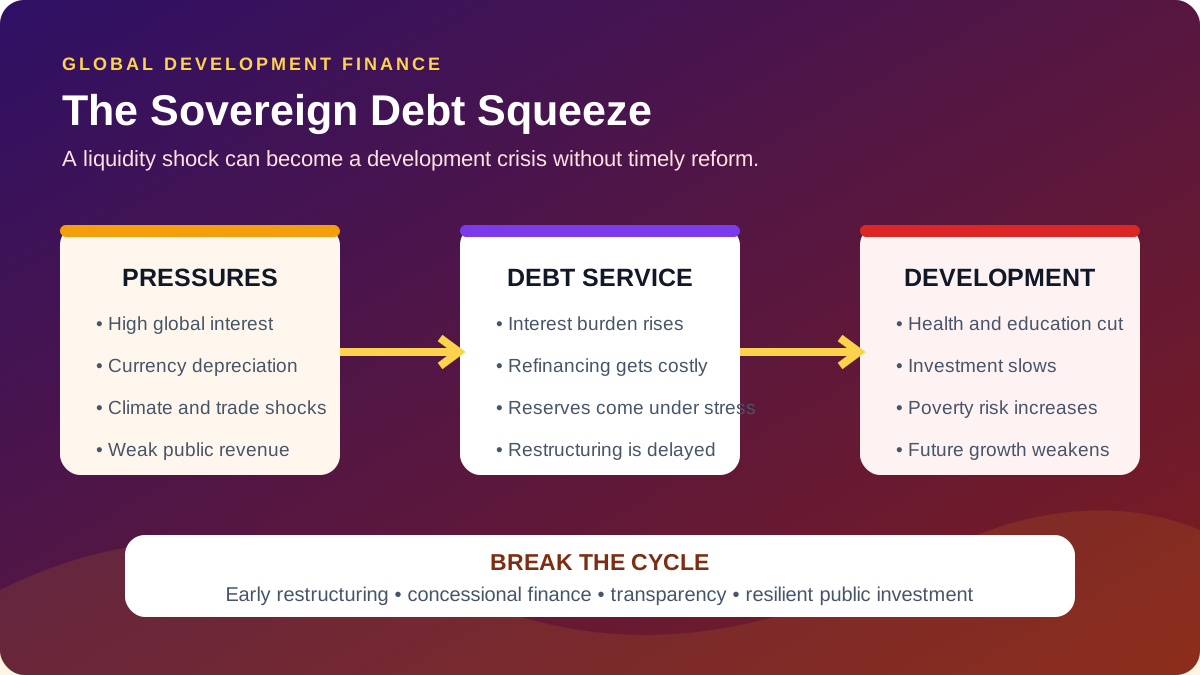
The developing countries debt crisis is not simply a story of governments borrowing too much. It is a development-finance problem shaped by high global interest rates, volatile exchange rates, expensive private credit, weak tax capacity, climate shocks and a slow international restructuring system. Debt can finance roads, health systems and productive investment; it becomes dangerous when repayment absorbs the revenue needed to sustain them.
The Fourth International Conference on Financing for Development (FfD4), held in Sevilla from 30 June to 3 July 2025, brought the issue into focus. The conference adopted the Sevilla Commitment and launched initiatives intended to close the annual SDG financing gap and improve the international debt architecture.
What is sovereign debt?
Sovereign debt is borrowing by a national government. It may be domestic or external, denominated in local or foreign currency, and owed to different creditors. These distinctions determine risk.
| Debt category | Meaning | Main risk |
|---|---|---|
| Domestic debt | Borrowed from residents, often in local currency | Can crowd out private credit and create bank–sovereign dependence |
| External debt | Owed to non-resident creditors | Foreign-exchange and refinancing risk |
| Official bilateral debt | Loans from another government or its agencies | Coordination and geopolitical complexity |
| Multilateral debt | Loans from institutions such as the World Bank and regional development banks | Policy conditions, though terms are often more concessional |
| Commercial debt | Bonds and bank loans from private creditors | Higher interest, short maturities and difficult restructuring |
Public debt, public and publicly guaranteed external debt, and total external debt are not interchangeable. A careful UPSC answer must identify which measure a statistic uses.
How large is the debt problem?
UN Trade and Development’s A World of Debt 2025 reported that global public debt reached a record $102 trillion in 2024. Developing countries accounted for $31 trillion, and their public debt had grown twice as fast as that of advanced economies since 2010.
- Developing countries paid $921 billion in public-debt interest in 2024, 10% more than in 2023.
- 61 countries used more than 10% of government revenue for interest payments.
- About 3.4 billion people lived in countries spending more on interest than on either health or education.
- Developing countries borrowed at average rates two to four times those paid by the United States after 2020.
The World Bank’s International Debt Report 2025 adds a different external-debt perspective. Low- and middle-income countries paid creditors $741 billion more in principal and interest than they received in new external financing during 2022–2024—the largest such outflow in at least five decades. Their combined external debt reached $8.9 trillion in 2024, while interest payments alone reached $415 billion.
These datasets cover different concepts and country groups; they should not be added together. They converge on the same finding: debt service is transferring scarce fiscal resources away from development.
Why is sovereign debt rising in developing countries?
- Successive shocks: the pandemic, food and fuel price spikes, wars, climate disasters and weak global demand increased spending while reducing revenue.
- High interest rates: tighter monetary policy in advanced economies raised global borrowing costs and attracted capital away from riskier markets.
- Currency depreciation: when debt is denominated in dollars or euros, a weaker local currency raises the domestic cost of repayment.
- Low and volatile revenue: narrow tax bases, informality, commodity dependence and illicit financial flows limit the state’s capacity to service debt.
- Expensive risk premium: credit ratings and investor perceptions can produce a self-reinforcing cycle—higher perceived risk raises interest, which worsens debt sustainability.
- Climate vulnerability: disasters create emergency borrowing needs, while high debt leaves little fiscal room for resilience investment.
- Weak project selection: non-transparent loans and low-return projects create liabilities without enough growth or revenue to repay them.
When does debt become unsustainable?
There is no universal debt-to-GDP threshold. Sustainability depends on growth, interest rates, maturity, currency composition, revenue, exports, foreign-exchange reserves and the credibility of institutions. A country may have a moderate debt ratio but face a crisis because a large foreign-currency payment falls due immediately. Another may sustain a higher ratio because it borrows long-term in its own currency at low interest.
A useful relationship is:
Debt dynamics worsen when the effective interest rate exceeds economic growth, especially if the government also runs a large primary deficit.
Analysts therefore examine the debt-service-to-revenue ratio, interest-to-revenue ratio, external debt to exports, gross financing needs and the share of short-term or foreign-currency debt—not one headline number.
How does the debt crisis affect citizens?
| Transmission channel | Effect on people and the economy |
|---|---|
| Budget squeeze | Interest competes with health, schools, nutrition and infrastructure |
| Austerity | Rapid tax increases or spending cuts can deepen recession and inequality |
| Currency pressure | Imported food, fuel and medicine become more expensive |
| Private-credit crowding out | Banks prefer government securities over lending to firms |
| Investment uncertainty | Default risk delays projects and weakens job creation |
| Climate trap | Countries borrow after disasters but lack funds for prevention |
This is why debt sustainability is not merely a creditor’s concern. It is connected to the right to development and the ability of a government to provide essential public goods.
Why is debt restructuring so difficult?
Today’s creditor landscape is fragmented. A sovereign may owe multilateral banks, Paris Club governments, non-Paris Club bilateral creditors, bondholders, commercial banks and domestic institutions. Each group has different contracts and incentives. Private bonds may contain collective-action clauses, while official creditors debate comparable treatment.
The G20 Common Framework for Debt Treatments coordinates Paris Club and other official bilateral creditors for eligible low-income countries. Its early cases exposed long delays between a request, creditor agreement and final restructuring. Delay destroys value: investment falls, arrears grow and citizens endure uncertainty while creditors may ultimately recover less.
What did FfD4 and the Sevilla Commitment change?
FfD4 produced the first intergovernmentally agreed financing-for-development framework since 2015. The Sevilla Commitment addresses domestic resource mobilisation, private finance, development cooperation, debt, trade, technology and reform of international institutions. More than 130 initiatives under the Sevilla Platform for Action sought to convert the agreement into implementation.
Debt-related initiatives included support for debt-pause clauses after severe shocks, a hub for debt swaps and further dialogue on sovereign debt. In October 2025, Spain, UNCTAD and UN DESA launched the Sevilla Forum on Debt as an inclusive platform for borrowers, creditors, institutions and experts.
The conference did not create a binding global bankruptcy court. Its importance lies in political consensus and practical initiatives; its weakness is that delivery still depends on creditors, borrowers and international institutions acting after the conference.
Reforms for a fairer debt architecture
- Earlier restructuring: use clear timelines, debt-service standstills and protection against disruptive litigation while good-faith negotiations proceed.
- Comparable creditor treatment: publish a transparent method that recognises differences in interest, maturity and concessionality.
- More concessional finance: expand grants and long-maturity low-cost loans for vulnerable countries and global public goods.
- State-contingent clauses: automatically pause or reduce service after verified disasters or severe economic shocks.
- Responsible lending and borrowing: disclose contracts, collateral, beneficial owners and contingent liabilities.
- Stronger domestic revenue: improve progressive taxation, customs capacity and action against illicit financial flows without imposing regressive austerity.
- Better investment: subject projects to transparent appraisal so borrowing raises productivity, resilience or human capability.
- Reform credit assessment: improve ratings transparency and incorporate resilience investment without concealing genuine fiscal risk.
Development cooperation can also reduce reliance on costly commercial borrowing when it uses grants, concessional credit and jointly selected projects. LearnPro’s explainer on India–Bhutan development cooperation provides a concrete bilateral example.
India and the developing-country debt debate
India is not part of the low-income Common Framework group, but it matters as a G20 member, a voice of the Global South, a shareholder in multilateral banks and a bilateral development partner. During its G20 presidency, India supported work on strengthening multilateral development banks and faster debt treatment. Its policy interest is two-sided: advocate affordable development finance internationally while preserving domestic fiscal credibility and transparent lending practices.
UPSC and State PSC relevance
The developing countries debt crisis connects GS Paper II international institutions and Global South diplomacy with GS Paper III fiscal policy, inclusive growth and external-sector vulnerability. Use a dated statistic, explain the interest-growth-currency mechanism, show the human impact and evaluate both national reform and global architecture.
Mains practice question: The sovereign debt crisis in developing countries reflects unequal borrowing costs as much as domestic fiscal weakness. Examine and suggest reforms to the international debt architecture.
Conclusion
Debt is neither inherently harmful nor a substitute for sound development policy. The real test is whether borrowing finances durable public value and can be serviced without sacrificing essential needs. Faster restructuring, transparent contracts, affordable long-term finance and stronger domestic institutions are all necessary to prevent a liquidity shock from becoming a lost decade of development.
Frequently asked questions
What is sovereign debt?
Sovereign debt is money borrowed by a national government from domestic or external creditors through loans, bonds and other instruments.
Why is debt rising in developing countries?
Major causes include pandemic and climate shocks, high global interest rates, currency depreciation, weak revenue, expensive risk premiums and borrowing for development needs.
What was FfD4?
FfD4 was the Fourth International Conference on Financing for Development, held in Sevilla from 30 June to 3 July 2025. It adopted the Sevilla Commitment.
What is the G20 Common Framework?
It is a process for coordinating debt treatments by official bilateral creditors for eligible low-income countries, with an expectation of comparable treatment by other creditors.
Does a high debt-to-GDP ratio always mean default?
No. Sustainability also depends on interest, growth, revenue, currency, maturity, reserves and refinancing needs. No single ratio is sufficient.
Primary references
- UNCTAD: A World of Debt 2025
- World Bank: International Debt Report 2025 findings
- United Nations: Fourth International Conference on Financing for Development
- United Nations: Sevilla Forum on Debt
- IMF: debt treatment under the G20 Common Framework