
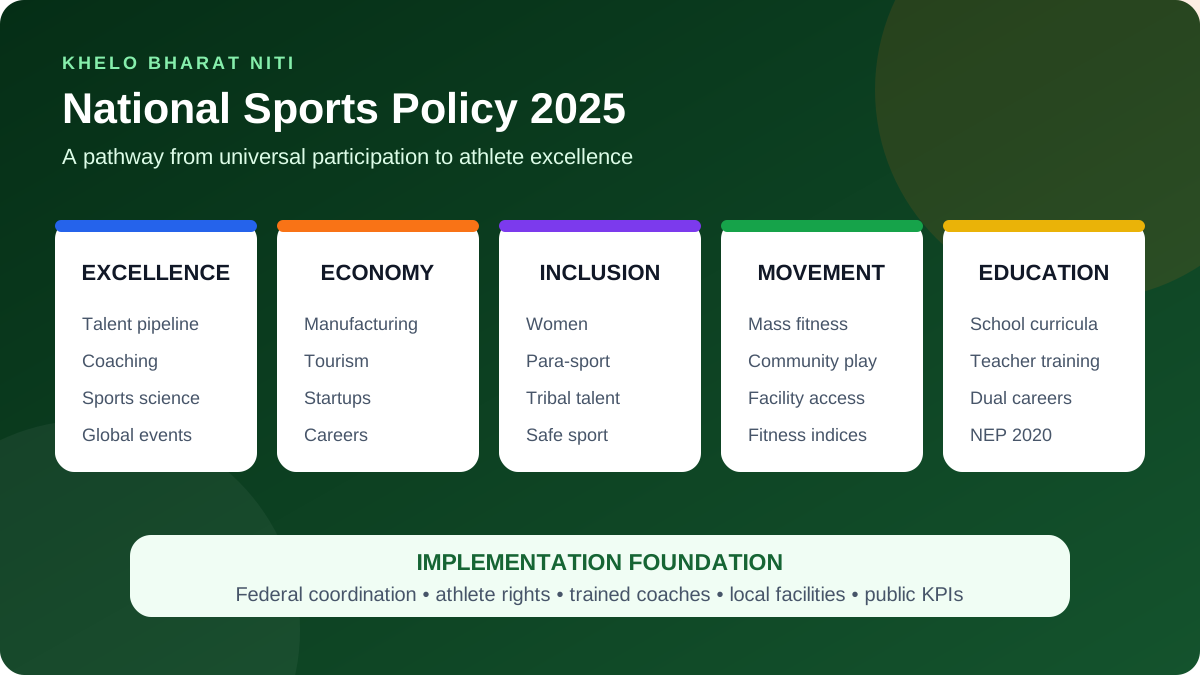
The National Sports Policy 2025, also presented as Khelo Bharat Niti 2025, is India’s new roadmap for sporting excellence, mass fitness, social inclusion and a larger sports economy. Approved by the Union Cabinet on 1 July 2025, it replaces the National Sports Policy, 2001 and aligns sports development with the National Education Policy 2020 and India’s aspiration to host the 2036 Olympic Games.
The policy is broader than winning medals. It treats sport as a public-health activity, an educational component, a source of employment and manufacturing, and a vehicle for social participation. Its success will depend on measurable implementation by the Union, states, schools, local bodies and sports federations.
Why did India need a new sports policy?
The 2001 policy was written before the rise of sports leagues, digital performance analysis, modern athlete-welfare standards and the present scale of the sports industry. India’s performance also revealed a pipeline problem: talent exists, but access to coaching, competition, sports science and safe facilities remains uneven.
At the Paris 2024 Olympics, India sent 117 athletes and won six medals. This was stronger than the two medals at Rio 2016 but below the seven at Tokyo 2020. Medal counts alone are not a full measure of sporting health, yet they show why isolated elite support cannot substitute for a broad and continuous system.
Five pillars of the National Sports Policy 2025
| Pillar | Core measures | Expected outcome |
|---|---|---|
| 1. Excellence on the global stage | Early talent identification, competitive leagues, rural and urban infrastructure, coaching, sports science, medicine, technology and stronger federations | A reliable pathway from grassroots talent to elite performance |
| 2. Sports for economic development | Sports tourism, major events, manufacturing, startups, entrepreneurship, PPPs, CSR and innovative finance | Jobs, investment and a larger domestic sports industry |
| 3. Sports for social development | Focused participation by women, weaker sections, tribal communities and persons with disabilities; indigenous games; dual careers | Inclusion, mobility and wider recognition of sport as a career |
| 4. Sports as a people’s movement | Community events, mass fitness, fitness indices and universal access to facilities | Daily physical activity and improved public health |
| 5. Integration with education | Sports in school curricula and specialised training for educators and physical-education teachers | Movement from optional recreation to mainstream learning |
How will the policy be implemented?
The Cabinet framework identifies six enabling mechanisms:
- Governance: create a robust regulatory and legal framework for sports administration.
- Private finance: mobilise PPPs, CSR and new funding models without abandoning public responsibility.
- Technology and innovation: use AI and data analytics for talent identification, performance tracking, research and programme delivery.
- National monitoring: define benchmarks, key performance indicators and time-bound targets.
- Model policy for states: encourage states and Union Territories to revise their policies in line with national objectives.
- Whole-of-government action: integrate sport into programmes of education, health, tribal affairs, rural development, urban development and other departments.
This last point is crucial because sport is primarily implemented locally. A national policy cannot create a playable school ground, appoint a coach or maintain a district stadium without state and local administrative capacity.
Policy, scheme and law: do not confuse them
| Instrument | Function | Legal character |
|---|---|---|
| National Sports Policy 2025 | Sets the strategic vision and priorities | Executive policy; not itself a penal statute |
| Khelo India, TOPS and KIRTI | Fund infrastructure, athletes, competition and talent identification | Programmes and schemes operating under administrative guidelines |
| National Sports Governance Act, 2025 | Creates a statutory governance framework for recognised sports bodies, athlete welfare and dispute resolution | Act of Parliament, notified on 18 August 2025 and brought into force in phases |
| National Anti-Doping Act, 2022 | Provides the legal framework for anti-doping institutions and compliance | Parliamentary law |
The National Sports Governance Act complements the policy. It provides for institutional oversight, athlete representation, ethical standards, a Safe Sports Policy, grievance redressal and a National Sports Tribunal. The Act and the policy should therefore be read together, but they are not the same instrument.
Existing programmes that support the policy
Khelo India
Khelo India supports mass participation, infrastructure, competitions, academies and selected athletes. An August 2025 government review listed 1,045 Khelo India Centres, 34 notified State Centres of Excellence, 306 accredited academies and support for 2,845 Khelo India athletes. These dated figures establish the base on which the new policy must build.
KIRTI
Khelo India Rising Talent Identification assesses children aged 9–18 through standard protocols and technology-assisted talent centres. Its design can reduce reliance on informal scouting, but algorithmic or test-based selection must be independently validated so that late developers, rural children and athletes with disabilities are not excluded.
Target Olympic Podium Scheme
TOPS supplies customised training, equipment, international exposure and allowances to elite and development-group athletes. It addresses the final stage of the pathway; school sport, local competition and competent coaching must supply the larger base.
Fit India
Fit India aims to make physical activity a people’s movement. The new policy’s proposed fitness indices for schools, colleges and workplaces should measure improvement without becoming punitive rankings or encouraging unsafe one-size-fits-all tests.
Sports and education under NEP 2020
NEP 2020 rejects a rigid separation between curricular and extracurricular learning. The sports policy carries that principle into implementation. Effective integration requires:
- regular timetabled activity rather than an annual sports day;
- safe and inclusive facilities or shared community grounds;
- trained physical-education teachers and age-appropriate coaching;
- assessment based on participation, skill and health, not body type;
- academic flexibility for competitive athletes; and
- dual-career counselling so an injury does not end education or employment prospects.
Where schools lack grounds, cluster facilities, municipal spaces and transparent agreements with local academies can help. Digital modules cannot replace actual movement and supervised play.
Sports as an economic sector
The policy recognises value chains beyond professional athletes: equipment manufacturing, venue management, broadcasting, analytics, physiotherapy, nutrition, coaching, events, tourism and sports technology. India can use its manufacturing base to develop affordable equipment and reduce import dependence.
However, hosting a mega-event is not automatically development. Public authorities should publish the full capital and operating cost, post-event use, displacement impact, procurement data and environmental plan. A successful legacy means community use and sustainable maintenance after the closing ceremony.
Inclusion and athlete welfare
Women, persons with disabilities, tribal communities and economically weaker groups face different barriers: unsafe travel, lack of changing facilities, equipment cost, social norms, inaccessible venues and weak complaint systems. Equal policy language is insufficient without targeted budgets and disaggregated data.
A safe-sport system must cover prevention and response to harassment, abuse, retaliation and medical negligence. Complaints need confidential reporting, trained independent personnel, interim protection, reasoned decisions and appeal. Minors require child-protection protocols rather than ordinary workplace rules.
Implementation challenges
- federal coordination: state capacity and priorities vary widely;
- facility maintenance: construction receives attention while staffing and upkeep are neglected;
- coach quality: shortages and weak continuing education can limit both safety and performance;
- governance conflict: federation autonomy must coexist with transparency and athlete rights;
- urban–rural inequality: travel and competition costs disadvantage remote talent;
- data quality: registrations are easier to count than sustained participation or athlete progression; and
- commercial imbalance: popular sports may attract private funding while other disciplines and para-sports remain dependent on public support.
A measurable way forward
- Publish a costed national action plan with annual Union and state targets.
- Track active participation, coach-to-athlete ratios, facility uptime, injury management and progression—not only enrolment.
- Reserve transparent funding for women’s sport, para-sport, tribal areas and indigenous games.
- Create a national coach-licensing and continuous-training framework with sport-specific standards.
- Map every public facility and publish booking, accessibility and maintenance information.
- Strengthen athlete representation and independent grievance redressal under the governance law.
- Require open evaluation of AI-assisted talent identification and protect children’s data.
UPSC and State PSC relevance
The National Sports Policy 2025 fits GS Paper II social-sector governance and federalism, GS Paper III economy and technology, and Essay topics on youth, health and nation-building. In an answer, explain all five pillars, distinguish policy from the 2025 Governance Act, and evaluate implementation through inclusion and measurable outcomes.
Mains practice question: National Sports Policy 2025 seeks to connect elite excellence with mass participation and economic development. Examine its design and implementation challenges.
Conclusion
India will not become a sporting nation through medals alone. The policy’s real achievement would be a system in which every child can play safely, talent can progress fairly, athletes have enforceable rights and sport supports health as well as livelihoods. Clear funding, local capacity and public monitoring must now turn the five pillars into everyday opportunity.
Frequently asked questions
When was National Sports Policy 2025 approved?
The Union Cabinet approved it on 1 July 2025. It supersedes the National Sports Policy, 2001.
What are the five pillars of National Sports Policy 2025?
They are global sporting excellence, sports for economic development, sports for social development, sports as a people’s movement, and integration with education under NEP 2020.
Is the sports policy the same as the National Sports Governance Act?
No. The policy sets strategic priorities, while the 2025 Act creates a statutory framework for governance, athlete welfare and dispute resolution.
What is KIRTI?
Khelo India Rising Talent Identification is a programme for identifying and nurturing sporting talent among children aged 9–18 through standard assessment protocols and talent centres.
Why is sports policy important for UPSC?
It connects youth development, health, education, inclusion, federalism, governance, technology and the sports economy across several General Studies topics.
Primary references
- Press Information Bureau: Cabinet approves National Sports Policy 2025
- PIB: Sports Transformation for Viksit Bharat 2047
- Ministry of Youth Affairs and Sports: Khelo India programme
- Ministry of Youth Affairs and Sports: talent identification framework
- Legislative Department: central legislation and gazette resources





Sources and further reading
- Press Information Bureau: Cabinet approves National Sports Policy 2025pib.gov.in
- PIB: Sports Transformation for Viksit Bharat 2047pib.gov.in
- Ministry of Youth Affairs and Sports: Khelo India programmeyas.nic.in
- Ministry of Youth Affairs and Sports: talent identification frameworkyas.nic.in
- Legislative Department: central legislation and gazette resourceslegislative.gov.in