The Shubhanshu Shukla Axiom-4 mission marked India’s return to human spaceflight after a gap of 41 years. Group Captain Shubhanshu Shukla flew to the International Space Station (ISS) as the mission pilot of Axiom Mission 4 (Ax-4). He became the first Indian to visit the ISS and the second Indian to travel to space after Rakesh Sharma’s 1984 mission.
Ax-4 was not a Gaganyaan flight. It was a commercial mission to the ISS operated by Axiom Space, using SpaceX’s Crew Dragon spacecraft, with NASA supporting ISS operations. Its importance for India lies in the operational experience, biomedical observations and microgravity research that can strengthen the country’s own human-spaceflight programme.
Why was the Shubhanshu Shukla Axiom-4 mission historic?
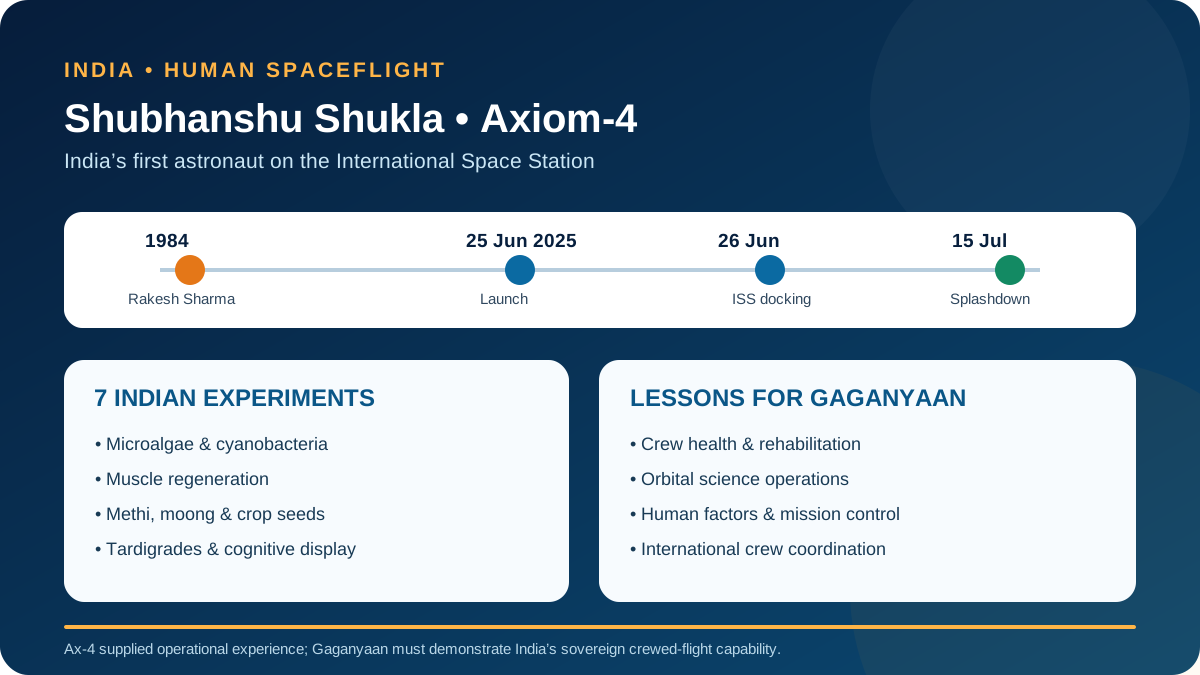
India’s first astronaut, Rakesh Sharma, travelled aboard the Soviet Soyuz T-11 spacecraft in April 1984. The Ax-4 flight in 2025 therefore ended a 41-year gap in Indian human spaceflight. It also gave an Indian astronaut direct experience of working on the ISS—a permanently inhabited laboratory in low-Earth orbit.
- Mission role: Shubhanshu Shukla served as Ax-4 pilot.
- Commander: Peggy Whitson of the United States.
- Mission specialists: Sławosz Uznański-Wiśniewski of Poland and Tibor Kapu of Hungary.
- Indian milestone: first Indian aboard the ISS and second Indian in space.
- Scientific contribution: completion of seven Indian microgravity experiments coordinated by ISRO’s Human Space Flight Centre.
The mission must be understood alongside India’s wider space capabilities. LearnPro’s explainer on the SpaDeX docking experiment explains why rendezvous and docking matter for future crewed missions and an Indian space station.
Axiom-4 mission timeline
| Date | Mission event | Why it mattered |
|---|---|---|
| 25 June 2025 | Ax-4 launched on a SpaceX Falcon 9 from Kennedy Space Center. | Shukla began India’s first human spaceflight mission since 1984. |
| 26 June 2025 | Crew Dragon docked with the ISS. | The crew entered a working orbital laboratory and joined Expedition 73 activities. |
| 26 June–14 July | Science, station operations and public-outreach activities were conducted. | Shukla completed all seven Indian experiments and gained practical orbital experience. |
| 14 July 2025 | Dragon undocked from the ISS. | The return phase tested crew procedures and coordination with mission-control teams. |
| 15 July 2025 | Dragon splashed down in the Pacific Ocean near California. | The approximately 18-day ISS mission concluded safely; samples returned for analysis. |
ISRO described the flight as a journey of roughly 12 million kilometres. After splashdown, Shukla entered a structured rehabilitation programme that included cardiovascular assessment, musculoskeletal tests and psychological debriefing. These checks generate evidence about how the human body adapts after microgravity exposure.
What were the seven Indian microgravity experiments?
Microgravity changes fluid movement, muscle use, plant growth and cellular behaviour. Experiments in orbit can therefore reveal processes that gravity masks on Earth. ISRO confirmed that all seven Indian experiments were completed and the samples were returned for detailed analysis.
| Experiment theme | Core question | Long-term relevance |
|---|---|---|
| Microalgae | How do edible algae grow and respond to radiation in space? | Compact food, nutrition and life-support possibilities. |
| Myogenesis | Can selected supplements support muscle regeneration? | Managing muscle loss during long-duration missions. |
| Methi and moong sprouts | How does microgravity affect seed germination and early growth? | Fresh food production beyond Earth. |
| Tardigrades | How do highly resilient organisms survive and age in space? | Understanding biological stress and survival. |
| Electronic display | How does an astronaut perform cognitive tasks using display interfaces? | Safer cockpit and crew-interface design. |
| Crop seeds | How does spaceflight affect seed health and later growth? | Food security for sustained missions. |
| Cyanobacteria | How do different strains grow and function in microgravity? | Oxygen, biomass and regenerative life-support research. |
These were not symbolic demonstrations. They addressed three practical needs of future human spaceflight: crew health, reliable food systems and usable life-support technologies. The broader context is discussed in LearnPro’s notes on India’s space programme and Viksit Bharat.
How does Ax-4 help the Gaganyaan programme?
Gaganyaan aims to demonstrate India’s independent capability to send a crew into low-Earth orbit and bring it safely back. Ax-4 did not test India’s launch vehicle, crew module or recovery system; those remain separate Indian responsibilities. It did, however, provide useful experience in areas where human performance and operational discipline are central.
- Astronaut operations: living and working to a strict schedule in microgravity.
- Experiment execution: handling samples, documenting results and coordinating with ground investigators.
- Medical knowledge: monitoring physical adaptation and post-flight recovery.
- Mission coordination: working across ISRO, NASA, Axiom Space, SpaceX and international crew teams.
- Human factors: learning how displays, procedures, communication and workload affect performance.
- Public engagement: connecting human spaceflight with students and scientific education.
A useful distinction for the examination is that Ax-4 supplied experience, while Gaganyaan must demonstrate sovereign capability. India still has to validate its human-rated launch system, life-support arrangements, abort systems, crew module, tracking and recovery chain. Autonomous docking is another strategic capability; see the 2025 review of India’s space programme for the wider mission sequence.
Strategic significance for India
1. Human-spaceflight knowledge
Hardware alone cannot create a mature crewed-space programme. Institutions also need trained astronauts, flight surgeons, experiment teams, mission planners and recovery specialists. Ax-4 gave Indian teams exposure to this complete operating environment.
2. Space diplomacy
The mission showed how national programmes and commercial providers can cooperate. India participated through ISRO while working with American and European institutions and astronauts from four countries. Such partnerships can speed learning without replacing domestic capacity.
3. Microgravity research ecosystem
The seven experiments connected Indian universities and research institutions with a live orbital mission. A regular pipeline—from laboratory proposal to flight-qualified payload and post-flight publication—can strengthen biotechnology, materials science and space medicine.
4. Commercial-space transition
Ax-4 was a private astronaut mission to a government-built space station, launched by a commercial company. It illustrates the emerging model in which public agencies set safety and research objectives while private firms provide transport and infrastructure.
Challenges and cautions
- Technology transfer is not automatic: flying on Crew Dragon does not provide India with its design knowledge.
- Dependence must be balanced: international cooperation should complement, not delay, indigenous human-rating and life-support capability.
- Research needs continuity: the real value of the samples depends on transparent analysis, peer-reviewed findings and follow-up missions.
- Safety remains decisive: crew escape, redundancy, medical readiness and recovery must take priority over schedule pressure.
- Clear public communication is essential: Ax-4 and Gaganyaan should not be presented as the same mission.
UPSC exam relevance
The Shubhanshu Shukla Axiom-4 mission can be used in General Studies Paper III under science and technology, indigenisation, space technology and the role of private industry. It also offers examples for essays on international cooperation and scientific temper.
Possible Mains question: “Axiom-4 was an international commercial mission, yet it has important implications for India’s sovereign human-spaceflight programme. Discuss.” A balanced answer should separate direct operational learning from the technologies India must still develop independently.
Conclusion
The Shubhanshu Shukla Axiom-4 mission was historic because it restored an Indian presence in human spaceflight, placed the first Indian on the ISS and delivered seven national experiments in orbit. Its deeper value lies in converting a high-visibility flight into durable capability: better astronaut training, stronger microgravity research, disciplined mission operations and evidence that supports Gaganyaan. The next test is whether India institutionalises these lessons through repeatable science and safe indigenous systems.
Frequently asked questions
Who was the first Indian to visit the International Space Station?
Group Captain Shubhanshu Shukla became the first Indian to visit the ISS as the pilot of Axiom Mission 4 in 2025.
Was Axiom-4 part of the Gaganyaan mission?
No. Ax-4 was an Axiom Space mission to the ISS using SpaceX Crew Dragon. It provided useful experience for Gaganyaan, but it did not test India’s Gaganyaan launch vehicle or crew module.
How long did the Axiom-4 mission stay at the ISS?
The spacecraft docked on 26 June and undocked on 14 July 2025. ISRO described Shukla’s stay as an approximately 18-day scientific mission aboard the ISS.
How many Indian experiments did Shubhanshu Shukla complete?
He completed seven Indian microgravity experiments covering microalgae, myogenesis, seed germination, tardigrades, crop seeds, cyanobacteria and cognitive interaction with electronic displays.
Why is Axiom-4 important for UPSC preparation?
It links human spaceflight, microgravity science, private participation, space diplomacy and the preparation of India’s Gaganyaan programme—important themes in General Studies Paper III.