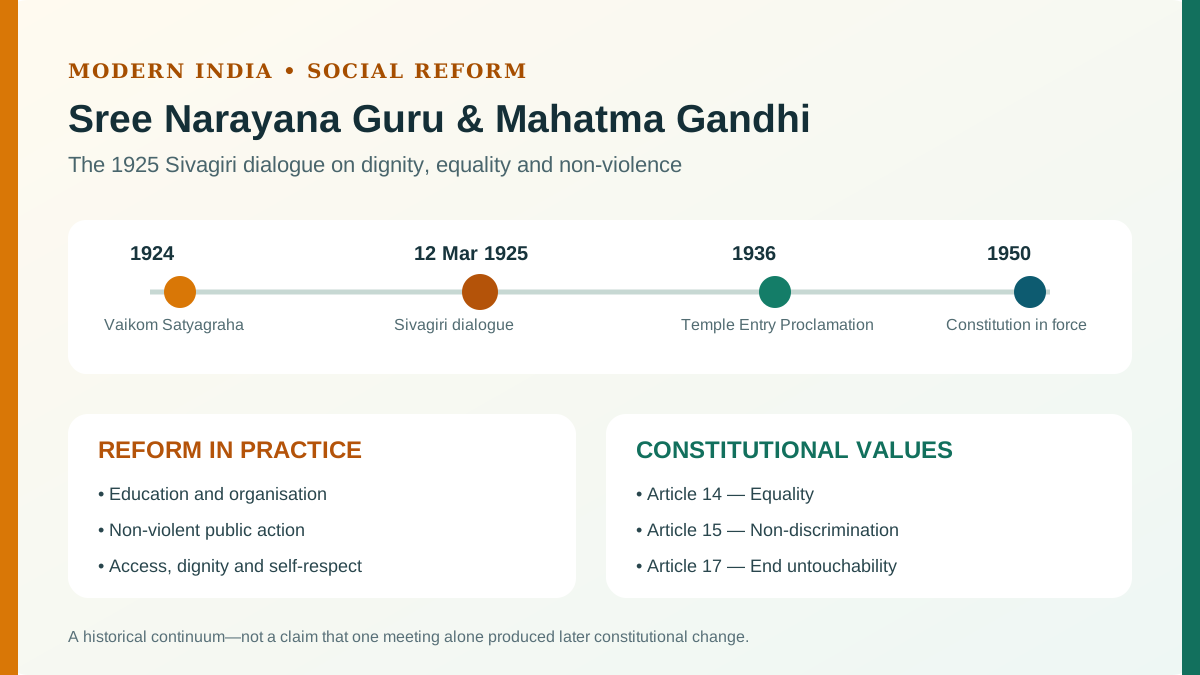
The Sree Narayana Guru–Mahatma Gandhi dialogue took place at Sivagiri Mutt on 12 March 1925, during the Vaikom Satyagraha. The two reformers discussed untouchability, religious conversion, non-violence, spiritual liberation and the uplift of oppressed communities. A century later, the Government of India commemorated this meeting at Vigyan Bhawan, New Delhi, on 24 June 2025.
The conversation matters because it brought together two connected approaches to social change. Sree Narayana Guru stressed dignity, education, organisation and inner reform; Gandhi connected social equality with mass non-violent action and the national movement. Their meeting helps explain how social reform and political freedom interacted in modern India.
Why was the 1925 dialogue commemorated?
The centenary programme recalled a meeting held exactly within the historical setting of the Vaikom Satyagraha (1924–25). The satyagraha challenged caste-based restrictions that prevented oppressed communities from using public roads around the Vaikom temple in the princely state of Travancore.
| Fact | Detail |
|---|---|
| Original meeting | 12 March 1925 at Sivagiri Mutt, Kerala |
| Historical setting | Vaikom Satyagraha and the wider struggle against caste exclusion |
| Main themes | Untouchability, religious conversion, non-violence, salvation and uplift of marginalised people |
| Centenary event | 24 June 2025 at Vigyan Bhawan, New Delhi |
| Organiser | Sree Narayana Dharma Sanghom Trust |
The commemoration was not simply a ceremonial anniversary. It invited reflection on a continuing constitutional question: how can formal equality become real social dignity? LearnPro’s explainer on Periyar and the Vaikom Satyagraha provides the wider movement context.
Who was Sree Narayana Guru?
Sree Narayana Guru (1856–1928) was a philosopher, spiritual teacher, poet and social reformer from Kerala. He challenged the graded inequality of caste not only through speeches but also through institutions. His reform method joined spiritual equality with practical tools such as education, organisation, clean living and economic improvement.
- Aruvippuram consecration (1888): his consecration of a Shiva image challenged the monopoly of upper-caste priestly authority.
- Institution-building: schools, temples and community organisations became spaces for dignity and learning.
- SNDP Yogam: founded in 1903 with associates including Dr Palpu and Kumaran Asan, it organised social and educational advancement.
- Universalism: the Guru’s well-known principle of one caste, one religion and one God for humanity rejected inherited social hierarchy.
- Ethical reform: he linked freedom with education, productive work, self-respect and moral conduct.
His approach was radical in purpose but constructive in method. Instead of accepting exclusion, he created alternative institutions that demonstrated equality in practice.
What did Gandhi bring to the conversation?
Gandhi visited Kerala while the Vaikom movement was under way. His method emphasised satyagraha—non-violent resistance grounded in truth, discipline and persuasion. He treated the removal of untouchability as a moral duty connected to the freedom struggle, although his approach to caste differed from that of several anti-caste thinkers.
At Sivagiri, the discussion addressed both immediate protest and deeper social reform. Gandhi’s presence linked the regional struggle to a national audience. Guru’s position kept attention on the lived dignity of communities, not only on access to a particular road or temple.
What were the central ideas in the dialogue?
1. Abolition of untouchability
Untouchability converted birth into a system of exclusion from roads, places of worship, education and public life. Both leaders rejected this humiliation. The debate was about how moral transformation, social organisation and collective action could end it.
2. Non-violence as social power
Vaikom showed that non-violent protest could expose an unjust custom without dehumanising its supporters. Discipline helped the movement claim public legitimacy and build wider alliances.
3. Religious conversion
Conversion was discussed because oppressed communities could reasonably question a social order that denied them equality. The core issue was not numerical competition between religions; it was whether a community offered its members dignity, access and moral equality.
4. Education and self-organisation
Guru’s reform practice treated education and organisation as instruments of emancipation. Legal reform is essential, but communities also need schools, associations, skills and economic opportunity to exercise freedom.
5. Spiritual equality and social equality
The conversation challenged the contradiction between proclaiming spiritual unity and practising social exclusion. It therefore connected ethics with institutions: a belief in human equality must be visible in access to common spaces and opportunities.
Comparing the reform approaches
| Dimension | Sree Narayana Guru | Mahatma Gandhi |
|---|---|---|
| Primary arena | Spiritual, educational and community reform | Mass politics, constructive work and satyagraha |
| Core method | Alternative institutions, education and ethical transformation | Non-violent mobilisation, persuasion and public action |
| View of dignity | Universal spiritual equality must reshape social practice | Untouchability was a moral wrong incompatible with freedom |
| Scale of influence | Deep social transformation, especially in Kerala | Integration of social reform with the national movement |
| Common ground | Non-violence, service, moral courage and the uplift of oppressed people | |
This comparison should not erase differences or turn the meeting into a simple agreement. Its value lies in the encounter between community-led social reconstruction and national political mobilisation.
From social reform to constitutional morality
The 1925 dialogue did not itself create later constitutional provisions. It belongs, however, to the wider historical struggle that made equality and dignity unavoidable principles of independent India.
- Article 14: equality before law and equal protection of laws.
- Article 15: prohibition of discrimination on grounds including religion, race, caste, sex or place of birth.
- Article 17: abolition of untouchability and prohibition of its practice in any form.
- Article 21: protection of life and personal liberty, interpreted to include dignity.
- Articles 38 and 46: direction to reduce inequalities and promote the educational and economic interests of weaker sections, particularly Scheduled Castes and Scheduled Tribes.
For the constitutional dimension, read LearnPro’s analysis of Ambedkar’s constitutional legacy and social justice. The legal abolition of untouchability is foundational, but discrimination in housing, education, employment, worship and everyday interaction shows why constitutional morality requires continuous public action.
UPSC relevance and answer framework
The Sree Narayana Guru–Mahatma Gandhi dialogue is relevant to GS Paper I under modern Indian history, social reform movements and Indian society. It also fits GS Paper IV themes such as human dignity, non-violence, persuasion and ethical leadership.
Possible Mains question: “The dialogue between Sree Narayana Guru and Mahatma Gandhi represented the meeting of spiritual reform and political action. Examine its significance in India’s struggle against caste exclusion.”
A strong answer can follow four steps:
- Place the dialogue in the Vaikom Satyagraha and 1925 context.
- Explain Guru’s institution-building and Gandhi’s mass non-violent politics.
- Identify common ground as well as differences in method.
- Connect the historical movement to Articles 14, 15 and 17 without claiming a direct one-event causation.
Contemporary lessons
- Dignity must be measurable: equality is incomplete if access to schools, jobs, housing and public spaces remains unequal.
- Law and society must move together: penalties deter discrimination, while education and social contact change behaviour.
- Reform needs institutions: durable change requires schools, community organisations and accountable public bodies.
- Non-violence is organised action: it requires strategy, discipline and clear demands—not passivity.
- Leadership should empower communities: affected people must be participants in reform, not merely recipients of welfare.
Conclusion
The 1925 Sree Narayana Guru–Mahatma Gandhi dialogue remains important because it joined moral reasoning with the practical politics of equality. Guru demonstrated that spiritual ideals must produce education, organisation and dignity; Gandhi helped carry the struggle against exclusion into mass public life. Its centenary is most meaningful when remembered not as an isolated meeting, but as part of India’s unfinished journey from social hierarchy to constitutional fraternity.
Frequently asked questions
When did Sree Narayana Guru meet Mahatma Gandhi?
They held their historic conversation at Sivagiri Mutt on 12 March 1925, during Gandhi’s visit in the period of the Vaikom Satyagraha.
What did Sree Narayana Guru and Gandhi discuss?
Their conversation covered the Vaikom Satyagraha, untouchability, religious conversion, non-violence, spiritual liberation and the uplift of oppressed communities.
Why was the Vaikom Satyagraha important?
It challenged caste restrictions on the use of public roads around the Vaikom temple and became a major non-violent struggle against social exclusion in Kerala.
What was Sree Narayana Guru’s method of social reform?
He combined spiritual equality with education, community organisation, institution-building, ethical reform and economic self-improvement.
Which constitutional articles are relevant to this topic?
Articles 14, 15 and 17 are central because they guarantee equality, prohibit specified forms of discrimination and abolish untouchability. Articles 38 and 46 add important Directive Principles.