
Brief Context
In News The recent Group Captain Shubhanshu Shukla journey to ISS marks Indias ascent as a major space power, aligning with the vision of Viksit Bharat 2047 and embracing the philosophy of Vishwabandhu Bharat in the space sector. Challenges Rising competition from private global giants (SpaceX, Blue Origin, etc.). Space debris and orbital congestion issues.
Source Content
Syllabus: GS3/ Space
In News
- The recent Group Captain Shubhanshu Shukla journey to ISS marks India’s ascent as a major space power, aligning with the vision of Viksit Bharat 2047 and embracing the philosophy of Vishwabandhu Bharat in the space sector.
Dimensions of India’s Space Programme
- Scientific & Technological Dimension:
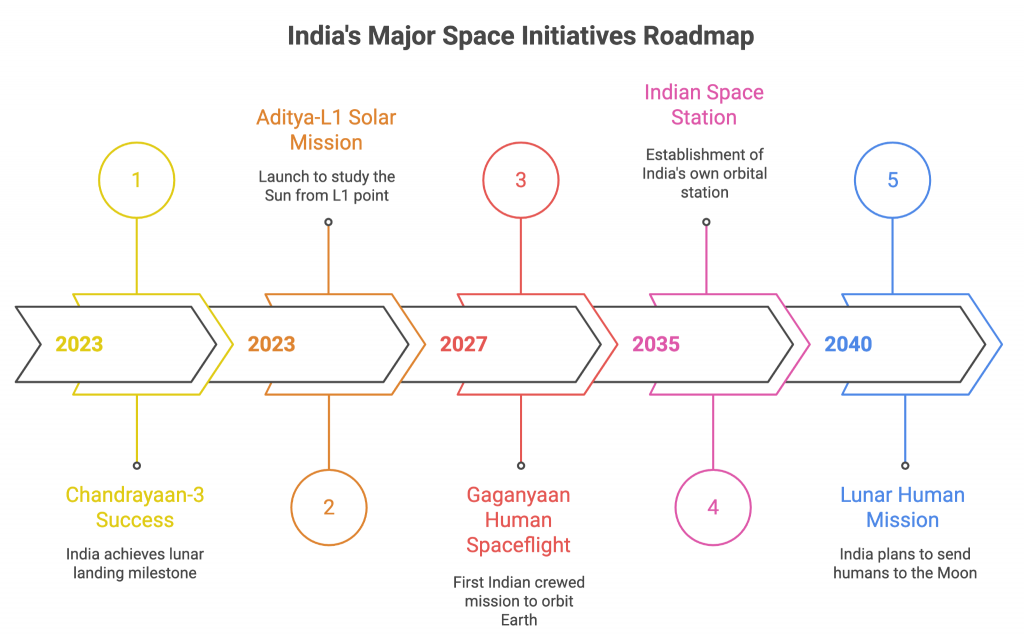
- Cost-effective innovation: India’s missions, such as Chandrayaan-3, succeeded in lunar landing at about 1/10th the cost of global peers; the ISS research mission was also completed at a fraction of international costs.
- Indigenous R&D: Development of launch vehicles (PSLV, GSLV Mk-III), navigation (NavIC), and cryogenic technology showcases India’s self-reliance.
- Economic Dimension:
- Space Economy: Currently worth ~$8 billion, India’s space sector is projected to reach $40 billion by 2040.
- Startup ecosystem: Home to over 300 startups like Skyroot Aerospace, Agnikul Cosmos, and Pixxel, supported by IN-SPACe and NSIL.
- Satellite services: Drive growth in broadband (OneWeb, Jio-Satellite), agriculture, logistics, and financial inclusion.
- Diplomatic & Global Dimension (Vishwabandhu Bharat):
- South-South cooperation: India provides satellites and launch services to African and Asian nations (e.g., GSAT-9 “South Asia Satellite”).
- International collaborations: Key projects with NASA (NISAR mission), Artemis Accords, and partnerships with France, Russia, SpaceX, and Axiom Space.
- Soft power: India is recognized as a responsible, affordable space launch provider fostering goodwill worldwide.
- Social & Developmental Dimension:
- Health & education: Telemedicine and tele-education programs connect rural India via INSAT satellites.
- Agriculture: Satellite-based yield forecasting, soil moisture mapping, and precision farming increase productivity.
- Disaster management: Real-time alerts and tracking (INSAT, RISAT) bolster climate resilience.
- Urban planning: Remote sensing and GIS underpin smart city development.
- Inclusivity: Spaces technology benefits extend beyond urban areas, supporting rural and marginalized communities.
- Security & Strategic Dimension:
- Indigenous navigation: NavIC ensures India is not reliant on foreign navigation systems.
- Military use: Development of military communication and surveillance satellites; dual-use technologies enhance security.
- ASAT Test (2019): Demonstration of anti-satellite capability established deterrence in space.
- Geopolitical leverage: Strategic autonomy enhanced vis-à-vis the US, China, and Russia.
Challenges
- Rising competition from private global giants (SpaceX, Blue Origin, etc.).
- Space debris and orbital congestion issues.
- Low R&D investment.
- Balancing commercialization with national security.
- Need for clear regulatory frameworks for startups and FDI.
Way Forward
- Increase R&D investment to meet global benchmarks.
- Facilitate private sector participation with simplified procedures.
- Enhance space diplomacy—especially with the Global South and major powers.
- Prioritize sustainability and responsible use of outer space.
Source: PIB