
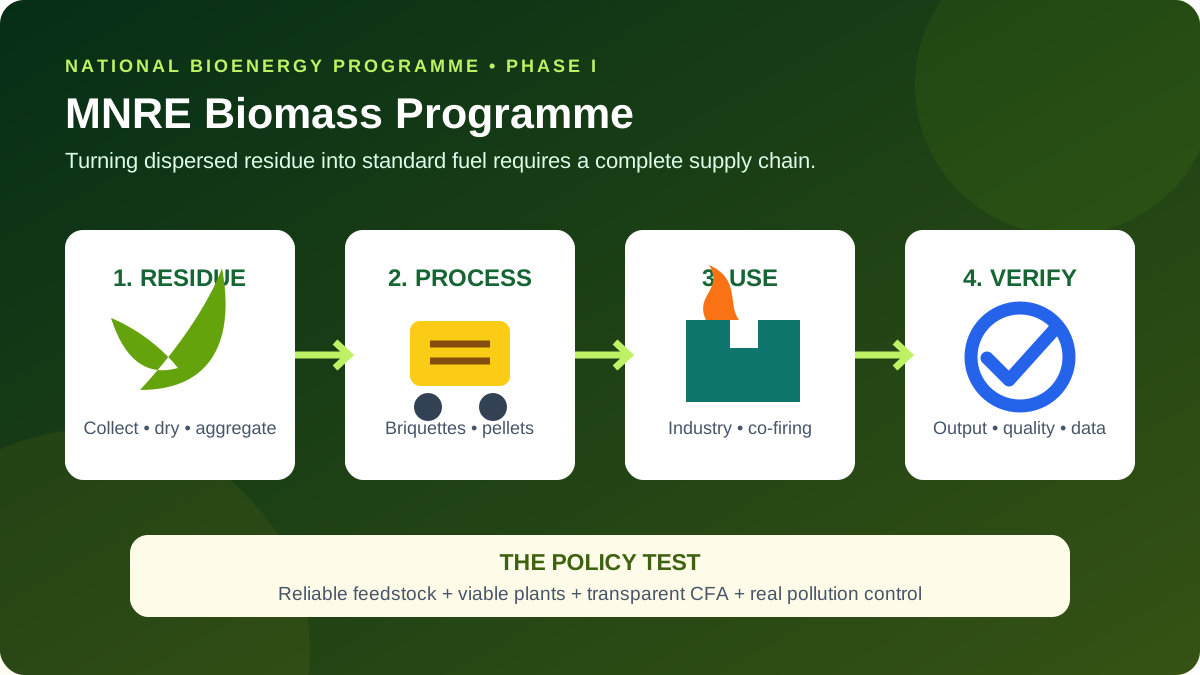
The MNRE Biomass Programme supported plants that convert agricultural and other biomass residues into briquettes or pellets, along with non-bagasse biomass cogeneration in industry. Its purpose was to build the missing link between dispersed residue in the field and a standard fuel that boilers and thermal power plants can use.
The programme formed one of three components of Phase I of the National Bioenergy Programme, notified for 1 April 2021 to 31 March 2026. MNRE revised important operating conditions in June 2025. Because Phase I has now ended, aspirants should distinguish the scheme’s design and 2025 revision from any future continuation; an old application deadline should not be presented as currently open.
What is biomass?
Biomass is organic material of recent biological origin that can be used as fuel or converted into energy products. Relevant feedstock includes crop residue, forestry residue, agro-industrial waste and purpose-grown biomass. The programme discussed here mainly supported densification and industrial cogeneration; it should not be confused with every waste-to-energy or biofuel scheme.
| Term | Meaning | Typical use |
|---|---|---|
| Briquette | Compressed block of processed biomass | Industrial boilers and thermal applications |
| Pellet | Small, dense and more uniform cylindrical fuel | Automated boilers and coal-plant co-firing |
| Torrefied pellet | Biomass heated in low oxygen to improve fuel properties | Higher-quality substitute in suitable systems |
| Cogeneration | Simultaneous production of useful heat and electricity | Energy-intensive industries |
National Bioenergy Programme structure
MNRE notified Phase I with an outlay of ₹858 crore. It comprised:
- Waste to Energy Programme: energy from urban, industrial and agricultural wastes or residues;
- Biomass Programme: briquette and pellet manufacturing plus non-bagasse biomass cogeneration in industry; and
- Biogas Programme: support for smaller biogas systems and associated applications.
These components address different conversion routes. A pellet plant mechanically densifies dry biomass, while a biogas plant uses anaerobic digestion. Clear classification matters in Prelims questions.
Financial support under the Biomass Programme
The MNRE programme page specifies Central Financial Assistance (CFA) of ₹9 lakh per metric tonne per hour (MTPH) for briquette or pellet manufacturing capacity, capped at ₹45 lakh per plant. Non-bagasse biomass cogeneration projects were eligible for ₹40 lakh per MW, capped at ₹5 crore per project.
Applications were routed through the BioURJA portal. New machinery was required, self-funded projects could be eligible, and the standard commissioning periods were 12 months for briquette or pellet plants and 24 months for cogeneration projects after in-principle approval.
What changed in the June 2025 revision?
The Office Memorandum dated 27 June 2025 simplified documentation and changed the way plant performance affected CFA. The major changes were:
- Some pre-application documents were omitted: the listed techno-economic feasibility report for debt-funded projects, high-resolution site photographs and EIA clearance entry for briquette or pellet plants were removed from that document list. This did not cancel environmental law where a clearance or consent was independently required.
- Offtake proof became more flexible: the earlier two-year sale-contract wording was replaced by an offtake or sale agreement where the output was to be sold.
- Monitoring changed: the requirement referred to an IoT-based monitoring solution or an undertaking to share quarterly production data.
- No duplicate capital subsidy: an applicant seeking MNRE capital subsidy could not claim another Central ministry’s capital subsidy for the same plant.
- Commissioning status: a developer commissioning after application was required to update the plant’s status on the BioURJA portal.
- Shorter performance test: the revised test measured operation over a continuous 10-hour period rather than the earlier multi-day and three-month structure.
How did the revised performance-linked CFA work?
A briquette or pellet plant operating at an average of at least 80% of rated capacity during the 10-hour inspection became eligible for 100% of the eligible CFA. Output between 50% and 80% received a pro-rata share. Output below 50% received no CFA.
For example, the 2025 memorandum illustrates that 73% capacity utilisation would produce 91.25% of eligible CFA: 73 divided by the 80% benchmark, multiplied by 100. Inspection agencies were also asked to submit a one-minute video and geotagged photographs with the report.
This design rewards an operating plant rather than installed machinery alone. Its weakness is that a 10-hour test may not prove year-round feedstock supply, reliable offtake or long-term financial viability. Periodic production data therefore remains important.
Why biomass pellets matter
- Reduced residue burning: a dependable market can give farmers and aggregators a reason to collect crop residue.
- Coal substitution: pellets can be co-fired in suitable coal-based thermal power plants.
- Industrial decarbonisation: boilers can replace a portion of fossil fuel where quality and supply are reliable.
- Rural value chains: collection, baling, transport and processing can create decentralised income.
- Waste management: residues become feedstock rather than an unmanaged disposal problem.
The Ministry of Power’s SAMARTH Mission is related but institutionally distinct. It promotes biomass co-firing in coal-based thermal power plants and aims to increase co-firing beyond the initial 5% level. MNRE’s support for pellet capacity can supply that demand.
Economic and environmental limitations
- Seasonal, dispersed feedstock: residue must be aggregated, dried and stored, making transport a major cost.
- Competing uses: crop residue may already be used as fodder, bedding, soil cover or household fuel. Policy should target genuine surplus.
- Quality variation: moisture, ash, size and calorific value affect plant efficiency and emissions.
- Air pollution: biomass combustion still produces particulate matter and other pollutants. Renewable origin does not remove the need for emission control.
- Carbon accounting: climate benefit depends on sustainable harvest, avoided open burning, transport distance and the fossil fuel actually displaced.
- Working capital and offtake: small plants can fail when buyers delay procurement or feedstock prices rise.
- Soil health: removing all residue can reduce organic matter and nutrients. Retention rules should reflect local agronomy.
Policy priorities after Phase I
- Plan residue at district level: map sustainable surplus after accounting for fodder and soil needs.
- Standardise fuel quality: transparent testing reduces disputes between manufacturers and power plants.
- Use long-term procurement: predictable tenders can finance collection equipment and pellet capacity.
- Track actual output: public dashboards should show production, co-firing, plant utilisation and subsidy paid.
- Enforce pollution control: boilers and plants need consent, monitoring and appropriate control equipment.
- Support farmer organisations: FPOs and local entrepreneurs can retain more value in residue aggregation.
Biomass should sit within a broader, technology-neutral transition. LearnPro’s decarbonisation in India explainer shows why grids, industry, finance and a just transition must move together.
UPSC and State PSC relevance
The MNRE Biomass Programme links GS Paper III topics of energy, environment, agriculture, air pollution and government policy. For Prelims, distinguish briquettes, pellets, biogas and cogeneration. For Mains, assess the whole value chain: sustainable residue, logistics, conversion, offtake, emissions and verification.
Mains practice question: Biomass can address crop-residue management and industrial decarbonisation, but only through a viable and environmentally sound supply chain. Examine.
Conclusion
The 2025 revision reduced paperwork and linked CFA more directly to observed output. That can speed viable projects, but a single inspection cannot establish durable success. The real test is whether plants operate across seasons, farmers receive value, buyers use standard fuel and pollution is actually controlled. Bioenergy policy must reward verified outcomes, not equipment alone.
Frequently asked questions
What was the MNRE Biomass Programme?
It was a National Bioenergy Programme component supporting briquette and pellet manufacturing plants and non-bagasse biomass cogeneration projects in industry.
What CFA was available for briquette or pellet plants?
The MNRE programme page states ₹9 lakh per MTPH of manufacturing capacity, subject to a maximum of ₹45 lakh per plant.
What did the 2025 performance revision change?
It used a continuous 10-hour performance test: at least 80% capacity qualified for full eligible CFA, 50–80% received pro-rata support and below 50% received none.
Is biomass energy pollution-free?
No. Biomass is renewable when sourced sustainably, but combustion can produce particulate and other air pollutants, so quality standards and emission controls remain necessary.
What is the difference between MNRE’s programme and SAMARTH?
MNRE supported pellet, briquette and cogeneration capacity, while the Ministry of Power’s SAMARTH Mission promotes biomass co-firing in coal-based thermal power plants.
Primary references
- MNRE: Biomass Programme—objectives, CFA and implementation
- MNRE: June 2025 revised Biomass Programme guidelines
- MNRE: National Bioenergy Programme overview
- Ministry of Power: SAMARTH Mission





Sources and further reading
- MNRE: Biomass Programme—objectives, CFA and implementationmnre.gov.in
- MNRE: June 2025 revised Biomass Programme guidelinesmnre.gov.in
- MNRE: National Bioenergy Programme overviewmnre.gov.in
- Ministry of Power: SAMARTH Missionsamarth.powermin.gov.in