
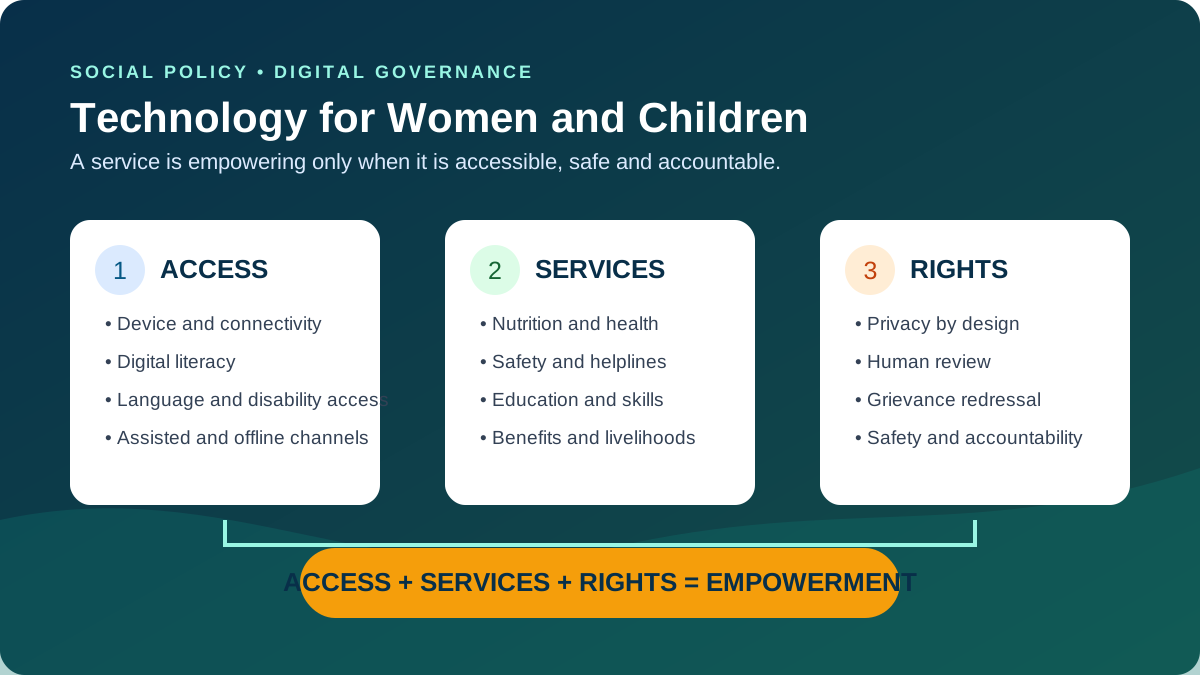
Technology for women and children can make nutrition services, safety systems, learning and benefits easier to reach. But a mobile app is not empowerment by itself. A digital system works only when the intended user controls a device, understands the service, can use it in her language and has a human channel when the system fails.
India’s policy challenge is therefore not technology versus welfare. It is how to combine technology with capable frontline workers, accountable institutions and enforceable rights. Platforms such as Poshan Tracker, SHe-Box and Child Helpline show both the promise and the limits of this approach.
What does technology-enabled empowerment mean?
Empowerment means greater agency: the ability to make informed choices, claim entitlements, participate in education or work and seek remedy against harm. Technology can lower distance and information costs, but it can also transfer the cost of service delivery to the user.
| Policy objective | Digital tool can help by | Outcome that must be measured |
|---|---|---|
| Nutrition | Recording growth and service delivery | Timely referral and better nutrition, not data entry alone |
| Safety | Routing complaints and emergency calls | Fast, confidential and fair response |
| Education | Delivering lessons and teacher support | Participation and learning gains |
| Economic agency | Providing skills, markets and digital payments | Income controlled by the woman |
| Child protection | Connecting cases across institutions | Rescue, care, rehabilitation and family-based support |
Important government platforms
1. Poshan Tracker
Poshan Tracker is an ICT governance tool under Saksham Anganwadi and Mission Poshan 2.0. Rolled out on 1 March 2021, it supports near-real-time monitoring, growth measurement and last-mile tracking of nutrition services. The Ministry says it is available in 24 languages and digitises physical registers used by Anganwadi workers.
Its public value depends on what follows the measurement. A child identified as wasted or underweight needs verification, counselling, health referral and sustained follow-up. Poor connectivity, faulty devices or excessive reporting burden should not take time away from care.
2. SHe-Box and Mission Shakti
Mission Shakti covers safety, security and empowerment through its Sambal and Samarthya sub-schemes. The revamped SHe-Box, launched on 29 August 2024, is a central repository of Internal Committees and Local Committees and an online complaint-monitoring system under the Sexual Harassment of Women at Workplace Act, 2013.
A portal can make a complaint easier to route and track. It cannot replace a lawfully constituted committee, confidential inquiry, protection from retaliation or a reasoned decision. Readers can connect this institutional question with LearnPro’s analysis of women’s digital safety.
3. Child Helpline 1098 and Mission Vatsalya
Child Helpline 1098 is a 24x7x365 service for children in difficult circumstances. It operates under Mission Vatsalya and is integrated with Emergency Response Support System 112 so an emergency can be transferred rapidly while child-protection institutions handle care and rehabilitation. By 1 January 2026, the government reported installation in 728 districts.
This is an example of useful interoperability: the caller should not need to understand departmental boundaries. However, speed must be accompanied by trained counsellors, District Child Protection Units, police coordination and follow-up.
The digital access gap is narrowing, not disappearing
The sixth National Family Health Survey for 2023–24 reported that 64.3% of women aged 15–49 had ever used the internet, up from 33.3% in NFHS-5. Women with a mobile phone they themselves used increased from 53.9% to 63.6%. This is major progress, but the indicators do not show frequency, digital skill, quality of connectivity or whether a woman can use a shared device privately.
- Access is not control: a phone may be shared or monitored by another household member.
- Connectivity is not capability: a user may still struggle with forms, passwords, fraud or an unfamiliar language.
- Registration is not delivery: a successful entry on a dashboard does not prove that food, counselling or protection reached the person.
- National averages conceal gaps: income, disability, age, location and education change the ability to use a digital service.
Risks for women and children
- Digital exclusion: app-only delivery can exclude people without a compatible phone, stable network, documents or digital confidence.
- Privacy and surveillance: nutrition, pregnancy, violence and child-protection records are highly sensitive. Excessive collection can expose individuals to stigma or harm.
- Online abuse: stalking, impersonation, non-consensual images, financial fraud and grooming can restrict participation instead of expanding it.
- Algorithmic bias: automated risk scores may reproduce gaps in the data and make opaque decisions about vulnerable people.
- Weak grievance systems: an error becomes exclusion when the user cannot correct data or reach an accountable official.
- Frontline workload: multiple apps and repeated data entry can reduce the time available for counselling, teaching and home visits.
The Digital Personal Data Protection Act, 2023 and the notified DPDP Rules, 2025 create a general data-protection framework, including special duties concerning children’s data. Sectoral systems must still translate legal duties into clear notices, limited collection, access controls, retention limits, breach response and effective complaint handling.
A rights-based design checklist
- Keep an assisted and offline option: no essential service should depend exclusively on a smartphone.
- Collect the minimum data: every field should have a defined purpose, access rule and deletion schedule.
- Design for the actual user: use local languages, audio guidance, accessible interfaces and low-bandwidth operation.
- Provide human review: no adverse welfare or protection decision should rest only on an automated flag.
- Build safety by default: conceal sensitive notifications, prevent unauthorised access and protect complainants from retaliation.
- Measure outcomes: publish response time, resolution, exclusion and user-satisfaction data—not merely downloads or registrations.
- Support frontline workers: integrate systems, reduce duplicate entry and provide devices, training and technical help.
- Include women and children in design: test services with users from rural, low-income and disability groups before scale-up.
The same principles apply to emerging AI systems. See the related LearnPro explainer on the AI and gender empowerment casebook.
UPSC and State PSC relevance
Technology for women and children connects GS Paper I themes of women and social empowerment with GS Paper II welfare delivery, vulnerable groups and e-governance, and GS Paper III cybersecurity and technology. A strong Mains answer should avoid both technological optimism and blanket rejection. Use the sequence access → service → safeguard → measurable outcome.
Mains practice question: Digital platforms can improve the reach of welfare and protection systems, but technology alone cannot create social empowerment. Discuss with examples relating to women and children.
Conclusion
India’s digital systems can reduce distance, make cases visible and improve coordination. Yet meaningful empowerment is visible only when a woman gains control over decisions or a child receives timely protection and care. The correct goal is therefore not the maximum number of apps. It is accessible services, minimal and secure data, accountable human decisions and outcomes that users can verify.
Frequently asked questions
What is Poshan Tracker?
It is an ICT governance tool under Saksham Anganwadi and Mission Poshan 2.0 for near-real-time monitoring, growth measurement and tracking nutrition service delivery.
What is SHe-Box?
SHe-Box is the Ministry of Women and Child Development’s central portal for information on workplace Internal and Local Committees and for routing and monitoring sexual-harassment complaints.
What is the Child Helpline number?
Child Helpline 1098 is a 24x7x365 service for children in difficult circumstances and is integrated with ERSS 112 for emergency response.
Why is a digital option not enough?
A user may lack a private device, connectivity, literacy or documents. Essential services therefore need assisted and offline alternatives plus accountable human support.
How should digital empowerment be measured?
Measure access, successful service delivery, response and resolution time, learning or health outcomes, user control and the number of people wrongly excluded—not just downloads.
Primary references
- Ministry of Women and Child Development: Poshan Tracker
- Ministry of Women and Child Development: Mission Shakti
- Press Information Bureau: SHe-Box and Mission Shakti
- Press Information Bureau: Mission Vatsalya and Child Helpline
- International Institute for Population Sciences: NFHS fact sheets
- MeitY: Digital Personal Data Protection Rules, 2025





Sources and further reading
- Ministry of Women and Child Development: Poshan Trackerspniwcd.wcd.gov.in
- Ministry of Women and Child Development: Mission Shaktispniwcd.wcd.gov.in
- Press Information Bureau: SHe-Box and Mission Shaktipib.gov.in
- Press Information Bureau: Mission Vatsalya and Child Helplinepib.gov.in
- International Institute for Population Sciences: NFHS fact sheetsiipsindia.ac.in