Meghalaya GK for MPSC should be prepared as a separate and systematic part of the Meghalaya Civil Service (MCS) examination. General UPSC books can provide the foundation for History, Geography, Polity, Economy and Environment, but they cannot provide adequate coverage of Meghalaya’s traditional institutions, Khasi-Jaintia-Garo society, Sixth Schedule administration, state history, economy, geography, culture and current developments.
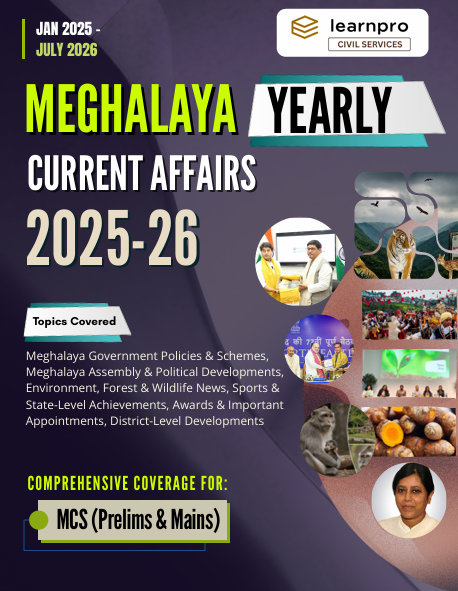
A strong Meghalaya GK preparation therefore needs to combine static Meghalaya knowledge + current affairs + previous-year-question orientation. LearnPro’s Meghalaya PSC Notes already organises these areas under History & Culture, Geography, Polity & Sixth Schedule, Economy, Society & Tribes, Environment, Current Affairs and Meghalaya GK. (LearnPro)
Candidates who want concentrated state-specific preparation can also use the Meghalaya Special Course, which covers Meghalaya’s history, geography, constitutional and administrative structure, society, economy, tribal traditions and culture. (LearnPro)
Meghalaya GK for MPSC: What to Study
The Meghalaya-specific portion can broadly be divided into the following areas:
| Meghalaya GK Area | Important Topics |
|---|---|
| History | Khasi Syiemships, Jaintia Kingdom, British expansion, resistance movements, statehood |
| Geography | Hills, plateau, rivers, rainfall, caves, waterfalls, forests and districts |
| Polity | Sixth Schedule, ADCs, traditional institutions, State Government |
| Society | Khasi, Jaintia and Garo society, matriliny, clans and customary institutions |
| Land System | A’king, Nokma, Khasi and Jaintia land tenure |
| Economy | Agriculture, horticulture, tourism, mining, handloom and infrastructure |
| Environment | Biodiversity, forests, protected areas, mining and water resources |
| Culture | Festivals, dances, languages, crafts, sacred landscapes |
| Current Affairs | Schemes, economy, environment, governance and major state developments |
| District GK | Headquarters, important places, rivers, resources, protected areas and culture |
The biggest mistake is to study only a conventional “Meghalaya GK book” containing capitals, rivers, festivals and personalities. MPSC preparation requires a much broader understanding of how these facts connect with the state’s history, society and administration.
Basic Meghalaya GK
Before moving into detailed topics, candidates should have a strong command over the basic identity of the state.
| Fact | Meghalaya |
|---|---|
| State | Meghalaya |
| Meaning of Meghalaya | Abode of Clouds |
| Capital | Shillong |
| Region | Northeast India |
| Statehood | 21 January 1972 |
| Major indigenous communities | Khasi, Jaintia and Garo |
| International boundary | Bangladesh |
| Neighbouring Indian state | Assam |
| Major physiographic feature | Meghalaya Plateau |
| Important hill divisions | Khasi, Jaintia and Garo Hills |
These basic facts are only the starting point. MPSC questions can move from a simple geographical fact to institutions, history, environment or contemporary policy.
Meghalaya History GK
Meghalaya history should begin with the traditional political systems that existed before British rule.
Three areas deserve particular attention:
- Khasi political institutions
- Jaintia Kingdom
- Garo social and political organisation
These systems differed substantially from one another, so candidates should not treat Khasi, Jaintia and Garo institutions as interchangeable.
Khasi Syiemships
Traditional Khasi political organisation developed through Hima or Syiemships, where authority was distributed between the Syiem and councils rather than concentrated completely in the ruler.
Important terms include:
- Hima
- Syiem
- Dorbar Hima
- Raid
- Dorbar Shnong
For detailed coverage, read Khasi Syiemships: Structure, Administration and Dorbar System.
This topic should also be connected with modern questions concerning:
- traditional governance;
- customary law;
- village institutions;
- Sixth Schedule administration.
Jaintia Kingdom
The Jaintia Kingdom was one of the major historical political formations of the Meghalaya region.
Candidates should understand:
- its origin;
- political development;
- territorial influence;
- administrative structure;
- relationship with neighbouring Assam, Cachar and Bengal;
- British intervention;
- annexation;
- subsequent resistance.
Use Jaintia Kingdom: Origin and Political Development as the starting point.
Do not reduce Jaintia history to a single date of annexation. The development of the kingdom before British rule is equally important.
Garo Society and Political Organisation
Garo political organisation was closely linked with the clan, village and land system.
The most important terms are:
- Nokma
- A’king
- clan;
- village community.
Read Garo Society and Political Organisation together with Nokma and A’king System among the Garos.
The two topics should be studied together because political authority and land rights were closely connected.
Meghalaya Land Tenure GK
Traditional land ownership is one of the areas where Meghalaya differs sharply from many other Indian states.
Candidates should understand the separate land systems of:
- Khasi Hills;
- Jaintia Hills;
- Garo Hills.
Important concepts include:
- community land;
- clan land;
- private land;
- A’king land;
- Nokma authority;
- customary ownership.
The detailed topic is available in Traditional Land Tenure Systems of Khasi, Jaintia and Garo Hills.
Matrilineal System in Meghalaya
One of Meghalaya’s most widely known social characteristics is the matrilineal system found among Khasi, Jaintia and Garo communities.
However, candidates should not write simply:
Property passes through women.
The actual system involves:
- lineage through the mother;
- clan identity;
- inheritance;
- family organisation;
- social responsibilities.
Most importantly:
Matrilineal does not automatically mean matriarchal.
A matrilineal society traces descent through the maternal line, while political or household authority may still involve men in important positions.
Read Matrilineal System in Meghalaya.
British Expansion into Meghalaya
Colonial history is another high-value Meghalaya GK area.
British expansion should be studied chronologically:
British interest in communication and territory
↓
Expansion into Khasi-Jaintia-Garo Hills
↓
Resistance
↓
Military conflict
↓
Colonial administration
Important themes include:
- David Scott;
- Sylhet-Assam Road;
- Anglo-Khasi War;
- U Tirot Sing;
- annexation of Jaintia Kingdom;
- U Kiang Nangbah;
- Garo resistance.
Anglo-Khasi War
The Anglo-Khasi War of 1829–1833 was one of the defining episodes in Meghalaya’s colonial history.
Candidates should know:
- background;
- British road project;
- Khasi concerns;
- leadership;
- nature of resistance;
- consequences.
Read Anglo-Khasi War 1829–1833.
U Tirot Sing
U Tirot Sing Syiem is one of the most important figures in Meghalaya history.
His resistance should be studied in the broader context of:
- Khasi political autonomy;
- British road construction;
- expanding colonial influence;
- Anglo-Khasi conflict.
Use U Tirot Sing Syiem: Life, Resistance and Legacy.
For Prelims, remember the factual details.
For Mains, understand why Khasi political institutions came into conflict with expanding British power.
U Kiang Nangbah
The Jaintia resistance of 1862–63 is closely associated with U Kiang Nangbah.
Prepare:
- background of British annexation;
- interference with traditional life;
- causes of rebellion;
- leadership;
- suppression;
- historical importance.
Read U Kiang Nangbah and the Jaintia Rebellion 1862–63.
Meghalaya Statehood
Modern Meghalaya GK must include the political development that led to statehood.
The broad sequence should be understood as:
Colonial hill administration
↓
Post-Independence Assam
↓
Demand for hill autonomy
↓
Autonomous State arrangement
↓
Full statehood
↓
21 January 1972
The topic should be connected with:
- tribal identity;
- language;
- political representation;
- Sixth Schedule institutions.
Meghalaya Geography GK
Geography is one of the easiest areas to improve through map-based preparation.
Candidates should be able to locate:
- Khasi Hills;
- Jaintia Hills;
- Garo Hills;
- Shillong Plateau;
- important rivers;
- waterfalls;
- caves;
- protected areas;
- district headquarters;
- Bangladesh border.
Do not simply memorise lists.
Every geographical feature should be linked to its district and physical region.
Meghalaya Plateau
Meghalaya forms a prominent plateau block in Northeast India.
The plateau is traditionally divided into:
Garo Hills → west
Khasi Hills → central
Jaintia Hills → east
This west-to-east arrangement should be fixed mentally before studying individual rivers, towns, waterfalls and protected areas.
A blank map is one of the most useful tools for Meghalaya GK preparation.
Khasi Hills
The Khasi Hills contain important geographical and cultural locations such as:
- Shillong;
- Sohra/Cherrapunji region;
- Mawsynram;
- numerous waterfalls;
- caves;
- sacred groves;
- living root bridges.
Questions can combine Geography and Culture.
For example:
Sacred grove → location → Khasi tradition → biodiversity
rather than asking only a place name.
Jaintia Hills
Jaintia Hills should be studied through:
- physical geography;
- limestone;
- caves;
- rivers;
- historical Jaintia Kingdom;
- mining;
- cultural sites.
This is a good example of how one region can appear under:
History + Geography + Economy + Environment
in different questions.
Garo Hills
The Garo Hills form the western part of Meghalaya.
Candidates should connect them with:
- Garo society;
- Nokma;
- A’king;
- forests;
- biodiversity;
- Nokrek;
- agriculture;
- important rivers.
Again, geography and society should be prepared together.
Rivers of Meghalaya
Candidates should prepare rivers under a simple table:
| River | Region | Direction/Drainage | Importance |
|---|---|---|---|
| Umngot | Jaintia region | Bangladesh drainage | Tourism and water quality |
| Umiam | Khasi Hills region | Major river system | Reservoir and power |
| Simsang | Garo Hills | Major Garo Hills drainage | Agriculture and settlements |
| Myntdu | Jaintia Hills | Important regional river | Local economy |
| Kynshi | Khasi region | Plateau drainage | Hydropower/geographical importance |
Do not memorise river names without locating them.
For a current geographical case study, read Umngot River: Geography, Tourism and Environmental Concerns.
Waterfalls of Meghalaya
Important waterfalls should be prepared through:
Name → District/Region → River if relevant → Special Feature
Instead of memorising 30 waterfalls at once, first learn major ones such as:
- Nohkalikai;
- Nohsngithiang;
- Elephant Falls;
- Krang Suri;
- Wei Sawdong.
Then expand your list.
Caves of Meghalaya
Meghalaya’s limestone landscape has produced extensive cave systems.
Candidates should understand why caves are concentrated here:
Limestone
High rainfall
Chemical weathering
↓
Karst topography
↓
Caves and underground drainage
This is much better preparation than simply memorising cave names.
Mawsynram and Cherrapunji
Both Mawsynram and Sohra/Cherrapunji are internationally known for exceptionally heavy rainfall.
For MPSC, understand the geographical mechanism:
Bay of Bengal moisture
↓
Bangladesh plains
↓
Abrupt southern escarpment of Meghalaya Plateau
↓
Rapid uplift of moist air
↓
Very heavy orographic rainfall
This concept may be more important than merely memorising which location receives a particular annual figure.
Meghalaya Polity GK
Meghalaya Polity should be studied at two levels:
Constitutional Institutions
- Governor;
- State Legislature;
- Chief Minister;
- High Court;
- State Public Service Commission.
Special Tribal Governance
- Sixth Schedule;
- Autonomous District Councils;
- traditional institutions;
- customary law.
The second category is particularly important for Meghalaya.
Sixth Schedule of the Constitution
The Sixth Schedule provides for autonomous administration in specified tribal areas of Northeast India.
For Meghalaya, prepare:
- constitutional basis;
- Autonomous District Councils;
- legislative powers;
- judicial powers;
- taxation powers;
- land administration;
- relationship with the State Government.
Do not confuse the Sixth Schedule with reservation policy.
They are different institutional arrangements.
Autonomous District Councils in Meghalaya
Three major Autonomous District Councils should be remembered:
- Khasi Hills Autonomous District Council
- Jaintia Hills Autonomous District Council
- Garo Hills Autonomous District Council
Questions can involve:
- location;
- powers;
- elections;
- customary law;
- relationship with traditional institutions.
Traditional Institutions vs ADCs
This distinction deserves special attention.
Traditional institutions such as:
- Syiem;
- Dorbar;
- Nokma
developed historically.
Autonomous District Councils are constitutional institutions created under the Sixth Schedule.
The two can interact, but they are not the same thing.
Meghalaya Reservation Policy
Another important state-polity topic is the reservation system in government recruitment.
The long-standing State-level structure broadly provides:
- 40% Khasi-Jaintia
- 40% Garo
- 5% Other ST/SC
Candidates should also understand the separate district-level combined reservation arrangements rather than memorising only “80% reservation”.
Meghalaya Society GK
The social structure of Meghalaya should be prepared comparatively.
| Area | Khasi | Jaintia | Garo |
|---|---|---|---|
| Descent | Matrilineal | Matrilineal | Matrilineal |
| Traditional political institution | Syiemship/Dorbar | Traditional Jaintia institutions | Nokma-based organisation |
| Land system | Clan/community/private forms | Distinct customary forms | A’king system |
| Main geographical region | Khasi Hills | Jaintia Hills | Garo Hills |
The table gives the broad framework. Candidates should then study each system separately.
Meghalaya Tribes GK
The three principal indigenous communities are:
- Khasi
- Jaintia
- Garo
However, Meghalaya society contains additional groups and sub-groups, so candidates should avoid treating the entire population as culturally uniform.
Study tribes through:
Region + Language + Clan + Land + Institution + Festival
This six-part framework is excellent for revision.
Meghalaya Festivals GK
Festivals are popular GK topics, but they should be associated correctly with their communities.
Important examples include:
- Shad Suk Mynsiem
- Nongkrem Dance Festival
- Behdienkhlam
- Wangala
Do not simply memorise the names.
Prepare:
| Festival | Community | Region | Basic Significance |
|---|---|---|---|
| Shad Suk Mynsiem | Khasi | Khasi region | Cultural/religious celebration |
| Nongkrem | Khasi | Khasi Hills | Traditional festival |
| Behdienkhlam | Jaintia | Jaintia region | Major community festival |
| Wangala | Garo | Garo Hills | Harvest-related festival |
Languages of Meghalaya
Important languages include:
- Khasi;
- Garo;
- Pnar/Jaintia;
- English.
Language questions may also connect with:
- tribal identity;
- official recognition;
- literature;
- cultural preservation.
Candidates should therefore prepare language as a cultural and political topic rather than merely a vocabulary question.
Meghalaya Economy GK
Meghalaya’s economy should be studied sector-wise.
Important sectors include:
- Agriculture
- Horticulture
- Tourism
- Mining
- Handloom and handicrafts
- Services
- Infrastructure
- Cross-border trade
The Meghalaya PSC Notes hub currently groups topics such as Lakadong turmeric, organic agriculture, handloom, connectivity, skill mobility and mining under Meghalaya Economy. (LearnPro)
Agriculture in Meghalaya
Agriculture remains important to rural livelihoods.
Candidates should prepare:
- major crops;
- horticulture;
- spices;
- organic farming;
- shifting cultivation;
- market access.
Do not simply memorise crop names.
Understand how:
relief + rainfall + soil + transport + markets
influence agriculture.
Lakadong Turmeric
Lakadong turmeric has become one of Meghalaya’s important high-value agricultural products.
Candidates should connect it with:
- West Jaintia Hills;
- spice cultivation;
- value addition;
- farmer income;
- branding.
The broader current-affairs context can be read in Mission Golden Spice and Lakadong Turmeric.
Meghalaya Handloom and Ryndia
Traditional textiles provide an important connection between culture and economy.
Ryndia, associated with eri silk traditions, should be studied through:
- traditional weaving;
- livelihoods;
- cultural identity;
- geographical indication and branding.
See Ryndia and Khasi Handloom GI Recognition.
Mining in Meghalaya
Mining is one of the most important Economy-Environment crossover topics.
Prepare:
- coal;
- limestone;
- mining methods;
- employment;
- environmental impact;
- water pollution;
- safety;
- regulation.
A single mining question can therefore involve:
Economy
Environment
Governance
Local livelihood
Meghalaya Environment GK
Meghalaya’s high rainfall, forests, caves and biodiversity make Environment a major state-specific area.
Important topics include:
- forests;
- sacred groves;
- biodiversity;
- national parks;
- wildlife sanctuaries;
- community conservation;
- mining pollution;
- river pollution;
- climate change.
Protected Areas of Meghalaya
Prepare protected areas using:
Name → District → Important ecosystem/species → Special feature
Important examples include:
- Nokrek National Park;
- Balpakram National Park;
- Nongkhyllem Wildlife Sanctuary;
- Siju Wildlife Sanctuary.
Maps are particularly useful for this section.
Nokrek
Nokrek should be connected with:
- Garo Hills;
- biodiversity;
- protected area;
- biosphere conservation.
Do not memorise it simply as a name in a national-park list.
Balpakram
Balpakram is another important protected landscape of the Garo Hills.
Prepare:
- location;
- relief;
- biodiversity;
- cultural significance.
Protected areas often combine geography + environment + tribal culture.
Sacred Groves
Sacred groves are particularly important in Meghalaya because they demonstrate traditional community-based conservation.
Candidates should understand:
- customary protection;
- biodiversity value;
- religious/cultural significance;
- community governance.
This is a strong example for descriptive answers on traditional ecological knowledge.
GREEN Meghalaya Plus
Current environmental programmes should be linked with static conservation concepts.
GREEN Meghalaya Plus can be connected with:
- community forests;
- ecosystem services;
- conservation finance;
- climate adaptation;
- local institutions.
Meghalaya Current Affairs
Current affairs should be an extension of Meghalaya GK, not a separate pile of monthly PDFs.
For every current development, ask:
Which static Meghalaya topic does this connect with?
Examples:
Mining news
→ Meghalaya geology + coal + environment
ADC issue
→ Sixth Schedule + tribal governance
Agricultural scheme
→ Meghalaya Economy + district geography
River pollution
→ Geography + tourism + environmental governance
This method dramatically improves retention.
Meghalaya Current Affairs 2026
High-priority categories for 2026 should include:
- State Government schemes;
- economy;
- environment;
- agriculture;
- connectivity;
- Sixth Schedule;
- tribal institutions;
- public health;
- culture;
- important state appointments and awards.
The Meghalaya PSC Notes page currently maintains a separate Meghalaya Current Affairs section alongside the static subjects. (LearnPro)
Meghalaya District GK
District GK should not become a giant list of memorised headquarters.
For each district, prepare:
- headquarters;
- physical region;
- major river;
- important protected area;
- economic activity;
- important cultural/historical place.
This makes district knowledge much easier to retain.
Meghalaya Map Practice
Keep at least three blank maps.
Map 1 – Physical Geography
Mark:
- Khasi Hills;
- Jaintia Hills;
- Garo Hills;
- Shillong Plateau;
- major rivers.
Map 2 – Political Geography
Mark:
- districts;
- district headquarters;
- border with Assam;
- Bangladesh boundary.
Map 3 – Environment and Culture
Mark:
- national parks;
- wildlife sanctuaries;
- important caves;
- waterfalls;
- heritage and cultural locations.
Repeat these maps until locations become automatic.
Meghalaya GK Questions: How MPSC Can Ask
The examination does not need to ask:
Where is Nokrek?
It can instead ask:
Nokrek – Garo Hills – Biosphere Reserve – Biodiversity
and require identification through combinations.
Similarly:
A’king → Garo
Nokma → Garo
Syiem → Khasi
Behdienkhlam → Jaintia
The best preparation is therefore relational rather than purely factual.
Meghalaya GK One-Liners vs Conceptual Preparation
One-line GK is useful for final revision.
It is not sufficient for first preparation.
For example:
One-line fact: Nokma is associated with Garo society.
That is useful during revision.
But initially you should understand:
- who the Nokma is;
- relationship with A’king land;
- clan structure;
- customary authority.
Then the one-line fact becomes much easier to remember.
Meghalaya GK for MPSC Screening Test
For the Screening Test, prioritise:
- factual accuracy;
- names and locations;
- institutions;
- matching;
- chronology;
- important terms;
- maps.
Your revision notes should become increasingly concise as the examination approaches.
A useful final format is:
| Topic | 5 Facts |
|---|---|
| Khasi Syiemship | Hima, Syiem, Dorbar, Raid, Shnong |
| Garo institution | Nokma, A’king, clan, land, village |
| Jaintia resistance | Annexation, British rule, Kiang Nangbah, 1862–63 |
| Geography | Plateau, hills, rivers, rainfall, caves |
| Sixth Schedule | ADCs, powers, customary administration |
Meghalaya GK for MCS Mains
For Mains, factual knowledge must become analytical.
For example:
Prelims
What is A’king?
Mains
Explain the significance of customary land systems in Meghalaya and discuss their relationship with contemporary development.
Similarly:
Prelims
U Tirot Sing was associated with which resistance?
Mains
Examine the political and geographical factors behind Khasi resistance to British expansion.
Therefore, the same GK preparation should support both stages.
How to Prepare Meghalaya GK in 30 Days
Days 1–5
History
- traditional institutions;
- Jaintia Kingdom;
- British expansion;
- resistance.
Days 6–10
Geography
- plateau;
- rivers;
- rainfall;
- waterfalls;
- caves;
- districts.
Days 11–14
Polity
- Sixth Schedule;
- ADCs;
- traditional administration;
- reservation policy.
Days 15–18
Society and Tribes
- matriliny;
- Khasi;
- Jaintia;
- Garo;
- land systems;
- festivals.
Days 19–22
Economy
- agriculture;
- tourism;
- mining;
- handloom;
- infrastructure.
Days 23–25
Environment
- national parks;
- wildlife sanctuaries;
- forests;
- biodiversity.
Days 26–28
Current Affairs
Days 29–30
Revision + MCQs + maps
How to Revise Meghalaya GK
Use three levels.
Level 1 – Detailed Notes
Understand the complete topic.
Level 2 – Short Notes
Reduce every topic to one or two pages.
Level 3 – Final GK Sheet
Reduce each topic to:
- 5–10 facts;
- important names;
- date;
- location;
- key institution.
The final stage should be fast enough to revise the entire Meghalaya GK portion repeatedly.
Meghalaya GK Previous-Year Questions
PYQs should be used to determine the depth at which a topic must be prepared.
When analysing a question, do not just record the answer.
Write:
Subject
Topic
Exact fact tested
Related facts
For example:
Question on Nokma
should trigger revision of:
- Garo political organisation;
- A’king;
- matrilineal inheritance;
- land ownership.
One question can therefore revise an entire cluster.
Common Mistakes in Meghalaya GK Preparation
Avoid these mistakes:
- memorising facts without maps;
- preparing only state capitals/districts/festivals;
- ignoring traditional institutions;
- ignoring Meghalaya Current Affairs;
- reading Khasi, Jaintia and Garo society as one homogeneous system;
- confusing Sixth Schedule institutions with traditional institutions;
- leaving state-specific preparation until the final week.
The Meghalaya portion should run parallel to General Studies preparation from the beginning.
Meghalaya Special Course for MPSC
Candidates who already have a General Studies foundation but require dedicated Meghalaya-specific preparation can use the:
Meghalaya Special Course
The course is currently structured around Meghalaya Special coverage and includes the state’s historical development and culture, geography and ecology, constitutional and administrative structure including the Sixth Schedule and Autonomous District Councils, society, economy, and tribal traditions. (LearnPro)
The current course page lists the programme at ₹8,000. (LearnPro)
Who Is This Course Most Useful For?
It is particularly suitable for candidates who:
- already study standard GS separately;
- need concentrated Meghalaya GK;
- need Meghalaya History and Culture;
- want structured Sixth Schedule preparation;
- need Khasi-Jaintia-Garo society coverage;
- want state-specific Economy and Geography preparation.
Course Link: Meghalaya Special Course
Free Meghalaya GK Notes
Candidates can also study Meghalaya GK free through:
Meghalaya PSC Notes for MCS Prelims & Mains
The hub currently contains dedicated sections for:
- Meghalaya History & Culture;
- Geography & Environment;
- Polity & Sixth Schedule;
- Economy;
- Society & Tribes;
- Meghalaya Current Affairs;
- Meghalaya GK. (LearnPro)
This should be the primary internal page linked from every Meghalaya-specific LearnPro article.
Meghalaya GK Quick Revision Table
| Topic | Key Association |
|---|---|
| Shillong | Capital |
| Khasi | Central Meghalaya |
| Jaintia | Eastern Meghalaya |
| Garo | Western Meghalaya |
| Syiem | Khasi traditional political institution |
| Nokma | Garo institution |
| A’king | Garo customary land |
| Dorbar | Khasi traditional institution |
| Tirot Sing | Khasi resistance |
| Kiang Nangbah | Jaintia resistance |
| Wangala | Garo festival |
| Behdienkhlam | Jaintia festival |
| Nokrek | Garo Hills biodiversity |
| Sixth Schedule | Autonomous tribal administration |
| KHADC | Khasi Hills |
| JHADC | Jaintia Hills |
| GHADC | Garo Hills |
This table is useful only for revision. Each item should first be studied in its full historical or institutional context.
Frequently Asked Questions (FAQs)
1. What is Meghalaya GK for MPSC?
It includes state-specific History, Geography, Polity, Sixth Schedule, Society, tribes, Economy, Environment, Culture and Current Affairs.
2. Is Meghalaya GK important for MCS?
Yes. Meghalaya-specific knowledge should be treated as a core component of MCS preparation rather than an additional GK section.
3. Where can I study Meghalaya GK?
Start with Meghalaya PSC Notes, which organises the material subject-wise. (LearnPro)
4. Which Meghalaya GK topic should I study first?
Begin with traditional political and social institutions, because they provide the foundation for later History, Society and Sixth Schedule topics.
5. Which Khasi topics are important?
Prepare Syiemship, Hima, Dorbar, Raid, matriliny, land systems, festivals and Khasi resistance.
6. Which Garo topics are important?
Prepare Nokma, A’king, matrilineal society, political organisation, Wangala and Garo Hills geography.
7. Which Jaintia topics are important?
Prepare the Jaintia Kingdom, customary institutions, land systems, Behdienkhlam, British annexation and U Kiang Nangbah.
8. Is Sixth Schedule important for MPSC?
Yes. It is one of the most important Meghalaya-specific Polity topics.
9. How many major Autonomous District Councils should I prepare?
Prepare the Khasi Hills, Jaintia Hills and Garo Hills Autonomous District Councils.
10. Is Meghalaya geography important?
Yes. Prepare the plateau, hills, rivers, rainfall, caves, waterfalls, protected areas and districts.
11. Should I practise Meghalaya maps?
Yes. Map practice is one of the fastest ways to improve geographical recall.
12. Should I study district GK?
Yes, but organise each district by headquarters, geography, economy, environment and culture instead of memorising random facts.
13. Is Meghalaya Current Affairs part of GK?
Yes. Current affairs should be integrated with the corresponding static Meghalaya topic.
14. Is Meghalaya Economy important?
Yes. Focus on agriculture, horticulture, tourism, mining, handloom, infrastructure and current schemes.
15. Is mining important for MPSC Meghalaya?
Yes. It connects the state’s Economy, Environment, governance and livelihoods.
16. Are Khasi, Jaintia and Garo societies all matrilineal?
They have important matrilineal traditions, but their institutions and customary arrangements should be studied separately.
17. Is matrilineal the same as matriarchal?
No. The two concepts should not be treated as synonyms.
18. What is A’king?
A’king is an important concept within the traditional Garo land system.
19. Who is a Nokma?
The Nokma is an important office within traditional Garo social and land organisation.
20. Who was U Tirot Sing?
U Tirot Sing Syiem was a major leader associated with Khasi resistance to British expansion.
21. Who was U Kiang Nangbah?
He was a major leader associated with the Jaintia resistance of 1862–63.
22. When did Meghalaya become a full state?
Meghalaya attained full statehood on 21 January 1972.
23. Is Meghalaya GK enough for the entire MCS examination?
No. Candidates still require the broader General Studies syllabus, Current Affairs and CSAT preparation.
24. How should I revise Meghalaya GK before Prelims?
Use short tables, maps, chronology, institution-community matching and MCQs.
25. How should I use Meghalaya GK in Mains?
Use state-specific institutions, examples, data and case studies to make answers Meghalaya-oriented.
26. Is there a dedicated Meghalaya Special Course?
Yes. LearnPro offers the Meghalaya Special Course for concentrated Meghalaya-specific preparation. (LearnPro)
27. What does the Meghalaya Special Course cover?
The current course description includes Meghalaya’s history and culture, geography and ecology, constitutional and administrative structure, Sixth Schedule, Autonomous District Councils, social and economic challenges, and tribal traditions. (LearnPro)
28. What is the current price of the Meghalaya Special Course?
The course page currently lists it at ₹8,000, discounted from ₹12,000. (LearnPro)
29. Where can I get free Meghalaya PSC notes?
Use Meghalaya PSC Notes.
30. What is the best strategy for Meghalaya GK?
Build concepts first, then compress them into one-line facts, tables, maps and MCQs for repeated revision.