Land has always occupied a central place in the social, economic and political life of the indigenous communities of Meghalaya. Among the Khasi, Jaintia and Garo peoples, land was traditionally regulated through customary institutions, clans, villages and community authorities rather than through a uniform system of individual private ownership.
Although the three regions developed different forms of landholding, they shared one important feature: land was closely connected with community identity, customary law and kinship.

Land Tenure among the Khasi
Traditional Khasi landholding was not based on a single uniform category. Different kinds of land existed under customary practice, and the rights over them varied from one Hima or locality to another.
Important categories included:
- Ri Raid – community or Raid land;
- Ri Kynti – privately or family-held land under customary rights;
- clan land in some areas;
- village or community-use land.
The exact meaning and legal status of these categories could vary according to local custom.
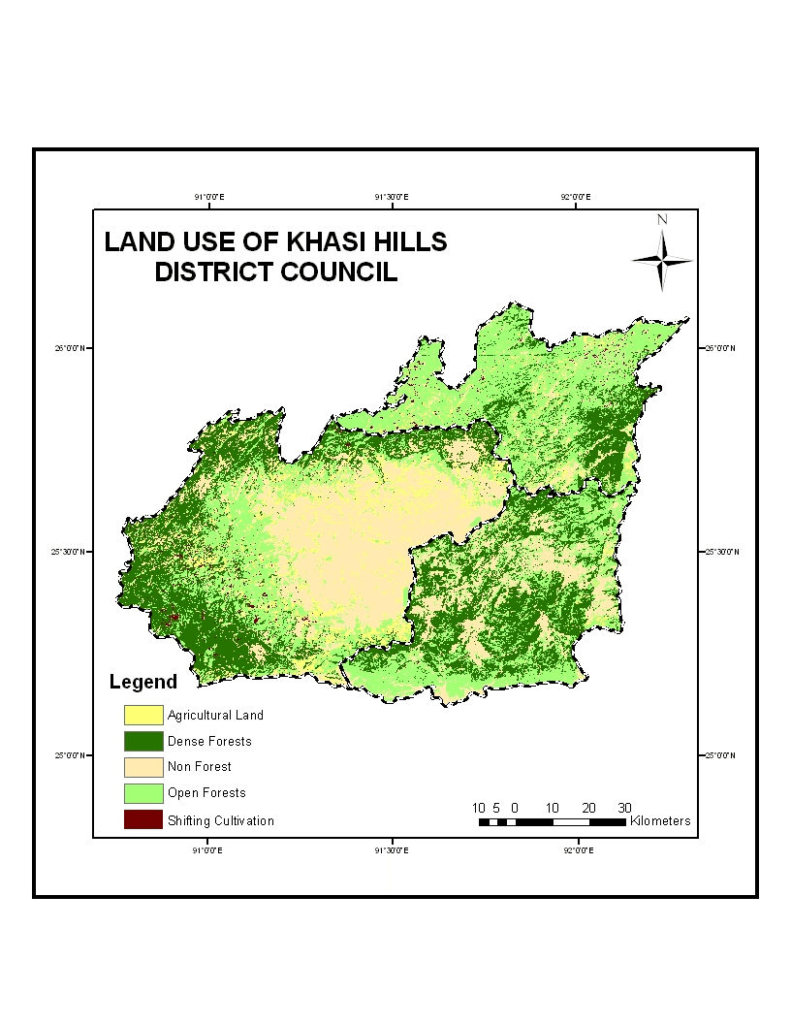
Ri Raid
Ri Raid refers broadly to land associated with the community or Raid.
Such land was generally used for the benefit of members of the community and could be allotted for cultivation according to customary rules.
Its main features included:
- community-based control;
- customary allocation for cultivation;
- regulated use of forests and common resources;
- limited individual rights compared with fully private land.
A person could cultivate a portion of Ri Raid without necessarily becoming its absolute private owner.
Ri Kynti
Ri Kynti refers to land held under more individualised or family-based customary rights.
Such land could be inherited and enjoyed by a particular family or lineage.
Its important features included:
- stronger family or individual control;
- customary inheritance;
- clearer possessory rights;
- greater freedom of use compared with community land.
Even in Ri Kynti, however, customary law remained important.
Role of the Dorbar in Khasi Land Management
Traditional Khasi institutions played a major role in regulating land.
The Dorbar Hima, Dorbar Raid and Dorbar Shnong could be involved in matters concerning:
- allocation of community land;
- settlement of boundary disputes;
- use of common forests;
- village paths and water sources;
- protection of community resources.
The exact authority of each institution varied from one Khasi state to another.
Clan and Land Rights
Khasi society is matrilineal, and clan identity is transmitted through the female line.
This influenced inheritance and control over certain categories of family or clan property.
Land could therefore be linked with:
- family lineage;
- clan identity;
- customary inheritance;
- community membership.
The land system reflected the broader social structure of Khasi society.
Land Tenure among the Jaintias
The Jaintia land system also developed within a matrilineal and clan-based society, but it was shaped by the existence of the Jaintia Kingdom and its control over both hill and plains territories.
Landholding in the hill areas remained strongly influenced by customary institutions.
Important forms of land included:
- clan land;
- family land;
- community land;
- agricultural land;
- forest and common-use land.
Community and Clan Control
In the hill areas, land was often closely connected with clan and village rights.
Customary authorities regulated:
- cultivation;
- access to forests;
- use of water;
- settlement of boundaries;
- transfer or inheritance of land.
The community therefore retained an important role in land management.
Plains Land under the Jaintia Kingdom
The plains territories were economically significant because they produced agricultural revenue.
Land there was more closely connected with:
- taxation;
- agricultural production;
- market access;
- royal revenue.
The Raja’s authority was stronger in revenue-related matters, although local customary practices continued to operate.
This created a difference between the hill and plains land systems.
Matrilineal Inheritance
Like the Khasi, the Pnar or Jaintia people followed a matrilineal system.
Land and property rights could therefore pass through the female line according to customary rules.
This helped preserve property within the maternal clan.
Village and Local Institutions
Village-level authorities played an important role in everyday land management.
They dealt with:
- allocation of agricultural plots;
- local boundary disputes;
- access to community resources;
- customary inheritance;
- settlement of family and clan claims.
The land system was therefore deeply rooted in local social organisation.
Land Tenure among the Garos
The traditional Garo land system was organised primarily around the A’king.
An A’king was a customary territorial estate belonging to a matrilineal clan or ma’chong.
This system was closely connected with the office of the Nokma.
A’king Land
The A’king could include:
- jhum fields;
- forests;
- streams;
- grazing areas;
- uncultivated land;
- village-use areas.
It was not ordinary private property.
Customary rights belonged to the clan, while the Nokma acted as custodian and representative.
Role of the Nokma
The Nokma regulated the use of A’king land.
His functions included:
- allocation of land for cultivation;
- supervision of jhum;
- settlement of land disputes;
- protection of forests and water resources;
- representation of the clan in boundary matters.
The Nokma’s powers were limited by customary law and clan rights.
Matrilineal Ownership
Garo society is matrilineal.
Rights over A’king territory were connected with the maternal lineage and passed through the female line.
The female heir ensured continuity of the property rights of the clan, while male representatives often performed public administrative functions.
Jhum and Land Use
Jhum cultivation was a major feature of Garo land use.
Because cultivators shifted from one plot to another, land had to be managed collectively.
The usual pattern involved:
- selection of land;
- clearing;
- burning;
- cultivation;
- fallow period;
- movement to another plot.
The A’king system ensured that the land remained within clan control even when individual plots changed from year to year.
Community Forests and Natural Resources
Across Khasi, Jaintia and Garo areas, forests were important community resources.
They supplied:
- fuel;
- timber;
- bamboo;
- medicinal plants;
- fruits;
- grazing;
- hunting resources.
Customary rules controlled access and prevented unrestricted exploitation.
Some forests also had religious or sacred significance.
Sacred Groves
Among the Khasi and Jaintia communities, sacred groves formed an important part of customary land use.
These forests were protected because of religious beliefs and community traditions.
Activities such as cutting trees or removing forest products could be restricted.
Sacred groves helped preserve:
- biodiversity;
- water sources;
- soil;
- traditional religious sites.
They represent an important example of indigenous conservation.
Land and Matriliny
Matrilineal descent influenced landholding across all three major communities.
The basic principle was that lineage identity passed through the mother.
This affected:
- inheritance;
- clan membership;
- transmission of property rights;
- continuity of ancestral land.
However, the exact rules differed between Khasi, Jaintia and Garo communities.
Land and Political Authority
Traditional political authority was closely linked with land.
Among the Khasi:
Hima / Raid / Dorbar → regulation of community land
Among the Jaintias:
Raja + local customary institutions → control of hill and plains land
Among the Garos:
Ma’chong → A’king → Nokma
Thus, land was not simply an economic resource. It was also the basis of political authority.
Land Disputes
Boundary and ownership disputes were generally settled through customary institutions.
Methods included:
- consultation with elders;
- examination of customary boundaries;
- clan negotiations;
- mediation;
- compensation;
- community decision-making.
The aim was usually to restore social harmony rather than rely immediately on formal courts.
Impact of British Rule
British rule introduced new administrative ideas about land, revenue and territorial boundaries.
Colonial officials attempted to:
- survey land;
- define administrative boundaries;
- regulate taxation;
- record customary rights;
- intervene in disputes.
However, the British did not completely abolish indigenous land systems.
Customary landholding continued because it was deeply embedded in local society.
Land Systems after Independence
After independence, customary landholding continued alongside modern law.
The Sixth Schedule and Autonomous District Councils became important for the regulation and protection of customary practices.
Today, land administration involves an interaction between:
- customary law;
- traditional institutions;
- Autonomous District Councils;
- Meghalaya State laws;
- courts and administrative authorities.
Khasi, Jaintia and Garo Land Systems Compared
| Feature | Khasi | Jaintia | Garo |
|---|---|---|---|
| Main social basis | Matrilineal clan | Matrilineal clan | Matrilineal clan |
| Major land category | Ri Raid, Ri Kynti | Clan/community/family land | A’king |
| Community role | Strong | Strong | Very strong |
| Main customary authority | Dorbar / traditional authorities | Local authorities + royal legacy | Nokma |
| Collective landholding | Common | Common | Central feature |
| Matrilineal inheritance | Yes | Yes | Yes |
| Jhum cultivation | Present in some areas historically | Present in hill areas | Major traditional feature |
| Private individual ownership | Exists in certain customary forms | Exists in some forms | Less central in traditional A’king system |
Major Similarities
The three systems shared several broad features:
- strong customary law;
- importance of clan and lineage;
- community control over resources;
- matrilineal inheritance;
- collective rights over forests and common land;
- local dispute settlement;
- limited role of unrestricted individual ownership.
Major Differences
Despite their similarities, the systems were not identical.
- Khasi land tenure developed important categories such as Ri Raid and Ri Kynti.
- Jaintia landholding reflected both hill customs and the influence of a former monarchy.
- Garo land organisation centred on the A’king and Nokma system.
- The degree of community control and individual rights differed between regions.
Important Terms
| Term | Meaning |
|---|---|
| Ri Raid | Khasi community or Raid land |
| Ri Kynti | Khasi family/private customary land |
| A’king | Garo clan territory |
| Nokma | Custodian of A’king land |
| Ma’chong | Garo matrilineal clan |
| Hima | Khasi traditional political unit |
| Raid | Khasi territorial/community unit |
| Sacred Grove | Community-protected forest with religious significance |
Frequently Asked Questions
What is Ri Raid?
Ri Raid is broadly a category of community land in Khasi customary practice, managed for the benefit of members of a Raid or community.
What is Ri Kynti?
Ri Kynti is land held under stronger family or individual customary rights in Khasi society.
What is A’king land?
A’king is the customary territorial estate of a Garo matrilineal clan.
Who controls A’king land?
The Nokma administers and represents the A’king, but the land is traditionally linked to the clan rather than being his unrestricted private property.
Were traditional land systems based entirely on private ownership?
No. Community, clan and family rights were all important, and large areas were traditionally regulated through collective customary systems.
How did matriliny affect landholding?
Matrilineal descent meant that clan identity and many property rights passed through the female line.
What was the role of traditional councils in land management?
Traditional councils and local authorities regulated community land, resolved disputes and controlled access to common resources.
What are sacred groves?
Sacred groves are community-protected forests preserved because of religious and cultural beliefs.
Did British rule abolish customary land systems?
No. British rule modified and regulated them but did not completely eliminate indigenous customary landholding.
Do these traditional land systems still exist?
Yes. Many customary landholding practices continue and operate alongside modern laws and the institutions created under the Sixth Schedule.
Read More about :
Jaintia Kingdom: Origin and Political Development
Khasi Syiemships: Structure, Administration & Dorbar System | Meghalaya History