Why in News
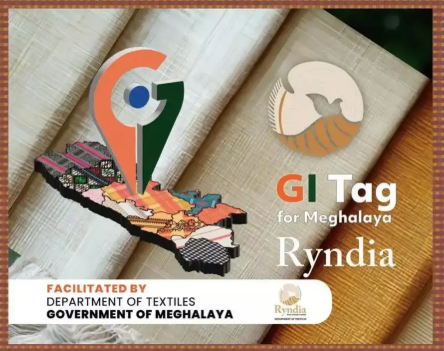
Meghalaya's Ryndia silk and Khasi handloom products received Geographical Indication recognition, strengthening legal and market identification of textiles rooted in local skills, natural dyeing and community traditions.
What Happened
Meghalaya's Ryndia silk and Khasi handloom products received Geographical Indication recognition, strengthening legal and market identification of textiles rooted in local skills, natural dyeing and community traditions. In April 2025, Chennai (Tamil Nadu, TN)-based Geographical Indications (GI) Registry, under the Department for Promotion of Industry and Internal Trade (DPIIT), Ministry of Commerce and Industry (MoC&I), officially granted the Geographical Indication (GI) tag to Meghalaya's indigenous textile, 'Ryndia' silk and Khasi handloom products. This achievement aligns with the vision of Meghalaya Chief Minister (CM) Conrad Kongkal Sangma and Textiles Minister Paul Lyngdoh to promote the state’s indigenous heritage and establish "Brand Meghalaya" on a global platform.
The GI recognition applies to Ryndia, a handwoven, hand-spun, naturally dyed, organically produced, and ethically sourced fabric, along with other traditional Meghalaya handloom products. The initiative was led by the Meghalaya Department of Textiles with support from NABARD and technical guidance from GI expert Dr. Rajnikanth, facilitating joint applications by the Textiles Department and the Meghalaya Ryndia Producers Association. It was further catalyzed by the recognition of Umden-Diwon Village (Ri-Bhoi district) as Meghalaya’s 1st Eri Silk Village on February 12, 2021. "Ryndia" is the Khasi name for Eri silk, derived from the ryndia (castor) plant that feeds the Philosamia ricini silkworms. It is a unique heirloom fabric known for its traditional and sustainable qualities.
Ryndia or Eri silk is also referred to as Peace Silk or Ahimsa Silk, as it is extracted without harming the silkworms, preserving Meghalaya's eco-conscious weaving heritage. This fabric is primarily produced by the indigenous Khasi, Bhoi, and Jaintia artisans of Meghalaya, with Ryndia weaving being a woman-centric tradition among the Khasi tribes. The fabric is hand-spun, handwoven, and naturally dyed, reflecting both cultural legacy and ethical craftsmanship. A Geographical Indication (GI) tag certifies products from a specific region with unique qualities or reputation. In India, it is governed by the GI Act, 1999 (effective from 15 Sept 2003).
The Ministry of Commerce & Industry (MoC&I) aims to reach 10,000 GI tags by 2030 to boost local heritage.
Background
Culture and sport are increasingly treated as parts of the creative and social economy. Public platforms, festivals and state games can preserve identity, broaden participation, generate livelihoods, promote tourism and create pathways for young talent. However, a current-affairs note should distinguish symbolic importance from measurable outcomes. Participation, institutional continuity, funding, access outside the capital, support for creators and athletes, and preservation of indigenous knowledge determine the long-term impact.
Key Features and Important Details
- Date / period – April 2025
- Theme – Culture, Sports & Society
- Core Meghalaya link – Ryndia and Khasi Handloom Products Receive Geographical Indication Recognition
- Verification result – Verified
Significance for Meghalaya
The development is important for Meghalaya's cultural visibility and youth participation. Taking events and platforms beyond Shillong can broaden access, while support for local languages, creators, crafts and sports can convert cultural capital into livelihoods. Long-term success requires transparent selection, regular programming and institutional continuity.
National and Constitutional Context
Connect the event with state identity, indigenous communities, creative economy, youth participation, sports administration and cultural preservation. In examinations, such news can be connected with cultural heritage, digital platforms, tribal traditions, women and youth participation, sports governance, creative industries and the role of state institutions.
Challenges and Way Forward
The initiative should protect local identity while creating real opportunities for young people, artists and communities. Transparent selection, sustained funding and wider district participation are essential.
Important Facts for Prelims
- Date / period – April 2025
- Theme – Culture, Sports & Society
- Core Meghalaya link – Ryndia and Khasi Handloom Products Receive Geographical Indication Recognition
- Verification result – Verified
Mains Relevance
Connect the event with state identity, indigenous communities, creative economy, youth participation, sports administration and cultural preservation. In examinations, such news can be connected with cultural heritage, digital platforms, tribal traditions, women and youth participation, sports governance, creative industries and the role of state institutions.
Practice Questions
Practice MCQ
Question: With reference to Ryndia and Khasi Handloom Products Receive Geographical Indication Recognition, consider the following statements:
- It is directly connected with Meghalaya.
- Its wider relevance can be linked with the category mentioned in this article.
Which of the statements given above is/are correct?
(a) 1 only (b) 2 only (c) Both 1 and 2 (d) Neither 1 nor 2
Answer: (c) Both 1 and 2.
Mains Question
Explain the importance of Ryndia and Khasi Handloom Products Receive Geographical Indication Recognition for Meghalaya. Discuss the main implementation challenges and suggest a practical way forward.