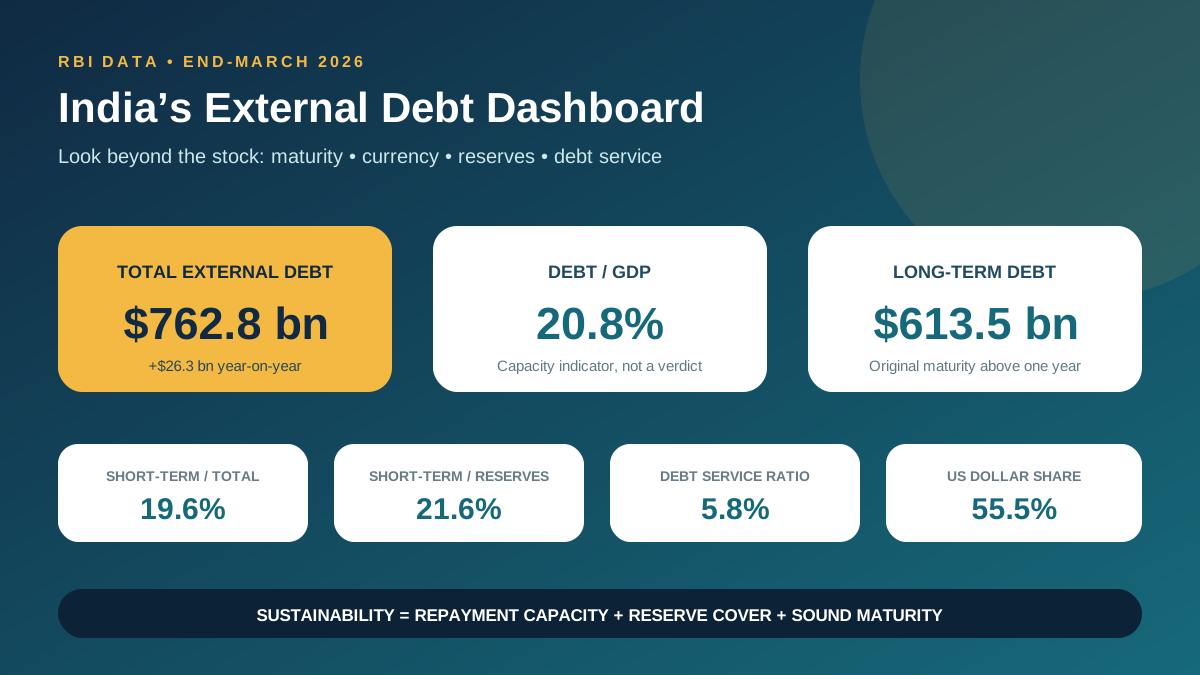
India’s external debt at end-March 2026 stood at US$762.8 billion, according to the Reserve Bank of India (RBI). It increased by $26.3 billion over end-March 2025, while the external debt-to-GDP ratio rose to 20.8%. The headline stock is important, but debt sustainability depends more on maturity, currency, borrowers, reserve cover and repayment capacity than on one absolute number.
The data also contain a crucial accounting lesson: appreciation of the US dollar reduced the dollar value of debt denominated in the rupee and other currencies. Excluding this $24.6 billion valuation effect, the underlying increase would have been $51.0 billion rather than $26.3 billion.
What is external debt?
External debt is the outstanding liability that Indian residents owe to non-residents and that requires future payment of principal and/or interest. “Residents” can include the general government, RBI, banks, non-bank financial companies, non-financial companies and households.
External debt is classified by the residence of the creditor, not simply by currency. A rupee-denominated bond held by a non-resident can be external debt. Conversely, a foreign-currency loan from one Indian resident to another is not automatically external debt.
External debt is not the same as public debt
| Concept | What it covers | Main question |
|---|---|---|
| External debt | Liabilities of all Indian resident sectors to non-residents | Can the economy obtain foreign exchange to service it? |
| Government/public debt | Domestic and external liabilities of government | Can government revenue and borrowing sustain repayment? |
| Foreign-currency debt | Debt payable in currencies other than the borrower’s domestic currency | How much exchange-rate risk does the borrower bear? |
| Net external debt | Gross external liabilities adjusted for specified external assets | What is the economy’s net exposure? |
Therefore, India’s $762.8 billion figure should not be described as money borrowed solely by the Union government.
Latest RBI data: end-March 2026
| Indicator | End-March 2026 | Interpretation |
|---|---|---|
| Total external debt | $762.8 billion | Up $26.3 billion year-on-year |
| External debt/GDP | 20.8% | Shows debt relative to economic output |
| Long-term debt | $613.5 billion | Original maturity above one year; majority of the stock |
| Short-term debt/total debt | 19.6% | Original maturity of up to one year |
| Short-term debt/reserves | 21.6% | Original-maturity measure of near-term pressure |
| Debt service/current receipts | 5.8% | Current foreign-exchange earnings used for scheduled debt payments |
The stock was slightly lower than the provisional $765.5 billion at end-December 2025, yet higher than a year earlier. Quarter-to-quarter and year-on-year comparisons answer different questions and should not be mixed.
Why did the dollar value rise by only $26.3 billion?
External debt is reported in US dollars, but not all liabilities are denominated in dollars. When the US dollar appreciates against the rupee, yen, euro or SDR, those liabilities translate into fewer dollars even if the original-currency obligation has not fallen.
RBI estimated a $24.6 billion valuation effect at end-March 2026. The arithmetic is:
Reported change ($26.3 bn) + valuation reduction ($24.6 bn) ≈ underlying change excluding valuation ($51.0 bn).
This does not mean India received $51 billion of fresh borrowing during the year. Changes in debt stock also reflect repayments, disbursements, trade credit, deposits, inter-company lending and other adjustments.
Currency composition
| Currency | Share of external debt | Risk implication |
|---|---|---|
| US dollar | 55.5% | Largest direct foreign-currency exposure |
| Indian rupee | 29.4% | Currency risk is largely borne by the non-resident creditor |
| Japanese yen | 6.4% | Often linked to official and infrastructure financing |
| Special Drawing Rights | 4.3% | IMF reserve-asset unit based on a currency basket |
| Euro | 3.7% | Exposure varies with euro-dollar and rupee-euro movements |
Rupee-denominated external debt still creates refinancing and investor-sentiment risks, but it does not impose the same currency mismatch on an Indian borrower as dollar debt.
Instrument and borrower composition
Loans were the largest instrument at 34.7%, followed by currency and deposits (22.3%), trade credit and advances (19.0%), and debt securities (16.1%). Non-financial corporations were the largest borrower group, while banks, the general government and other financial corporations also held significant shares.
RBI reported that general-government external debt declined over the year, while non-government debt increased. This matters because corporate and bank debt risks depend on the borrower’s foreign-currency revenue, hedging and balance sheet—not only on government finances.
Original maturity versus residual maturity
Two short-term debt measures serve different purposes:
- Original maturity: debt was contracted for one year or less. Its share was 19.6% of total external debt.
- Residual maturity: all principal due within the next year, including the current portion of long-term loans. This was 42.9% of total external debt and 47.3% of reserves at end-March 2026.
Residual maturity is often more useful for assessing immediate refinancing needs because a 10-year loan entering its final year still needs to be repaid soon.
Does $762.8 billion mean India faces a debt crisis?
No single threshold proves safety or crisis. India’s position has important buffers:
- long-term debt remains the majority of the stock;
- foreign-exchange reserves were about $689.4 billion at end-March 2026;
- the debt-service ratio was 5.8% of current receipts;
- a sizeable share of debt is rupee-denominated; and
- the debt-to-GDP ratio remains moderate compared with many stressed borrowers.
However, a comfortable aggregate can hide sectoral stress. A company without dollar earnings may struggle if the rupee depreciates, even when national reserve cover is strong.
Main external-debt risks
- Currency mismatch: foreign-currency debt becomes costlier in rupees when the rupee depreciates.
- Refinancing risk: short residual maturity creates dependence on continued market access.
- Global interest rates: floating-rate and new borrowing costs can rise.
- Corporate concentration: aggregate data may conceal vulnerable firms or sectors.
- Current-account stress: high oil prices or weak exports can reduce foreign-exchange availability.
- Sudden-stop risk: global risk aversion may reduce capital inflows and pressure the rupee.
- Contingent liabilities: private distress can spill into banks or government support.
Connect these risks with LearnPro’s explainer on India’s balance-of-payments resilience and the comparison with the 2013 “Fragile Five” episode.
How India manages external debt
- RBI regulation: external commercial borrowings, trade credit, hedging and foreign-exchange transactions operate under FEMA and RBI directions.
- Government monitoring: the Ministry of Finance publishes quarterly and annual external-debt reports.
- Reserve management: reserves provide liquidity against external shocks and disorderly market conditions.
- Maturity management: policy can discourage excessive short-term borrowing and monitor residual obligations.
- Prudential oversight: banks assess unhedged foreign-currency exposures and borrower repayment capacity.
Way forward
- Monitor residual maturity: publish clear sector-wise repayment schedules and stress tests.
- Reduce unhedged exposure: align foreign-currency borrowing with export earnings or credible hedging.
- Deepen rupee finance: stronger domestic bond markets reduce dependence on foreign-currency borrowing.
- Build current receipts: exports, services and stable remittances strengthen debt-servicing capacity.
- Protect reserve adequacy: assess reserves against imports, short-term debt and potential capital outflows together.
- Improve transparency: reconcile revisions and explain valuation effects so headlines do not mislead.
UPSC relevance
India’s external debt 2026 belongs to GS Paper III topics on the Indian economy, mobilisation of resources and external-sector stability. For Prelims, distinguish external debt from public debt, original from residual maturity, and debt stock from debt service. For Mains, use a dashboard of debt/GDP, short-term debt/reserves, currency mismatch and current receipts rather than judging risk from the stock alone.
Mains practice: India’s rising external debt stock does not by itself establish external vulnerability. Discuss using the end-March 2026 RBI indicators.
Conclusion
India’s external debt rose to $762.8 billion, but the quality of the liability matters more than the headline. Long maturity, reserve cover and moderate debt service provide buffers; higher residual obligations, corporate foreign-currency exposure and global volatility require vigilance. The correct policy response is risk-sensitive management, not alarm based on an absolute number or complacency based on one ratio.
Frequently asked questions
What was India’s external debt at end-March 2026?
RBI reported $762.8 billion, an increase of $26.3 billion over end-March 2025.
What was India’s external debt-to-GDP ratio?
It was 20.8% at end-March 2026.
Why was the increase affected by valuation?
A stronger US dollar reduced the dollar-converted value of debt in other currencies. Excluding the $24.6 billion valuation effect, the increase would have been about $51.0 billion.
Is external debt the same as government debt?
No. External debt includes liabilities of government, banks, companies and other Indian residents to non-residents.
Which indicators show external-debt risk?
Key indicators include debt-to-GDP, short-term and residual maturity, reserve cover, currency composition, borrower composition and the debt-service ratio.
Official references
- Reserve Bank of India: External debt at end-March 2026
- Department of Economic Affairs: External Debt Statistics
- India’s External Debt at end-December 2025
- India External Debt Status Report 2024–25