
Artificial rain in Delhi refers to cloud-seeding experiments intended to enhance rainfall and temporarily wash particulate pollution from the atmosphere. Delhi conducted pilot operations on 23 and 28 October 2025 with IIT Kanpur. The sorties did not produce meaningful rain because the available clouds lacked sufficient moisture, showing the technology’s central limitation: cloud seeding cannot create clouds or water vapour from a clear sky.
The Economic Survey of Delhi 2025–26 records those trials and says further trials may be conducted in consultation with the India Meteorological Department (IMD). Cloud seeding is therefore best understood as a weather-dependent experiment—not a substitute for reducing emissions.
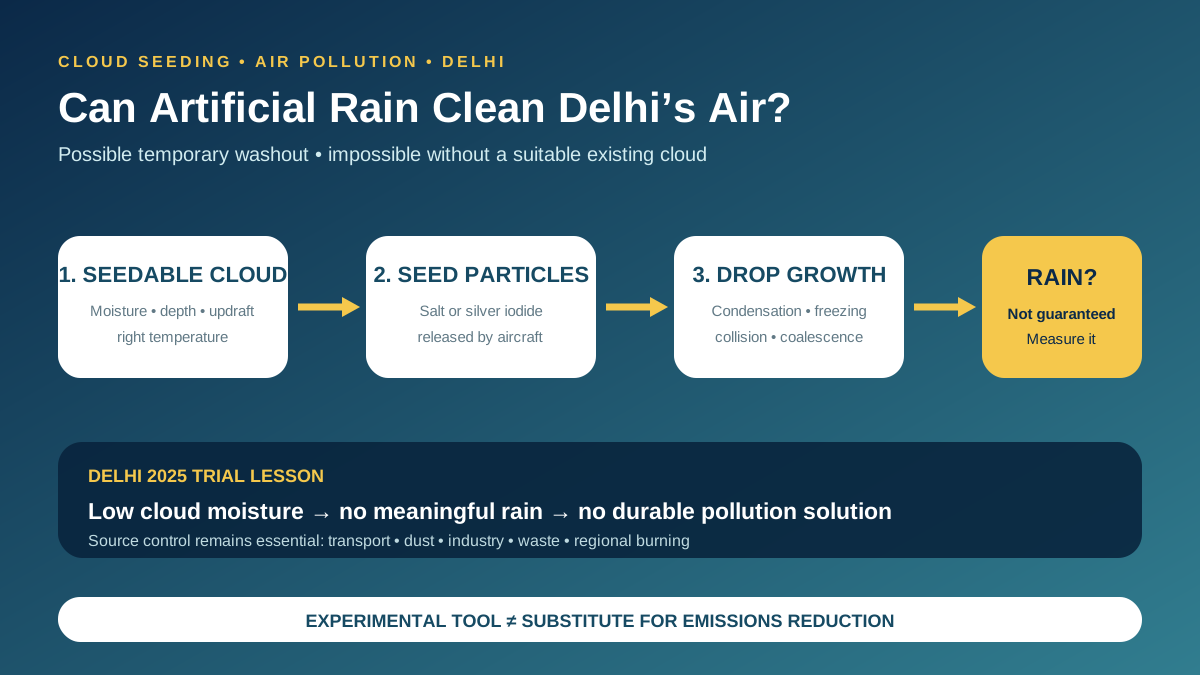
What is cloud seeding?
Cloud seeding is a weather-modification technique that introduces small particles into suitable existing clouds to influence droplet or ice-crystal formation. The particles provide nuclei around which water can condense or freeze. If cloud dynamics, moisture, temperature and particle growth are favourable, droplets or ice crystals may become large enough to fall as precipitation.
“Artificial rain” is convenient shorthand but can be misleading. The aircraft does not carry rainwater and cannot manufacture a rain-bearing cloud. Seeding tries to improve the efficiency of a natural cloud that already contains adequate water.
How cloud seeding works
The scientific pathway is:
Suitable cloud detected → seeding material released → more condensation or ice nuclei → droplet/crystal growth → collision and coalescence → possible precipitation.
| Method | Target cloud | Common material | Process |
|---|---|---|---|
| Hygroscopic seeding | Warm convective clouds | Salts such as calcium chloride | Salt particles absorb moisture and promote larger droplets that collide and merge |
| Glaciogenic seeding | Cold or mixed-phase clouds containing supercooled water | Silver iodide or other ice-nucleating agents | Particles encourage ice-crystal formation; crystals grow and may melt into rain while falling |
Aircraft flares, ground generators or—in some projects—other delivery systems disperse the material. Weather radar, aircraft instruments, satellite data and rain gauges are needed to choose clouds and measure outcomes.
Delhi’s 2025 cloud-seeding pilot
The Delhi government approved a pilot with IIT Kanpur to test whether induced precipitation could reduce episodic high air pollution. The programme required aviation and security clearances, suitable flight zones and real-time meteorological advice. Continuous air-quality stations were expected to track PM2.5 and PM10 before and after operations.
| Element | Delhi pilot |
|---|---|
| Implementing knowledge partner | IIT Kanpur |
| Purpose | Technology demonstration and evaluation for episodic air pollution |
| Recorded trial dates | 23 and 28 October 2025 |
| Operational dependence | Seedable cloud, adequate moisture, safe airspace and suitable winds |
| Observed outcome | No meaningful rainfall attributable to the trial; low moisture constrained the process |
| Official follow-up | Further trials proposed in consultation with IMD |
The trial should not be labelled simply “successful” because aircraft completed sorties. Operational success means safe delivery of seeding material; meteorological success means a measurable precipitation response; policy success would require a verified, useful and cost-effective improvement in air quality. These are different tests.
Why rain can temporarily reduce air pollution
Rain removes particles through wet deposition:
- Rainout: pollutants become incorporated into droplets inside a cloud.
- Washout: falling raindrops capture particles and soluble gases below the cloud.
This can lower airborne particulate concentration for a limited period. The size of the effect depends on rainfall intensity and duration, particle size, wind, atmospheric stability and continuing emissions. If traffic, combustion, dust and industrial sources continue, concentrations can rise again quickly after rain stops.
Why Delhi is a difficult location
Seedable clouds may be absent
Delhi’s worst pollution episodes often occur in dry winter conditions. A shallow or moisture-poor cloud cannot yield substantial rain merely because seed particles are added. Cloud properties—not the pollution level or political urgency—determine whether seeding is physically possible.
Winter meteorology traps pollution
Low wind speed, a shallow boundary layer and temperature inversion restrict vertical mixing. Emissions accumulate near the surface. Cloud seeding does not remove this meteorological tendency.
Pollution has multiple sources
Delhi-NCR pollution varies by season and includes transport, road and construction dust, industry, power and fuel combustion, waste burning, household fuels and regional biomass burning. Secondary particles also form in the atmosphere from precursor gases. One rain event cannot permanently control these sources.
What Indian research shows
The Indian Institute of Tropical Meteorology’s Cloud Aerosol Interaction and Precipitation Enhancement Experiment (CAIPEEX) conducted controlled research in the rain-shadow region near Solapur. Its Phase IV report found an average rainfall enhancement of about 18% in a 100 km² downwind area under suitable conditions for hygroscopic seeding.
That result cannot be transferred mechanically to Delhi:
- CAIPEEX studied selected warm convective clouds in a monsoon/rain-shadow setting;
- Delhi’s objective is pollution washout during episodic, often dry conditions;
- cloud type, aerosol background, humidity and winds differ; and
- rainfall enhancement and air-pollution reduction are different outcome variables.
The World Meteorological Organization similarly stresses the limits of cloud microphysics knowledge and the need for quality-controlled observations, modelling and rigorous evaluation.
How effectiveness should be measured
A credible trial needs a pre-published protocol rather than a before-and-after photograph. Evaluation should include:
- Cloud qualification: liquid-water content, temperature, depth, updraft and humidity.
- Comparable controls: seeded and suitable unseeded clouds or a defensible counterfactual.
- Precipitation measurement: calibrated radar and dense rain-gauge data.
- Air-quality measurement: PM2.5, PM10 and gases, corrected for wind and boundary-layer change.
- Chemical monitoring: rainwater and deposition testing where relevant.
- Duration: how long any air-quality improvement persists.
- Cost-effectiveness: verified benefit per sortie compared with source-control measures.
Natural rain might have occurred without intervention. Attribution therefore requires more than rain after a flight.
Benefits and possible uses
- Research value: improves understanding of Indian cloud microphysics.
- Water management: may enhance rainfall from suitable clouds in selected rain-deficit areas.
- Emergency relief: if adequate rain is induced, particulate concentration may fall temporarily.
- Institutional capacity: builds radar, aircraft, modelling and evaluation capability.
Risks, limits and governance concerns
- Uncertain efficacy: natural cloud variability makes cause and effect difficult to prove.
- Weather dependence: the technique is unavailable when suitable clouds are absent.
- Temporary pollution benefit: rainfall does not stop emissions.
- Environmental monitoring: seeding materials and deposition should be transparently measured.
- Downwind questions: distributional concerns require scientific study and interstate communication.
- Opportunity cost: public money should not displace proven emissions control.
- Public communication: calling every sortie “artificial rain” can create unrealistic expectations.
Cloud seeding versus pollution control
| Cloud seeding | Source-control policy |
|---|---|
| Acts on atmospheric pollution after emission | Prevents or reduces pollution at source |
| Requires suitable clouds | Can operate throughout the year |
| Potential effect is temporary | Produces sustained structural gains |
| Useful mainly as experiment or limited emergency measure | Core strategy for clean air |
Delhi’s durable strategy must prioritise cleaner transport and fuels, industrial compliance, dust management, waste-burning prevention, regional crop-residue solutions, reliable inventories and coordinated airshed governance. During severe episodes, the Graded Response Action Plan (GRAP) supplies pre-defined emergency actions, while long-term policies must reduce annual exposure.
Way forward for Delhi
- Treat seeding as research: use it only when objective cloud thresholds are met.
- Publish the protocol and results: release cloud data, flare composition, rainfall, air quality and uncertainty.
- Use independent evaluation: involve meteorologists, air-pollution scientists, statisticians and health experts.
- Monitor environmental deposition: test rainwater, soil and surface water where trials occur.
- Avoid exaggerated claims: distinguish test flight, seeding, precipitation and pollution improvement.
- Protect the main budget: emissions reduction must remain the primary clean-air investment.
UPSC relevance
Artificial rain in Delhi links GS Paper III topics on science and technology, environmental pollution and disaster management. For Prelims, distinguish hygroscopic and glaciogenic seeding. For Mains, explain why a technically possible intervention may still have limited policy value when the necessary weather conditions are rare and the underlying pollution sources continue.
Mains practice: “Cloud seeding may offer episodic relief but cannot be the foundation of urban air-quality management.” Examine scientifically and administratively.
Conclusion
Cloud seeding can sometimes enhance precipitation from a suitable existing cloud, but it cannot summon rain from a dry sky. Delhi’s 2025 trials demonstrated this constraint more clearly than they demonstrated pollution control. Future experiments should be transparent and scientifically evaluated, while public policy remains centred on year-round emissions reduction across the NCR airshed.
Frequently asked questions
What is artificial rain or cloud seeding?
It is the introduction of particles into suitable existing clouds to encourage droplet or ice-crystal growth and possibly enhance precipitation.
Can cloud seeding create rain without clouds?
No. It requires an existing seedable cloud with adequate water, suitable temperature, depth and air motion.
Did Delhi’s 2025 cloud-seeding trials produce rain?
The recorded October 2025 trials did not produce meaningful rainfall attributable to seeding; low moisture was a key constraint.
How can rain reduce air pollution?
Rain removes particles and soluble gases through rainout within clouds and washout below clouds, but the improvement may be temporary if emissions continue.
What is CAIPEEX?
It is India’s Cloud Aerosol Interaction and Precipitation Enhancement Experiment, led by the Indian Institute of Tropical Meteorology to study clouds and scientifically evaluate seeding.
Official and scientific references
- Economic Survey of Delhi 2025–26
- IITM: CAIPEEX cloud-seeding report
- IITM: cloud-seeding questions and answers
- WMO Statement on Weather Modification





Sources and further reading
- Economic Survey of Delhi 2025–26delhiplanning.delhi.gov.in
- IITM: CAIPEEX cloud-seeding reporttropmet.res.in
- IITM: cloud-seeding questions and answerstropmet.res.in
- WMO Statement on Weather Modificationwmo.int