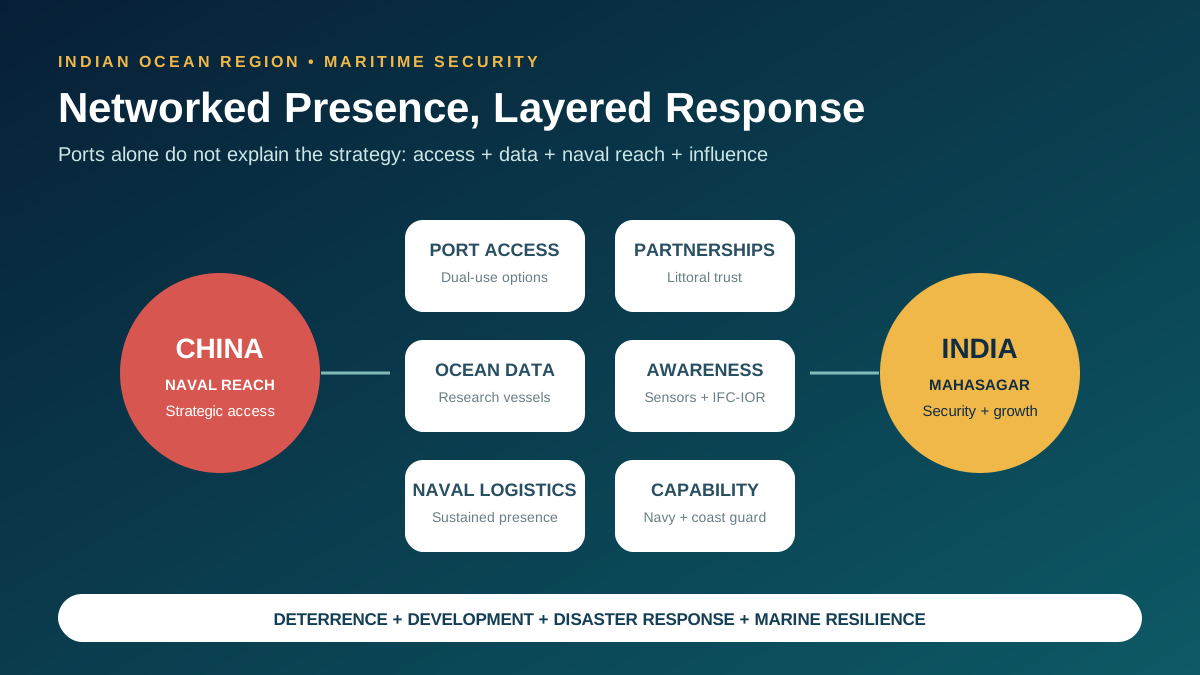
China’s presence in the Indian Ocean Region (IOR) has expanded through naval deployments, port and logistics projects, research vessels, defence relationships and regional diplomacy. India’s Parliamentary Standing Committee on External Affairs identified this growing footprint as a strategic challenge and recommended stronger maritime deterrence, surveillance, institutional coordination and partnerships with Indian Ocean littoral states.
The correct policy question is not whether every Chinese-funded port is automatically a military base. It is whether a network of commercial access, political influence, oceanographic data and naval capability can create dual-use options during a crisis.
Why the Indian Ocean matters
The Indian Ocean connects the energy-producing Gulf and Africa with the major markets and manufacturing centres of Asia. Its sea lines pass through narrow chokepoints such as the Strait of Hormuz, Bab el-Mandeb and Strait of Malacca. For India, the ocean is also the immediate maritime neighbourhood surrounding its long coastline and island territories.
- Trade and energy: India’s external commerce and imported energy depend heavily on maritime routes.
- Security: terrorism, piracy, narcotics, illegal fishing, submarine activity and attacks on shipping can affect national security.
- Connectivity: ports, cables and logistics hubs shape economic influence.
- Blue economy: fisheries, seabed resources, marine ecosystems and coastal livelihoods require governance.
- Geography: the Andaman and Nicobar Islands lie near critical routes linking the Indian and Pacific Oceans.
What did the parliamentary committee report say?
The Standing Committee on External Affairs examined India’s interests in the IOR and highlighted China’s growing naval presence, port and logistics infrastructure, survey activity and close military relationship with Pakistan. Its principal recommendations included:
- Inter-Ministerial Task Force: integrate External Affairs, Defence, Shipping, Commerce, Finance, Home Affairs, Environment and other agencies.
- Maritime domain awareness: expand satellite surveillance, artificial intelligence and information sharing.
- Naval modernisation: improve fleet readiness, anti-submarine warfare, logistics and long-term funding.
- Regional partnerships: deepen cooperation with littoral states, the Quad and Indian Ocean institutions.
- Clear maritime strategy: give the IOR consistent foreign-policy priority and reduce institutional silos.
- Green MAHASAGAR: combine security with marine conservation, disaster response, climate resilience and an inclusive blue economy.
The report is a parliamentary recommendation, not an executive order. Government departments must decide and report how recommendations are implemented.
Components of China’s Indian Ocean strategy
| Instrument | Examples | Strategic effect |
|---|---|---|
| Naval presence | Anti-piracy task groups, submarines and support ships | Operational familiarity and sustained presence |
| Overseas support | People’s Liberation Army support base in Djibouti | Logistics, maintenance, evacuation and deployment support |
| Ports and corridors | Gwadar, Hambantota, Kyaukpyu and other projects | Commercial influence and possible future access options |
| Research and survey vessels | Hydrographic, oceanographic and tracking missions | Scientific data can also improve knowledge of the undersea environment |
| Defence ties | Equipment, exercises and training with regional partners | Interoperability and political influence |
| Regional diplomacy | China–Indian Ocean forums and development finance | Agenda-setting beyond naval operations |
Port access and the dual-use problem
A commercial port is not automatically a naval base. Ownership, operating rights, host-country law, security arrangements and actual military activity must be examined separately. However, commercial infrastructure can acquire dual-use value when it offers deep berths, fuel, repair, storage, communications or privileged access.
The strategic risk is therefore cumulative. Even without formal bases, a navy can benefit from replenishment agreements, commercial service providers, intelligence, friendly governments and repeated port calls. India should avoid both extremes: dismissing every project as harmless and labelling every project a confirmed military base without evidence.
Important nodes
Djibouti
China’s military support facility in Djibouti, operational since 2017, is its clearest formal overseas naval foothold. Its location near Bab el-Mandeb supports anti-piracy, evacuation and wider deployments across the western Indian Ocean.
Gwadar, Pakistan
Gwadar links the Arabian Sea with the China–Pakistan Economic Corridor. Its proximity to Gulf sea routes and China–Pakistan defence ties give it strategic significance, even though commercial performance and the nature of military access must be assessed from evidence.
Hambantota, Sri Lanka
Hambantota’s long lease to a Chinese company is frequently cited in “debt-trap” arguments. The history is more complex than a simple asset seizure, but the episode shows how debt, commercial control and strategic location can generate political concern. Visits by Chinese survey or tracking vessels to Sri Lankan ports have added to India’s sensitivity.
Kyaukpyu, Myanmar
Kyaukpyu connects the Bay of Bengal with pipelines and planned transport links toward China’s Yunnan province. It offers China partial diversification from the Malacca route and gives the Bay of Bengal greater strategic weight.
Research vessels and undersea awareness
Oceanographic research is legitimate and supports climate, fisheries and navigation. Yet measurements of seabed shape, salinity, temperature and currents can also assist submarine operations and anti-submarine warfare. The committee therefore flagged the security relevance of research and survey vessels collecting sensitive marine data.
This is a governance challenge under the law of the sea: coastal-state rights differ across territorial seas, exclusive economic zones and the high seas. India needs legal clarity, technical tracking and diplomatic engagement rather than broad claims that all marine research is unlawful.
How China’s presence can affect India
- Two-front pressure: close China–Pakistan naval cooperation can complicate India’s planning.
- Submarine detection challenge: quiet platforms and better ocean data raise anti-submarine requirements.
- Political influence: dependence on finance, equipment or infrastructure may affect regional choices.
- Operational access: dispersed logistics can support longer deployments near Indian waters.
- Information competition: China can present itself as a development and security provider.
- Resource pressure: illegal, unreported and unregulated fishing and seabed competition affect livelihoods and ecology.
India’s current response
MAHASAGAR and neighbourhood partnerships
In March 2025, India announced MAHASAGAR—Mutual and Holistic Advancement for Security and Growth Across Regions—building on the earlier SAGAR vision. It combines maritime security, capacity building, trade, technology, development and the concerns of the Global South.
LearnPro’s explainer on the Prime Minister’s Mauritius visit and MAHASAGAR shows how island partnerships support this approach.
Maritime domain awareness
The Information Fusion Centre–Indian Ocean Region at Gurugram collates shipping information and works with partner countries. Coastal radar networks, white-shipping agreements, satellites, aircraft, drones and acoustic systems contribute different layers of awareness.
Mission-based naval deployments
The Indian Navy maintains deployments across important IOR approaches, supports anti-piracy operations and protects merchant shipping during crises. India’s first-responder record in evacuations, cyclones and other disasters creates trust that military presence alone cannot buy.
Regional and minilateral institutions
India works through the Indian Ocean Rim Association, Colombo Security Conclave, Indian Ocean Naval Symposium and the Quad. The Quad’s strategic continuity matters for maritime awareness, technology, infrastructure and disaster response, but the Quad is not a military alliance.
Capability and islands
Naval shipbuilding, maritime patrol aircraft, submarines, anti-submarine systems and logistics agreements increase reach. The Andaman and Nicobar Command can monitor approaches to the Malacca Strait, but infrastructure expansion must also protect fragile ecosystems and local communities.
Why India should not rely on military balancing alone
Indian Ocean states have agency. They seek finance, ports, jobs, climate support and bargaining space, and many prefer relations with both India and China. Asking them to “choose sides” can be counterproductive. India’s advantage must come from:
- fast, transparent and locally useful development projects;
- training, equipment maintenance and coast-guard capacity;
- humanitarian assistance and disaster relief;
- health, digital public infrastructure and education;
- respect for sovereignty and demand-driven cooperation; and
- marine conservation and climate-resilient blue growth.
Policy gaps
- Institutional silos: security, commerce, fisheries, ports and diplomacy are spread across ministries.
- Project delivery: delayed Indian projects weaken credibility even when financing terms are favourable.
- Fleet and submarine gaps: acquisition delays affect persistent surveillance and deterrence.
- Merchant marine weakness: naval power needs domestic shipping, repair and port capacity.
- Undersea-domain awareness: sensors, data fusion and specialist personnel require sustained investment.
- Climate-security integration: island partners often rank sea-level rise and disasters above great-power competition.
Way forward
- Create the recommended task force with measurable deadlines and a common maritime picture.
- Prioritise anti-submarine capability across aircraft, ships, submarines, sensors and data analysis.
- Offer credible infrastructure alternatives with transparent finance and reliable completion.
- Expand information sharing while protecting sovereign and commercial data.
- Strengthen island partnerships through coast guards, disaster response, climate finance and livelihoods.
- Build maritime industry in shipbuilding, repair, ports, cables and merchant shipping.
- Keep competition bounded through communication, international law and crisis-management mechanisms.
UPSC relevance
China’s Indian Ocean strategy links GS Paper II international relations with GS Paper III security. Prelims candidates should know MAHASAGAR, IORA, IFC-IOR, Colombo Security Conclave and the Quad. In Mains, avoid a one-dimensional “string of pearls” answer: analyse naval presence, economic access, dual-use infrastructure, data, regional agency and India’s combined security-development response.
Mains practice: China’s growing Indian Ocean presence is a networked strategic challenge rather than merely a chain of ports. Discuss and evaluate India’s response.
Conclusion
China’s expanding capability and access can narrow India’s strategic space, especially when combined with Pakistan and undersea surveillance. India needs credible naval power, but lasting influence will depend equally on trusted partnerships, fast development delivery, disaster response and climate-sensitive regional leadership. MAHASAGAR must therefore become an implementation framework, not only a slogan.
Frequently asked questions
Why is China’s Indian Ocean presence a challenge for India?
Naval deployments, dual-use access, research data and regional defence ties can support sustained Chinese operations close to India’s vital sea routes.
Is every Chinese-funded port a military base?
No. Actual ownership, access rights, host-state policy and military use must be examined. Commercial infrastructure can still create future dual-use options.
What did the parliamentary committee recommend?
It recommended an inter-ministerial task force, stronger maritime awareness, naval modernisation, anti-submarine capability, regional partnerships and a Green MAHASAGAR approach.
What is MAHASAGAR?
It means Mutual and Holistic Advancement for Security and Growth Across Regions, India’s 2025 extension of the SAGAR maritime vision.
What is IFC-IOR?
The Information Fusion Centre–Indian Ocean Region is an Indian maritime information-sharing hub at Gurugram that works with partner countries to improve domain awareness.
Official references
- Standing Committee on External Affairs: India’s interests in the IOR
- Committee press release and recommendations
- MEA: China’s presence in the Indian Ocean
- MEA: announcement of MAHASAGAR